Key takeaways
- Screen the outline against one rectangle with two straight, parallel track corridors, not against the curved waterline.
- Draw steps, spas, lobes and rockwork on the same plan; a feature outside the envelope changes the layout.
- Manufacturer construction routes for freeform pools are model and shell specific; ask which one the offered model uses.
- Concealed tracks and recessed mechanisms are easiest to plan before construction; an existing deck needs professional review before cutting.
- Record measurement status and who confirmed each item; an owner sketch is a screening record, not an approved design.
A freeform pool can take a track-based automatic cover only when a straight, rectangular cover layout fits around its curves, so the real question is about the layout, not the shape. Guessing that fit before anyone has drawn it is how owners end up cutting deck or ordering dimension-dependent parts for a layout that fails.
This guide gives you a screening method and a copyable record to take to your own qualified installer. It does not replace their survey or the manufacturer’s drawing. For how the whole system works, read the complete automatic pool cover guide first.
Quick screening table
Use one row per check. A row is answered only when the answer is confirmed and favorable. “Unresolved” means the answer is unknown or still awaiting confirmation; “incompatible” means it is confirmed that the layout currently proposed cannot meet that check, not that every possible redesign fails.
Scroll horizontally to see all columns when the table extends beyond the screen.
Measured values belong on the general automatic pool cover measurement sheet. This table only tells you whether the freeform-specific questions have answers.
Takeaway: The pool is a screening candidate only when all six rows have confirmed, favorable answers, and even then it is not an approval. Any unknown row keeps the outcome unresolved.
Why a curved pool still needs a straight-track rectangle
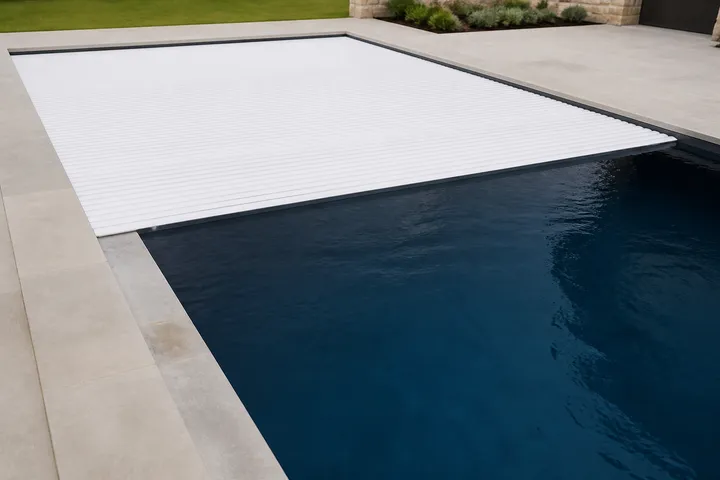
A track-based fabric cover runs between two tracks. The tracks are straight and must be parallel, so the cover always travels over a rectangle, whatever the waterline looks like. Cover-Pools states the condition plainly for its deck-mounted track: new and existing pools of virtually any shape can be covered “as long as there is room for the tracks to run parallel on opposite sides of the pool.”
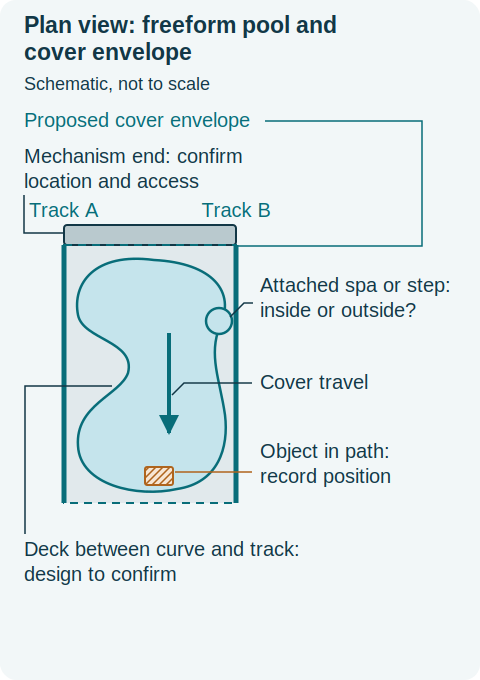
The manufacturer’s extended cantilever example shows how that rectangle meets a curve. The tracks are laid out parallel to each other at the widest part of the pool on a first deck. A second deck is built slightly raised, mirrors the shape of the pool and lets the cover open and close without obstruction. The maker gives no height for “slightly raised”, and this guide does not supply one.
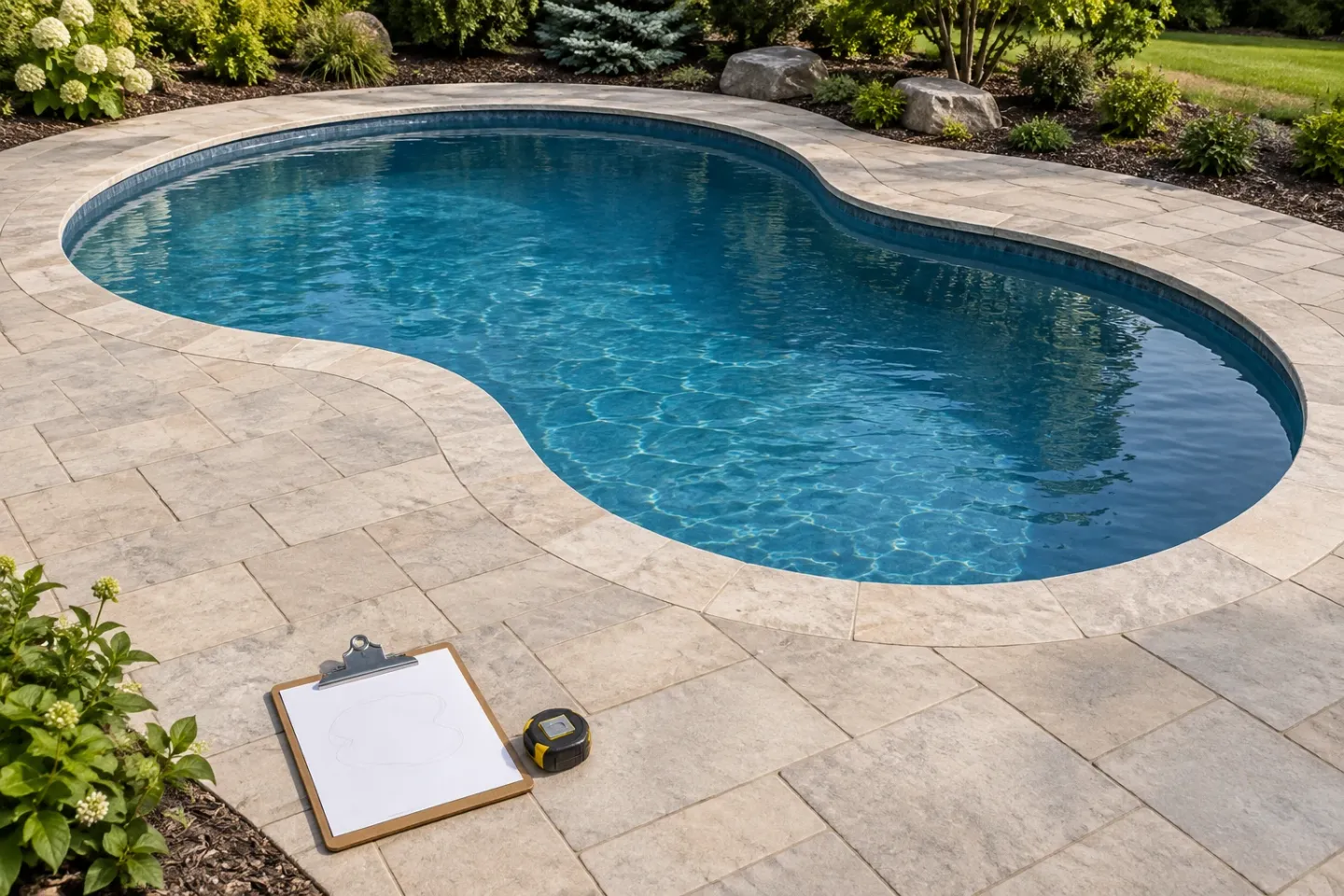
So the envelope is set by the widest points of the outline, not by its average width. On a kidney or lobed pool, the narrower sections leave deck or a raised second deck between the curved edge and the tracks. That area has to be designed, supported and finished, which is why the deck row in the table matters as much as the tracks. Track types themselves are compared in undertrack vs toptrack.
Takeaway: Draw the rectangle around the widest points first; the curve inside it is a deck design question, not a reason the cover cannot work.
Kidney lobes, steps, spas and rockwork
The features that make a pool freeform are usually the ones that break the envelope. Put each of them on the same plan as the rectangle:
- Lobes and bulges. Both lobes of a kidney shape set the envelope width at their widest point.
- Steps and benches outside the main perimeter. The manufacturer says attached spas or steps outside the pool perimeter can still be covered on deck-mounted layouts. That holds only if the parallel tracks clear them.
- Attached spa. Decide whether the spa is meant to sit under the same cover, then draw it in or out of the envelope.
- Rockwork, raised walls and water features. Anything higher than the deck inside the travel path needs a stated solution from the installer.
- Rails, ladders and other deck fittings. Record their position along the track corridors and the end walls.
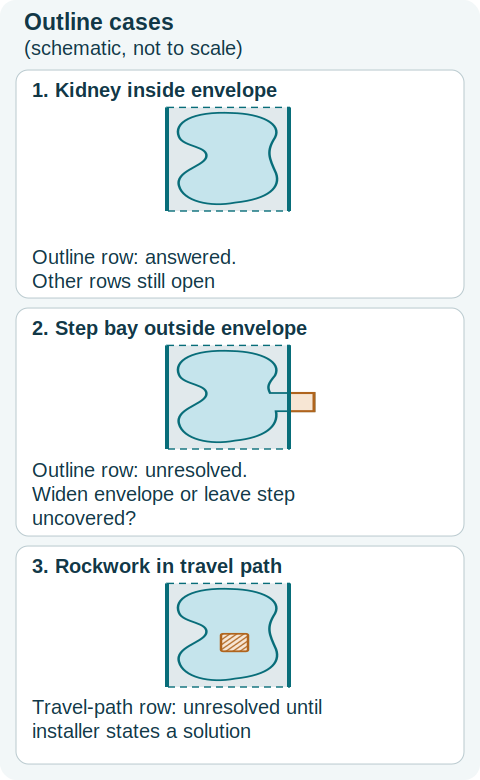
Each case in the figure settles one row of the screening table, not the overall outcome; the other rows still need answers. Describe each item and where it sits; do not decide on your own that it can be removed or moved. The automatic pool cover components guide explains the leading edge and fabric that pass over these areas.
Takeaway: If a feature is not on the plan, nobody has checked it against the cover’s path.
Construction routes the manufacturer names
Cover-Pools describes several arrangements for freeform pools. They are one maker’s examples, and the right one depends on the model, the shell and the stage of construction:
- Deck-mounted track for new and existing pools of many shapes, when the parallel tracks fit.
- Deck-on-deck construction, where track channel integrates an undertrack system on a freeform pool. The T4 family brochure describes it around vinyl, fiberglass or concrete pools.
- Extended cantilever deck, with tracks on a first deck at the widest part and a raised second deck following the pool shape.
- Raised track channel, described for fiberglass pools, including freeform fiberglass shells and deck-on-deck pools.
A family brochure is not the installation drawing for the model you are offered. Ask the installer which route they propose, why, and which drawing shows it. For a new build, add the answer to the new pool planning checklist before the deck design is fixed.
Takeaway: Ask for the route by name and on a drawing; do not assume the arrangement from a brochure photo.
Existing deck or new construction
Timing changes the options more than shape does. The manufacturer says provisions for its concealed Underside track must be made before construction. The brochure adds that a recessed mechanism works best if chosen before construction, though it can still be recessed in an existing deck if there is room to cut.
For an existing freeform pool, the deck-mounted route is the one the maker describes for new and existing pools alike. Anything beyond that, such as building a raised second deck, cutting for a recessed mechanism or rerouting services, is an alteration. It needs a scope, a responsible professional and a reinstatement plan. The wider trade-offs are in new build vs retrofit pool covers, and alteration scope belongs in the pool renovation planning guide.
Takeaway: On an existing pool, record which deck areas would change and who signs that off before treating the layout as workable.
Where the mechanism sits and how it is reached
The mechanism and roller sit at one end of the envelope. The brochure describes two broad options: a deck-mounted mechanism protected by a bench or end panels, or a recessed mechanism in a box below the deck. Neither description gives a footprint or service clearance, so mark the proposed end and its access side and leave the dimensions to the installer.
On a freeform pool, check what is at that end. A curved end wall, a step or a planter there can change where the mechanism goes or how large the envelope has to be. Record the proposed route for power or hydraulic lines; the drive options are covered in hydraulic vs electric pool cover drives.
Takeaway: A layout without an agreed mechanism location and access route is unresolved, however well the tracks fit.
Copyable freeform feasibility record
Save or copy this record and keep it with your pool drawings. Fill what you know, leave the rest blank, and discuss it with your own qualified installer. Keep measurement status separate from confirmation, so a preliminary sketch never reads as an approved design.
Scroll horizontally to see all columns when the table extends beyond the screen.
Plain-text version for notes or email:
FREEFORM POOL COVER FEASIBILITY RECORD
Pool address/reference:
Outline and features drawn (lobes, steps, spa, rockwork):
Proposed coverage envelope drawn:
Track corridor A:
Track corridor B:
Objects in travel path (item, position):
Mechanism end / type / access side:
Power or hydraulic route:
Deck areas to build, raise or cut:
Deck/structure signoff (name, date):
Manufacturer / model:
Layout drawing no. / revision:
Measurement status (sketch / measured / surveyed):
Screening outcome (candidate / unresolved / incompatible with current layout):
Unresolved items:
Next verification step and owner:
Attach the record to the pool drawings and BOM checklist so the cover drawing revision is tracked with the rest of the project. If you are comparing several offers, copy the model and drawing fields into your pool equipment RFQ template so every offer answers the same questions.
Takeaway: “Candidate” means you have enough to discuss with an installer; only a confirmed design from the installer and manufacturer approves the layout.
Limits and common mistakes
This method screens a single-cover rectangular layout. It does not assess zoned or multi-cover arrangements, such as the two covers meeting in the middle that the manufacturer describes for L-shaped pools built in from the start; those need the manufacturer’s own design. It also does not check loads, anchorage, safety-cover performance, local barrier rules or the exact model’s tolerances, and it does not replace a site survey. The common mistakes are:
- Assuming the tracks follow the curved edge. They run straight and parallel.
- Drawing the waterline but leaving out steps, a spa or rockwork that sit in the cover’s path.
- Guessing a clearance, deck height or mechanism size from photos or another model.
- Reading a family brochure as the installation drawing for the offered model.
- Treating one failed layout as proof that no layout works. A different envelope, route or deck design is a new question for the installer.
More cover planning guides are collected in the automatic pool covers section.
Takeaway: Keep the screening outcome, the unknowns and the confirmation owners together, and let the installer’s drawing settle the design.
Frequently asked questions
Can you get an automatic pool cover for an irregular shaped pool?
It can be, if a rectangular cover envelope with two straight, parallel tracks can clear the full outline and any attached features you want covered. One manufacturer describes freeform, kidney and abstract shapes as able to accommodate its system, but the layout still has to be confirmed for the offered model and your site.
Can automatic covers be installed on freeform pools?
Cover-Pools names several routes for freeform pools, including deck-mounted track, deck-on-deck construction with track channel, an extended cantilever deck and, for fiberglass shells, a raised track channel. Which route applies depends on the model, shell, deck and stage of construction, so ask the installer to name it on a drawing.
Can you put an automatic cover on an existing pool?
The manufacturer describes deck-mounted track for existing pools of many shapes when there is room for parallel tracks on opposite sides. Concealed track needs provisions before construction, and a recessed mechanism in an existing deck depends on there being room to cut. Any deck alteration needs review by the responsible professional.
How do you cover an irregular shaped pool?
With a track-based cover, the fabric travels over a rectangle rather than following the curve. The tracks run straight and parallel, typically set by the widest part of the pool, and the deck between the curved edge and the tracks is built or adapted to suit. The installer confirms the arrangement for the chosen model.
Can a kidney-shaped pool use an automatic cover?
A kidney shape is one of the freeform shapes the manufacturer lists. Check that both lobes and any step area sit inside the proposed envelope, and that the inward curve does not leave unsupported deck or an obstruction in the cover's path. Record those points for the installer rather than assuming a fit.
Can an automatic cover work on an odd-shaped pool?
It depends on what the odd shape adds. Steps or a spa outside the main perimeter can still be included on deck-mounted layouts if the parallel tracks clear them, but rockwork, raised walls or a ladder in the travel path need a model-specific decision. Mark each one on the plan with its position.
Sources
- Cover Any Type of Pool — Cover-Pools Accessed October 11, 2026.
- Track, Channel, and Coping Systems — Cover-Pools Accessed October 11, 2026.
- T4 Family brochure: Automatic Pool and Spa Covers — Cover-Pools Accessed October 11, 2026.