Key takeaways
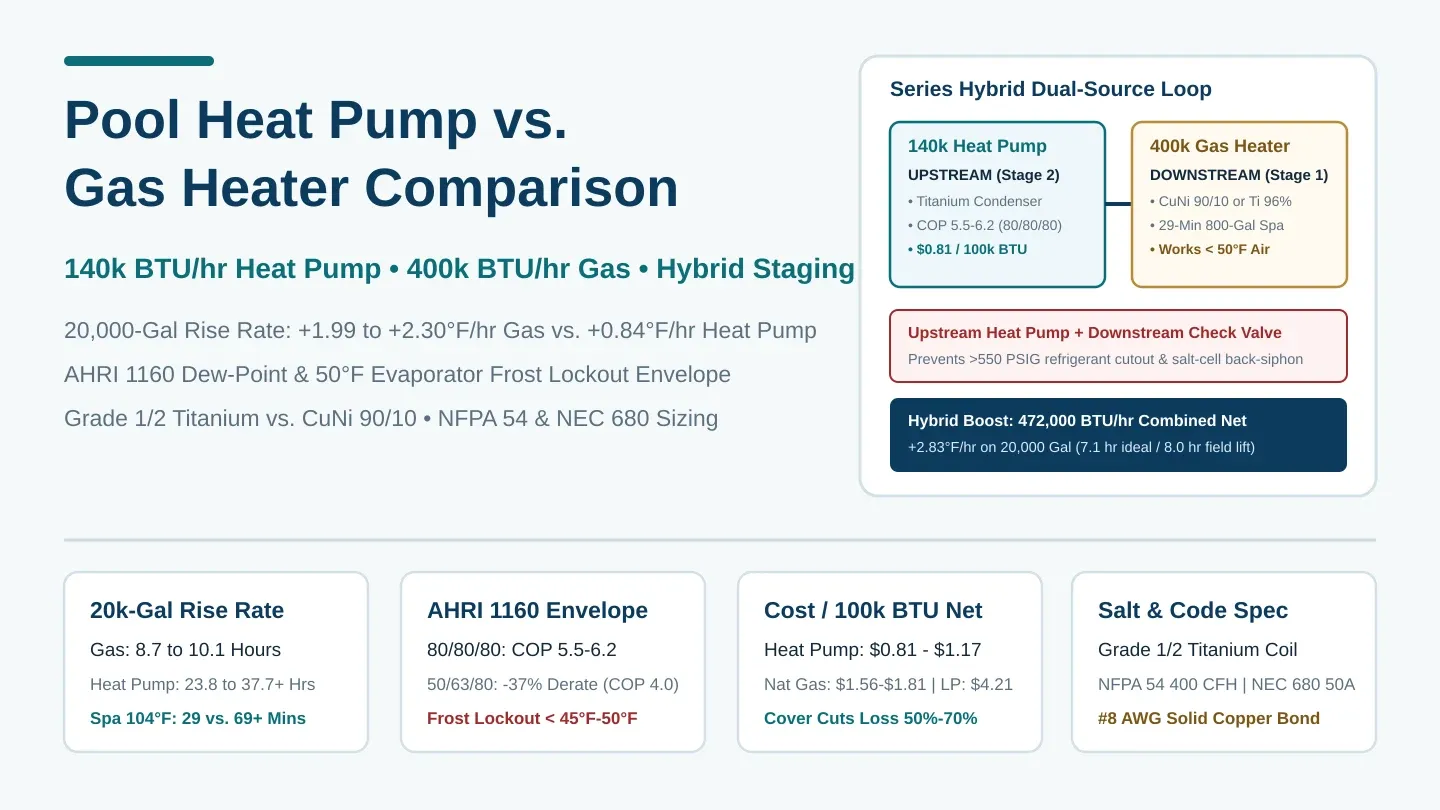
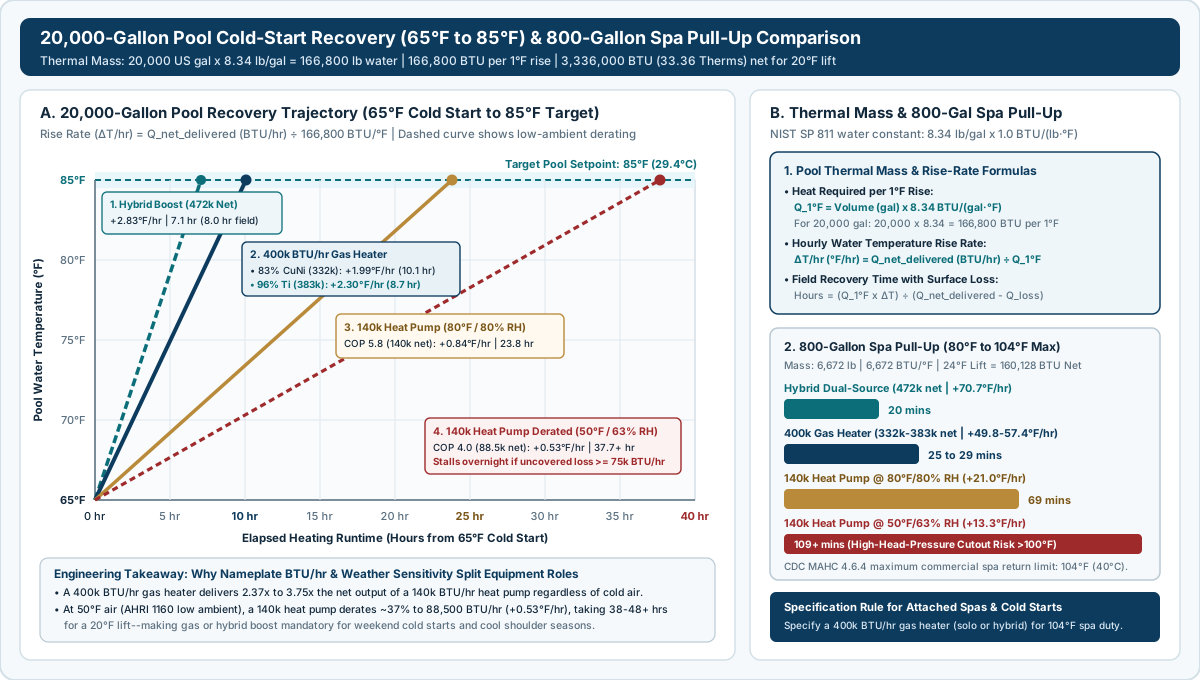
- A 20,000-gallon pool contains 166,800 lb of water (at 8.34 lb/gal) and requires 166,800 BTU per 1°F rise, or 3,336,000 BTU (33.36 Therms) net to recover 20°F from 65°F to 85°F.
- A 400,000 BTU/hr gas heater delivers 332,000 BTU/hr net at 83% efficiency (+1.99°F/hr, 10.1 hr recovery) or 383,040 BTU/hr net in 96% condensing titanium models (+2.30°F/hr, 8.7 hr) in any outdoor weather.
- A 140,000 BTU/hr heat pump delivers +0.84°F/hr (23.8 hr recovery) at AHRI 1160 high-ambient conditions (80°F air / 80% RH, COP 5.8), but derates 35%-40% to ~88,500 BTU/hr (+0.53°F/hr, 37.7+ hr) at 50°F / 63% RH and locks out below 45°F-50°F.
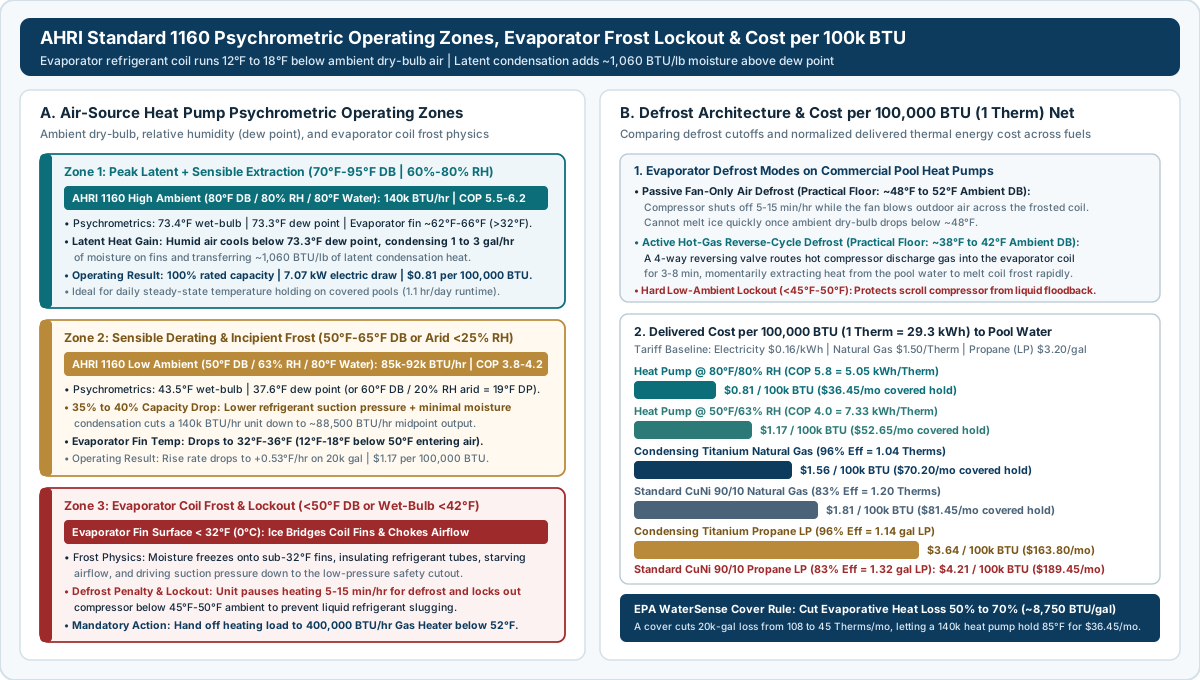
- Normalized per 100,000 BTU (1 Therm = 29.3 kWh) delivered, a heat pump at $0.16/kWh costs $0.81 (COP 5.8) to $1.17 (COP 4.0), compared with $1.56-$1.81 for natural gas ($1.50/Therm) and $3.64-$4.21 for propane ($3.20/gal).
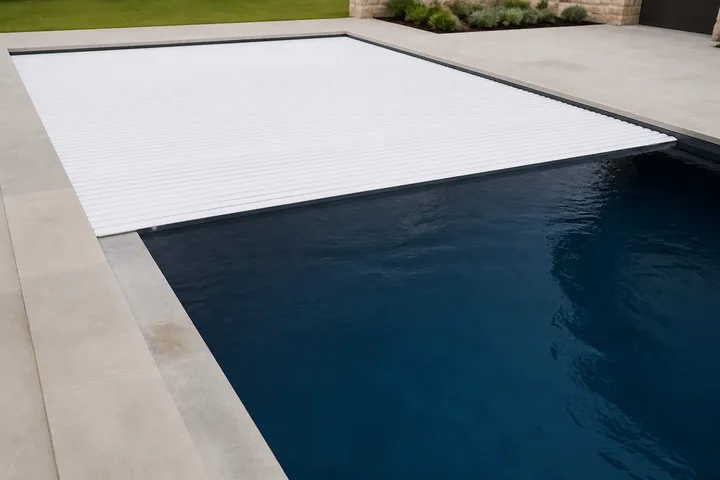
- Per EPA WaterSense Section 5.3, an automatic pool cover cuts evaporative heat loss by 50%-70%, reducing a 20,000-gallon pool's holding load from ~108 Therms/month to 45 Therms/month ($36.45/month on a heat pump).
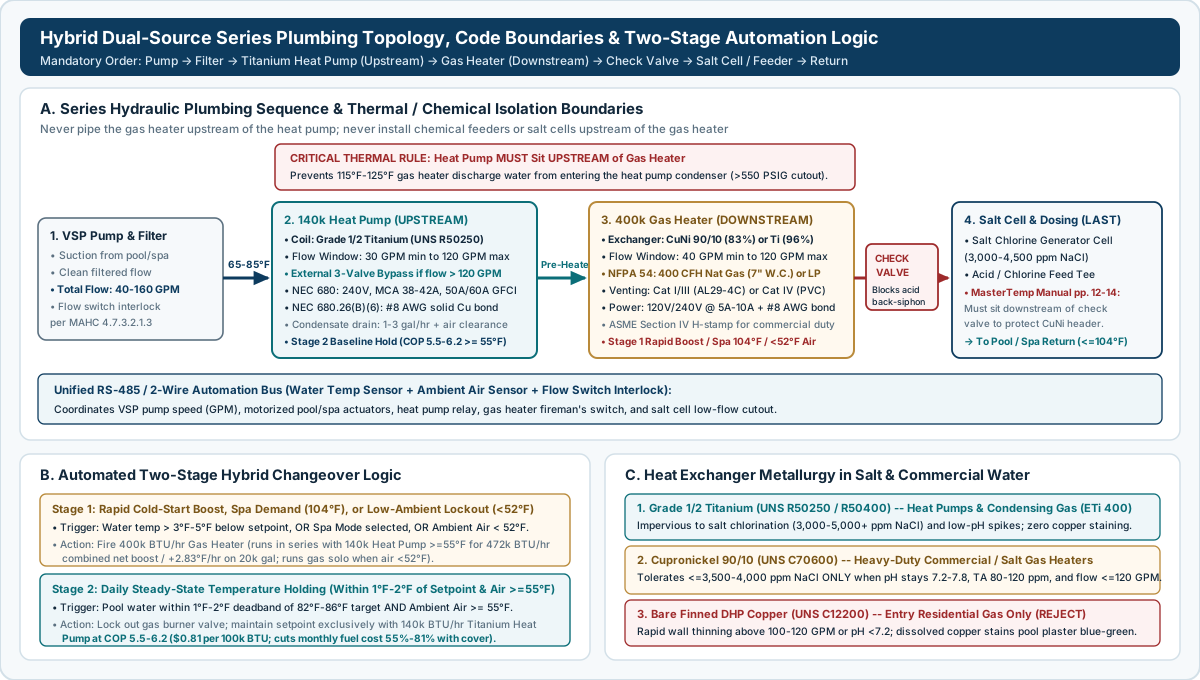
- In hybrid dual-source systems, pipe the Titanium Heat Pump UPSTREAM of the Gas Heater so 115°F-125°F gas heater discharge water never enters the heat pump condenser and trips its >550 PSIG high-pressure safety cutout.
Evaluating a pool heat pump vs gas heater by comparing catalogue BTU/hr ratings alone causes failed weekend cold-start recovery, stalled water heating during low-ambient frost lockouts, or costly seasonal fuel waste. A 400,000 BTU/hr natural gas or propane heater (ANSI Z21.56 / CSA 4.7) and a 140,000 BTU/hr electric air-source heat pump (AHRI Standard 1160) operate on fundamentally different thermodynamic cycles: combustion heaters generate high-output thermal power independently of outdoor weather, whereas air-source heat pumps move ambient latent and sensible heat at a high Coefficient of Performance (COP 5.5 to 6.2 in warm humid air) but lose 35% to 40% of their capacity near 50°F and lock out when evaporator fins freeze below 45°F to 50°F.
Separate your heating specification into two distinct duties–cold-start temperature rise rate (ΔT/hr) and steady-state holding cost per 100,000 BTU (1 Therm) delivered–before selecting a standalone unit or a series hybrid dual-source loop. Verify exact basin water volume first with our pool volume calculator, coordinate hydraulic branch flow across our pool equipment and automation guides, and check mechanical pad clearances in our pool planning and plant-room design guides. If your facility also requires active summer water cooling (pull-down kW plus solar heat-gain removal), calculate that summer chiller duty separately in our swimming pool chiller and heat-pump sizing guide.
Scroll horizontally to see all columns when the table extends beyond the screen.
Compare temperature rise rates and cold-start recovery on a 20,000-gallon pool
Before comparing utility tariffs or equipment pad footprints, verify whether the heater can physically raise the water mass to your target setpoint within your operational recovery window. Liquid water has a density of 8.34 pounds per US gallon at standard swimming pool temperatures (65°F to 85°F / 18°C to 29°C) and an isobaric specific heat capacity (c_p) of 1.0 BTU per pound per 1°F (NIST Special Publication 811, Appendix B).
Every US gallon of pool water therefore requires exactly 8.34 BTU of net absorbed thermal energy for each 1°F increase in temperature:
Formulas (Pool Thermal Mass, Hourly Temperature Rise Rate, and Recovery Time):
Q_1degF (BTU per 1°F rise) = Pool Volume (gal) × 8.34 lb/gal × 1.0 BTU/(lb·°F)Total Stored Heat Q_total (BTU) = Pool Volume (gal) × 8.34 × (T_target - T_initial)Ideal Hourly Rise Rate ΔT/hr (°F/hr) = Q_net_delivered (BTU/hr) ÷ (Pool Volume (gal) × 8.34)Field Recovery Time (hours) = Q_total (BTU) ÷ (Q_net_delivered (BTU/hr) - Q_surface_loss (BTU/hr))
Worked comparison: 20,000-gallon pool (20°F cold-start lift from 65°F to 85°F)
Consider a 20,000-gallon (75.7 m³) commercial or residential swimming pool containing 20,000 × 8.34 = 166,800 pounds of water. Raising that basin by 1°F requires 166,800 BTU (1.668 Therms). Executing a 20°F cold-start recovery from 65°F to 85°F (18.3°C to 29.4°C) requires 166,800 × 20 = 3,336,000 BTU (33.36 Therms) of net heat delivered to the water:
- 400,000 BTU/hr Standard Fan-Assisted Gas Heater (
ANSI Z21.56 / CSA 4.7,83%Thermal Efficiency):- Per the Pentair MasterTemp Pool and Spa Heater Installation Manual, a
400,000 BTU/hrgross input fan-assisted combustion heater operating at82% to 84%thermal efficiency (83%midpoint) transfers400,000 × 0.83 =332,000 BTU/hr net into the circulation loop, while~68,000 BTU/hrexits through the flue exhaust. - Hourly Rise Rate:
332,000 BTU/hr ÷ 166,800 BTU/°F =+1.99°F per hour(~2.0°F/hr). - 20°F Cold-Start Recovery:
3,336,000 ÷ 332,000 =10.05 hours ideal (~11.4 hoursin the field assuming~40,000 BTU/hror12%uncovered surface heat loss). Crucially, a gas burner delivers this exact332,000 BTU/hrnet output whether outdoor air is85°For38°F.
- Per the Pentair MasterTemp Pool and Spa Heater Installation Manual, a
- 400,000 BTU/hr Condensing Direct-Fire Titanium Gas Heater (
96%Thermal Efficiency):- Commercial condensing gas units such as the Pentair ETi 400 High-Efficiency Heater (
399,000 BTU/hrinput,96%thermal efficiency) recover latent heat from flue-gas water vapor across dual direct-fire Grade 1/2 Titanium heat exchangers, delivering 383,040 BTU/hr net to water. - Hourly Rise Rate & Recovery:
383,040 ÷ 166,800 =+2.30°F per hour, completing the20°Flift in 8.71 hours ideal (~9.8 hoursfield).
- Commercial condensing gas units such as the Pentair ETi 400 High-Efficiency Heater (
- 140,000 BTU/hr Electric Air-Source Heat Pump at
AHRI 1160High Ambient (80°FAir /80%RH /80°FWater):- Under AHRI Standard 1160 and the Pentair UltraTemp Heat Pump Installation Manual, Rev. AA (page 1), a commercial-class single-phase heat pump rated at
80°Fdry-bulb air,80%relative humidity, and80°Fentering water delivers 140,000 BTU/hr net (41.0 kWthermal) while drawing7.07 kW(24,138 BTU/hrelectrical equivalent) atCOP 5.8. - Hourly Rise Rate:
140,000 BTU/hr ÷ 166,800 BTU/°F =+0.84°F per hour. - 20°F Cold-Start Recovery:
3,336,000 ÷ 140,000 =23.83 hours ideal. Because outdoor temperature and humidity drop overnight during a multi-day pull-up, real-world uncovered recovery takes 28 to 32 hours.
- Under AHRI Standard 1160 and the Pentair UltraTemp Heat Pump Installation Manual, Rev. AA (page 1), a commercial-class single-phase heat pump rated at
- 140,000 BTU/hr Heat Pump Derated at
AHRI 1160Low Ambient (50°FAir /63%RH /80°FWater):- At the
AHRI 1160low-ambient certification point (50.0°Fdry bulb,63%relative humidity,43.5°Fwet bulb,37.6°Fdew point), a nominal140,000 BTU/hrheat pump derates by35% to 40%, delivering 85,000 to 92,000 BTU/hr net (88,500 BTU/hr midpoint atCOP 4.0,6.48 kWelectrical draw). - Hourly Rise Rate & Recovery:
88,500 ÷ 166,800 =+0.53°F per hour, stretching ideal zero-loss recovery to 37.69 hours. If the20,000-gallonpool (~800 sq ftsurface area) is left uncovered in50°Fair with a7 mphbreeze, evaporative and convective surface heat loss reaches 65,000 to 85,000 BTU/hr–consuming75% to 96%of the heat pump’s derated output and causing water temperature to stall below78°F.
- At the
Worked comparison: 800-gallon attached spa pull-up (80°F to 104°F = 24°F lift)
For an attached 800-gallon (6,672 lb) hydrotherapy spa requiring 800 × 8.34 = 6,672 BTU per 1°F rise, lifting water 24°F from 80°F to the 104°F (40°C) maximum commercial bather limit mandated by 2024 CDC Model Aquatic Health Code (MAHC) Section 4.6.4 requires 6,672 × 24 = 160,128 BTU net:
- 400k BTU/hr Gas Heater (
332kto383knet): Heats the800-galspa at+49.8°F/hrto+57.4°F/hr, reaching104°Fin 25 to 29 minutes in any weather. - 140k BTU/hr Heat Pump: Heats the spa at
+21.0°F/hr(69 minutes) in80°Fair and+13.3°F/hr(109+ minutes) in50°Fair–and many pool heat pumps trip their refrigerant high-head-pressure switch once entering water exceeds100°F to 102°F.
Scroll horizontally to see all columns when the table extends beyond the screen.
Rules-of-Thumb: Never specify a standalone air-source heat pump for an on-demand
104°Fspa or a weekend cabin pool that is allowed to cool to60°F-65°FMonday through Thursday; specify a400,000 BTU/hrgas heater (alone or in a hybrid loop) whenever you need a>= 1.8°F/hrpool pull-up or< 30-minutespa recovery.
Account for AHRI 1160 ambient dew point, wet-bulb and evaporator frost lockout
A gas-fired pool heater burns natural gas (~1,000 BTU/cu ft) or propane (91,500 BTU/gal) inside a sealed or atmospheric combustion chamber, so its thermal output depends only on fuel supply pressure and combustion air volume. An electric air-source pool heat pump, by contrast, is a vapor-compression refrigeration machine operating in reverse: its outdoor fan pulls 3,000 to 4,500 CFM of ambient air across a finned aluminum evaporator coil so cold boiling refrigerant (R-410A or R-32) can absorb thermal energy from the air and reject it through a titanium condenser into the pool water.
To prevent manufacturers from inflating catalogue ratings at unrealistic tropical temperatures, AHRI Standard 1160 (I-P) mandates two standardized psychrometric test conditions at 80.0°F (26.7°C) entering pool water temperature:
- AHRI 1160 High-Ambient Rating Point (
80/80/80):- Psychrometric State:
80.0°F (26.7°C)dry-bulb air,80%relative humidity,73.4°Fwet-bulb temperature, and73.3°Fdew point. - Sensible + Latent Heat Extraction: To transfer heat rapidly from air to refrigerant, the evaporator coil runs at an approach temperature differential (
ΔT_approach) of12°F to 18°F(6.7°C to 10.0°C) below ambient dry-bulb air. In80°Fair, the evaporator fins sit at62°F to 66°F–well above the32°Ffreezing point of water, but 7°F to 11°F below the73.3°Fambient dew point. - Because the coil surface is colder than the dew point, airborne water vapor condenses continuously onto the evaporator fins at
1 to 3 US gallons per hour, releasing~1,060 BTUof latent heat of condensation per pound of condensed moisture directly into the refrigerant. This latent heat bonus accounts for35% to 45%of the heat pump’s total thermal capacity in humid climates, enabling a140,000 BTU/hroutput atCOP 5.5 to 6.2.
- Psychrometric State:
- AHRI 1160 Low-Ambient Rating Point (
50/63/80):- Psychrometric State:
50.0°F (10.0°C)dry-bulb air,63%relative humidity,43.5°Fwet-bulb temperature, and37.6°Fdew point. - Why Output Derates
35% to 40%: Cooler ambient air lowers the refrigerant saturation temperature and suction vapor density entering the scroll compressor, reducing mass flow rate. Simultaneously, cold air holds far less moisture (37.6°Fdew point vs.73.3°F), collapsing latent condensation heat gain. Net output on a nominal140,000 BTU/hrunit falls to 85,000 to 92,000 BTU/hr (88,500 BTU/hrmidpoint) andCOPdrops to3.8 to 4.2. - Arid Desert Penalty (
<25%RH): In arid climates (such as Phoenix, Las Vegas, or Palm Springs during spring/autumn mornings at60°Fdry bulb and20%relative humidity), the wet-bulb temperature is only43.5°Fand the dew point is19.0°F. Because the evaporator coil (~45°F) remains warmer than the19.0°Fdew point, zero moisture condenses on the fins. The heat pump operates purely on dry sensible heat transfer, losing20% to 30%of its80/80/80capacity even at60°Fdry-bulb air. Compare arid and high-heat site constraints in our pool equipment guide for hot climates.
- Psychrometric State:
Evaporator coil frosting physics and defrost lockout below 50°F-55°F
As documented in the Pentair UltraTemp Installation Manual, once outdoor dry-bulb air drops into the 50°F to 55°F (10°C to 12.8°C) band, subtracting the 12°F to 18°F evaporator approach pushes the aluminum fin surface temperature below 32°F (0°C). Whenever the ambient dew point exceeds that sub-freezing coil temperature, condensed moisture freezes solid across the fin pack:
- Airflow starvation & suction pressure collapse: Frost bridges the narrow
14 to 18 FPI(fins per inch) evaporator spacing, blocking fan airflow. Without airflow, refrigerant inside the evaporator cannot boil completely; suction pressure plummets toward the low-pressure cutout switch while liquid refrigerant risks returning to the compressor scroll (liquid slugging). - Passive Fan-Only Air Defrost (
~48°F to 52°Ffloor): Standard heat pumps shut off the compressor for 5 to 15 minutes every hour when the coil sensor detects freezing, keeping the outdoor fan spinning to blow ambient air (>48°F) across the coil until the ice melts. Below~48°Fambient air, fan-only defrost cannot clear the ice before the next freeze cycle begins. - Active Hot-Gas Reverse-Cycle Defrost (
~38°F to 42°Ffloor): Cold-climate heat pumps (and reversible chiller/heat-pump models) energize a 4-way reversing valve for 3 to 8 minutes, routing hot high-pressure compressor discharge gas directly into the outdoor evaporator coil to melt frost rapidly. However, reverse-cycle defrost temporarily extracts heat out of the pool circulation loop to melt outdoor ice, and net useful heating capacity below45°Fdrops below50%of nameplate rating. - Hard Low-Ambient Compressor Lockout (
<45°F to 50°F): Below the unit’s minimum ambient temperature threshold, the controller locks out the compressor until outdoor air warms back above the reset deadband (~52°F to 54°F).
Calculate operating energy cost per 100,000 BTU (1 Therm) delivered and cover synergy
Because natural gas is billed in Therms (100,000 BTU), liquid propane (LP) is billed in US gallons (91,500 BTU/gal), and electricity is billed in kilowatt-hours (kWh, 3,412.14 BTU/kWh), comparing fuel bills requires normalizing every heater to the exact cost of 100,000 BTU (1 Therm) of net thermal energy delivered into the pool water.
Using the exact energy conversion factors in NIST Special Publication 811, Appendix B (100,000 BTU ÷ 3,412.14 BTU/kWh = 29.307 kWh per Therm, rounded to 29.3 kWh):
Formulas (Normalized Cost per 100,000 BTU / 1 Therm Delivered to Pool Water):
- Natural Gas Heater (
1 Therm = 100,000 BTUgross):Cost per 100,000 BTU Delivered ($) = (Natural Gas Rate ($/Therm)) ÷ Thermal Efficiency - Propane (
LP) Gas Heater (1 Gallon LP = 91,500 BTU = 0.915 Thermgross):Cost per 100,000 BTU Delivered ($) = (Propane Rate ($/Gallon)) ÷ (0.915 × Thermal Efficiency) - Electric Air-Source Heat Pump (
100,000 BTU = 29.3 kWhthermal equivalent):Cost per 100,000 BTU Delivered ($) = (29.3 kWh ÷ COP) × (Electricity Rate ($/kWh))
Worked cost comparison at benchmark utility tariffs ($0.16/kWh, $1.50/Therm, $3.20/gal LP)
Applying those three equations at national midpoint utility rates–and showing the full commercial tariff sensitivity band ($0.12 to $0.28/kWh electricity, $1.20 to $2.20/Therm natural gas, and $2.75 to $4.00/gal propane)–reveals why electric heat pumps dominate continuous temperature holding while gas heaters dominate rapid recovery:
- Heat Pump at Warm Ambient (
80°F / 80% RH,COP 5.8): Consumes29.3 ÷ 5.8 =5.05 kWhper100,000 BTUdelivered. At$0.16/kWh,5.05 × $0.16 =$0.81 per 100,000 BTU($0.61at$0.12/kWhup to$1.41at$0.28/kWh). - Heat Pump at Cool Shoulder (
50°F / 63% RH,COP 4.0): Consumes29.3 ÷ 4.0 =7.33 kWhper100,000 BTUdelivered. At$0.16/kWh,7.33 × $0.16 =$1.17 per 100,000 BTU($0.88to$2.05). - Condensing Titanium Gas Heater on Natural Gas (
96%Efficiency): Consumes1.0 ÷ 0.96 =1.04 Thermsper100,000 BTUnet. At$1.50/Therm,1.0417 × $1.50 =$1.56 per 100,000 BTU($1.25to$2.29). - Standard Cupronickel Gas Heater on Natural Gas (
83%Efficiency): Consumes1.0 ÷ 0.83 =1.20 Thermsper100,000 BTUnet. At$1.50/Therm,1.2048 × $1.50 =$1.81 per 100,000 BTU($1.45to$2.65). - Condensing Titanium Gas Heater on Propane LP (
96%Efficiency): Consumes1.0 ÷ (0.915 × 0.96) =1.14 gallons LPper100,000 BTUnet. At$3.20/gal,1.1384 × $3.20 =$3.64 per 100,000 BTU($3.13to$4.55). - Standard Cupronickel Gas Heater on Propane LP (
83%Efficiency): Consumes1.0 ÷ (0.915 × 0.83) =1.32 gallons LPper100,000 BTUnet. At$3.20/gal,1.3167 × $3.20 =$4.21 per 100,000 BTU($3.62to$5.27)–5.2 times the operating cost of a heat pump atCOP 5.8.
Scroll horizontally to see all columns when the table extends beyond the screen.
Why pairing an automatic pool cover with a heat pump cuts holding cost by 50%-70%
As documented in EPA WaterSense at Work, Section 5.3: Commercial Pool and Spa Equipment (November 2023) and the EPA WaterSense Pool Water Efficiency guide, surface water evaporation is the single largest source of heat loss in heated outdoor and indoor pools. Phase change from liquid water at 85°F to water vapor absorbs approximately 1,050 BTU of latent heat per pound of water evaporated (1,050 × 8.34 = 8,757 BTU lost for every single US gallon evaporated).
Deploying a mechanical or automatic pool cover during unoccupied hours cuts evaporative water and heat loss by 50% to 70%:
- Uncovered 20,000-gallon pool (
85°Ftarget): Loses~360,000 BTU/day(3.60 Therms/dayor108 Therms/month, equivalent to~2.16°F/dayof temperature decay). Holding85°Funcovered requires2.57 hours/dayof heat pump runtime at80°Fair ($87.48/month) or4.07 hours/dayat50°Fair ($126.36/month)–and costs$195.48/monthon standard natural gas or$454.68/monthon standard propane. - Covered 20,000-gallon pool (
58%loss reduction): Cuts daily heat loss to~150,000 BTU/day(1.50 Therms/dayor45 Therms/month, just~0.90°F/dayof overnight drift). A140,000 BTU/hrheat pump replaces that entire daily loss in 1.07 hours of daytime compressor runtime (when ambient air is warmest andCOPis highest), maintaining85°Fall month for$36.45/month.
Rules-of-Thumb: In high-electricity-rate / low-natural-gas-rate utility territories (for example, California or Northeast tiers where electricity exceeds
$0.32/kWhwhile natural gas is$1.40/Therm), check the COP parity point: at$0.32/kWhandCOP 5.8, a heat pump costs(29.3 ÷ 5.8) × $0.32 = $1.62/Therm, nearly equal to a96%condensing natural gas heater ($1.40 ÷ 0.96 = $1.46/Therm). Where propane (LP) is the only combustion fuel, a heat pump saves65% to 81%on operating energy in every U.S. tariff zone.
Select heat exchanger metallurgy (Titanium vs. Cupronickel vs. Copper) and utility services (NFPA 54 & NEC 680)
Choosing the wrong heat exchanger alloy on a salt-chlorinated pool (3,000 to 4,500 ppm NaCl) or a heavily dosed commercial hospitality loop perforates heat exchanger tubes and stains white plaster blue-green within 18 to 36 months. Coordinate your heater alloy directly with your salt chlorine generator sizing and runtime checklist.
1. Heat exchanger metallurgy tiers
- Grade 1 / Grade 2 Spiral-Fluted Titanium (
UNS R50250 / R50400):- Where Used: Standard in commercial and residential electric pool heat pumps (including the Pentair UltraTemp Titanium heat exchanger) and premium direct-fire condensing gas heaters (Pentair ETi 400 TitanTough).
- Corrosion & Velocity Envelope: Commercially pure titanium forms an instantaneous, self-healing titanium dioxide (
TiO2) passive film that is virtually impervious to chloride pitting, crevice corrosion, and galvanic attack in salt-chlorinated pools (3,000 to 5,000+ ppm NaCl), seawater/brackish therapy pools (up to 35,000 ppm), and low-pH chemical excursions. Spiral-fluted titanium tube-in-shell condensers induce turbulent water flow to maximize heat transfer while resisting erosion-corrosion.
- Cupronickel
90/10or80/20(UNS C70600 / C71500):- Where Used: Heavy-duty commercial and salt-rated non-condensing gas pool heaters (such as the
Pentair MasterTemp HDandASME Section IVH-stamped commercial bronze-header heaters). - Corrosion & Velocity Envelope: Alloying copper with
10% to 20%nickel plus1.0% to 1.8%iron toughens the surface oxide film against high-velocity impingement erosion and elevates chloride tolerance up to3,500 to 4,000 ppm NaCl. However, cupronickel is not corrosion-proof: ifpHdrops below7.0, if free chlorine spikes above5.0 to 10.0 ppm, if Langelier Saturation Index (LSI) falls below-0.3(corrosive water), or if total flow exceeds120 GPMwithout an external bypass, the protective cuprous oxide film strips away.
- Where Used: Heavy-duty commercial and salt-rated non-condensing gas pool heaters (such as the
- Standard Finned Deoxidized High-Phosphorus (
DHP) Copper (UNS C12200):- Where Used: Entry-level residential gas heaters on fresh-water pools.
- Why to Reject on Commercial & Salt Loops: While pure copper has high thermal conductivity (
226 BTU/(hr·ft·°F)), it suffers rapid impingement erosion above6 to 8 ft/stube velocity (>100-120 GPM) and rapid chloride/acid dissolution wheneverpH < 7.2or salt exceeds1,500 to 2,000 ppm. Dissolved copper ions (Cu2+) precipitate onto pool walls as turquoise copper carbonate/cyanurate stains. Reject bare copper heat exchangers in all commercial, HOA, and salt-pool RFQs.
Scroll horizontally to see all columns when the table extends beyond the screen.
2. Utility infrastructure: NFPA 54 gas piping vs. NEC Article 680 electrical service
Retrofitting or specifying a heater frequently hinges on whether the equipment pad has adequate fuel-gas volume under NFPA 54 / ANSI Z223.1 (National Fuel Gas Code) or spare 240V electrical panel capacity under NFPA 70 (National Electrical Code) Article 680. Coordinate both services early in your pool equipment room and pad design:
- 400,000 BTU/hr Gas Heater Utility Requirements (
NFPA 54& Pentair MasterTemp Manual):- Fuel Gas Flow & Dynamic Pressure: Requires 400 cubic feet per hour (
400 CFH) of Natural Gas (1,000 BTU/cu ft) at4.0 in. W.C.minimum dynamic pressure (with burner firing at full rate) to14.0 in. W.C.maximum static pressure (7.0 in. W.C.nominal), or160 CFH(4.37 gal/hr) of Propane (LP) at8.0 to 14.0 in. W.C.(11.0 in. W.C.nominal). - Low-Pressure Schedule 40 Iron Pipe Sizing (
7 in. W.C.supply,0.5 in. W.C.pressure drop): A400,000 BTU/hrheater cannot run on a long3/4-inchresidential gas stub. UnderNFPA 54tables,400 CFHrequires1-1/4 inchSchedule 40 pipe up to50 feetequivalent length,1-1/2 inchup to100 feet, and2 inchup to200 feet(counting3 to 5 equivalent feetper90°elbow), or a2 psielevated-pressure meter regulator paired with a listed step-down appliance regulator (5 to 10 ftupstream of the heater) and a3-inchvertical sediment trap (drip leg). - Flue Venting Categories (
NFPA 54): Indoor or enclosed plant rooms require either Category I (negative-pressure vertical draft hood), Category III (positive-pressure non-condensing vent usingAL29-4Csuper-ferritic stainless steel pipe for82%-84%fan-assisted heaters), or Category IV (positive-pressure condensing vent using Schedule 40PVC,CPVC, or polypropylene pipe with a condensate neutralizer drain for96%condensing titanium heaters). - Electrical Draw: Only
120Vor240Vat5A to 10A(shared equipment subpanel circuit) to power the combustion blower, hot-surface igniter, and digital control board.
- Fuel Gas Flow & Dynamic Pressure: Requires 400 cubic feet per hour (
- 140,000 BTU/hr Electric Heat Pump Utility Requirements (
NEC Article 680&Article 440):- Dedicated 240V Branch Circuit: Zero gas pipe or flue stack required, but a
140,000 BTU/hrsingle-phase208-230Vheat pump (scroll compressor Rated Load AmpsRLA ~28A-32A, fan motor Full Load AmpsFLA ~2.5A-3.0A) carries a nameplate Minimum Circuit Ampacity (MCA = 1.25 × RLA + FLA) of38A to 42Aand a Maximum Overcurrent Protection (MOP) rating of50Aor60A. - Conductor & Breaker Sizing: Requires a dedicated 2-pole
50Aor60AGFCI circuit breaker feeding#6 AWGcopper (75°CTHWN-2) conductors in liquidtight conduit, plus a lockable disconnecting switch mounted within sight of the unit (NEC 680.13). If an older residential property only has a100Aor125Amain service panel, adding a50Aheat pump circuit often triggers a main panel upgrade unless load-shedding automation is installed. - Airflow Clearance & Condensate Drainage: Requires 24 to 36 inches of unobstructed horizontal intake clearance around the evaporator coil, 60+ inches of vertical discharge clearance above the top fan grille (never install beneath a low deck soffit where cold exhaust air recirculates into the intake), and a gravity drain path for 1 to 3 gallons/hour of coil condensate.
- Dedicated 240V Branch Circuit: Zero gas pipe or flue stack required, but a
- Mandatory Equipotential Bonding (
NEC Section 680.26(B)(6)): Both the electric heat pump cabinet and the gas heater chassis must be bonded to the pool’s equipotential bonding grid using a solid bare copper conductor not smaller than#8 AWG(8.36 mm²) landed on the external factory bonding lug.
Pipe a hybrid dual-source heating loop with automated two-stage staging
For commercial hotels, resort pools, school/HOA lap pools, and four-season residential pools with attached spas, you do not have to compromise between the 29-minute spa recovery of a 400,000 BTU/hr gas heater and the $0.81/Therm operating economy of a 140,000 BTU/hr titanium heat pump. Piping both units in a series hybrid dual-source loop delivers 472,000 BTU/hr net (+2.83°F/hr on 20,000 gallons) during Stage 1 boost while handing off 80% to 90% of seasonal temperature-holding hours to the heat pump.
Verify your complete circulation manifold against our pool equipment system overview and enforce the following hydraulic sequence:
Pool/Spa Suction Outlets → Variable-Speed Circulation Pump → Filter → External 3-Valve Bypass Manifold around 140k BTU/hr Titanium Heat Pump (UPSTREAM) → 400k BTU/hr Gas-Fired Heater (DOWNSTREAM) → Positive-Seal Chemical-Resistant Check Valve → Salt Chlorine Generator Cell & Acid Dosing Tee → Pool/Spa Return Actuators
Three non-negotiable hydraulic & control rules for hybrid loops
- Always pipe the Heat Pump UPSTREAM of the Gas Heater (Thermal High-Pressure Protection):
- Under low-flow or spa-heating conditions (
40 to 60 GPM), a400,000 BTU/hrgas heater raises water temperature by11°F to 16°Fin a single pass (ΔT_pass = 332,000 ÷ (500 × GPM)), discharging water at105°F to 125°F. - If the gas heater is mistakenly plumbed upstream of the heat pump, that
115°F+water enters the heat pump’s titanium refrigerant condenser. BecauseR-410Asaturation pressure reaches550 to 610 PSIGat140°F-150°Fcondensing temperature, hot entering water immediately trips the heat pump’s high-refrigerant-pressure safety cutout, locking out the compressor. - Piping the Heat Pump first (immediately after the filter) guarantees that its titanium condenser always receives coolest bulk pool water (
65°F to 85°F, whereCOPis highest), adding2°F to 4°Fof pre-heat before the water enters the downstream gas heater.
- Under low-flow or spa-heating conditions (
- Size the external 3-valve bypass for
30 to 120 GPMbranch flow:- Both the Pentair UltraTemp manual (
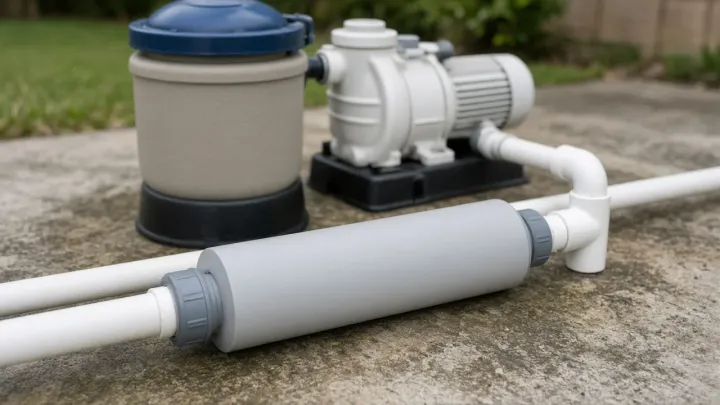
30 GPM min / 120 GPM max) and the Pentair MasterTemp 400k manual (40 GPM min / 120 GPM max) mandate an external manual or automated bypass manifold whenever total circulation flow exceeds 120 US GPM. Set variable-speed pump filtration speeds (45 to 75 GPMduring heating modes) so both heaters remain comfortably above their internal water pressure-switch dropout (>= 40 GPM) without exceeding tube erosion velocity limits (<= 120 GPM).
- Both the Pentair UltraTemp manual (
- Install a positive-seal check valve between the Gas Heater outlet and downstream Salt Cell / Feeders:
- Per the Pentair MasterTemp Manual (pages 12 and 14) and 2024 CDC MAHC Section 4.7.3.2.1.3, all salt chlorine generator cells, trichlor erosion feeders, and muriatic acid injection tees must sit downstream of the gas heater outlet, separated by a chemical-resistant positive-seal check valve (
18 to 24 inchesdownstream of the heater header), and interlocked with a dedicated flow switch so dense, acidic chlorine solution cannot diffuse backward into the heat exchanger when the pump shuts off.
- Per the Pentair MasterTemp Manual (pages 12 and 14) and 2024 CDC MAHC Section 4.7.3.2.1.3, all salt chlorine generator cells, trichlor erosion feeders, and muriatic acid injection tees must sit downstream of the gas heater outlet, separated by a chemical-resistant positive-seal check valve (
Automated two-stage changeover sequence
Connect both heaters via RS-485 serial bus (or 2-wire fireman’s switch relays) to a shared automation controller equipped with a water-temperature thermistor in the suction header and an outdoor ambient air thermistor mounted in the shade:
- Stage 1 – Rapid Cold-Start Recovery, Spa Mode (
104°F), or Low-Ambient Lockout (<52°FAir):- Whenever actual water temperature is more than
3°F to 5°Fbelow setpoint (for example, a Friday afternoon cold start at68°F), whenever Spa Mode (100°F-104°F) is activated, or whenever ambient air dry-bulb drops below52°F(evaporator frost zone), automation fires the 400,000 BTU/hr gas heater. If ambient air is>= 55°Fduring a pool cold start, both heaters run simultaneously in series boost (472,000 BTU/hrcombined net output, raising20,000 gallonsat+2.83°F/hr).
- Whenever actual water temperature is more than
- Stage 2 – High-COP Steady-State Maintenance (
Within 1°F-2°Fof Setpoint &>=55°FAir):- Once pool water reaches
83°F to 84°F(within the1°F to 2°Fdeadband below an85°Ftarget) and outdoor air is>= 55°F, the automation controller opens the gas heater’s fireman’s switch circuit and holds target temperature exclusively with the 140,000 BTU/hr Titanium Heat Pump atCOP 5.5 to 6.2($0.81 per 100,000 BTU).
- Once pool water reaches
Commercial & residential heater submittal verification checklist
Attach the following checklist to your pool equipment package checklist before approving contractor equipment submittals:
Scroll horizontally to see all columns when the table extends beyond the screen.
Frequently asked questions
How long does a 140,000 BTU/hr pool heat pump vs. a 400,000 BTU/hr gas heater take to heat a 20,000-gallon pool by 20°F?
A 20,000-gallon pool weighs 166,800 pounds (at 8.34 lb/gal) and requires 3,336,000 BTU (33.36 Therms) of net thermal energy for a 20°F rise (from 65°F to 85°F). A 400,000 BTU/hr gas heater at 83% thermal efficiency delivers 332,000 BTU/hr net (+1.99°F/hr), completing the lift in 10.05 hours ideal (about 11.4 hours with 12% surface heat loss) in any ambient temperature. A 140,000 BTU/hr electric heat pump operating at the AHRI 1160 warm-humid rating point (80°F air / 80% RH) raises water at +0.84°F/hr (23.8 hours ideal, 28 to 32 hours in the field). At the AHRI 1160 cool-ambient test point (50°F air / 63% RH), the heat pump derates to about 88,500 BTU/hr (+0.53°F/hr), requiring 37.7 to 48+ hours.
At what outdoor temperature does a swimming pool heat pump stop working effectively?
Because an air-source pool heat pump evaporator coil operates 12°F to 18°F colder than entering outdoor air, coil surface temperature drops below 32°F (0°C) whenever ambient dry-bulb air falls to 50°F-55°F (or near 58°F-60°F in arid desert climates with <25% relative humidity). Below this threshold, condensed moisture freezes across the evaporator fins, choking airflow and forcing the unit into passive fan-only or active hot-gas reverse-cycle defrost for 5 to 15 minutes per hour. Most pool heat pumps engage low-ambient compressor lockout below 45°F to 50°F.
Which is cheaper to run per 100,000 BTU (1 Therm): a pool heat pump, natural gas, or propane?
Using NIST conversion factors (1 Therm = 100,000 BTU = 29.3 kWh), an electric pool heat pump at $0.16/kWh delivers 100,000 BTU for $0.81 at COP 5.8 (80°F/80% RH) and $1.17 at COP 4.0 (50°F/63% RH). Natural gas at $1.50/Therm costs $1.56 per 100,000 BTU in a 96% condensing titanium heater and $1.81 in an 83% standard cupronickel heater. Liquid propane (91,500 BTU/gallon) at $3.20/gallon costs $3.64 per 100,000 BTU at 96% efficiency and $4.21 at 83% efficiency--more than five times the operating cost of a warm-weather heat pump.
Can a pool heat pump heat an attached commercial or residential spa to 104°F?
An electric heat pump is poorly suited for on-demand 104°F spa recovery. Raising an 800-gallon (6,672 lb) spa by 24°F (from 80°F to the 104°F CDC MAHC maximum) requires 160,128 BTU. A 400,000 BTU/hr gas heater (332,000 BTU/hr net) heats the spa at +49.8°F/hr, reaching 104°F in 29 minutes even on a freezing night. A 140,000 BTU/hr heat pump takes 69 minutes at 80°F air and 109+ minutes at 50°F air, and entering water above 100°F-102°F frequently trips the refrigerant high-head-pressure cutout switch.
Why must a pool heat pump be plumbed upstream of a gas heater in a hybrid dual-source loop?
In a series hybrid system, water must flow from the filter through the electric heat pump first and through the gas-fired heater second. A 400,000 BTU/hr gas heater discharges water at 110°F to 125°F depending on branch flow rate. If piped upstream of the heat pump, that hot discharge water enters the heat pump's titanium refrigerant condenser, driving R-410A or R-32 head pressure above 550-600 PSIG and immediately tripping the compressor high-pressure safety lockout.
Which heat exchanger metal is required for saltwater pools (3,000-4,500 ppm NaCl)?
Grade 1 or Grade 2 spiral-fluted Titanium (UNS R50250 / R50400)--standard in commercial electric heat pumps and direct-fire condensing gas heaters such as the Pentair ETi 400--is completely impervious to salt chlorination (3,000 to 5,000+ ppm NaCl) and low-pH excursions. Heavy-duty Cupronickel 90/10 (UNS C70600) in non-condensing gas heaters tolerates up to 3,500-4,000 ppm NaCl only if pH (7.2-7.8), total alkalinity (80-120 ppm), flow velocity (<=120 GPM), and a downstream positive-seal check valve before the salt cell are strictly maintained. Reject standard bare copper (UNS C12200) on all saltwater and commercial pools.
Sources
- Pentair UltraTemp Heat Pump Installation and User's Guide, Rev. AA (May 4, 2023) — Pentair Accessed October 25, 2026.
- Pentair MasterTemp Pool and Spa Heater Installation and User's Guide (PDF pp. 12-14 & Gas/Water Specs) — Pentair Accessed October 25, 2026.
- AHRI Standard 1160 (I-P): Performance Rating of Heat Pump Pool Heaters — Air-Conditioning, Heating, and Refrigeration Institute (AHRI) Accessed October 25, 2026.
- WaterSense at Work, Section 5.3: Commercial Pool and Spa Equipment (November 2023) — U.S. Environmental Protection Agency (EPA) Accessed October 25, 2026.
- EPA WaterSense: Pool Water Efficiency and Cover Heat Retention — U.S. Environmental Protection Agency (EPA) Accessed October 25, 2026.
- 2024 Model Aquatic Health Code (MAHC), 5th Edition -- Sections 4.6.4 (Pool Water Heating) & 4.7.3.2 (Disinfection Feed Interlocks) — U.S. Centers for Disease Control and Prevention (CDC) Accessed October 25, 2026.
- NFPA 54 / ANSI Z223.1: National Fuel Gas Code — National Fire Protection Association (NFPA) Accessed October 25, 2026.
- NFPA 70: National Electrical Code (NEC) Article 680 -- Swimming Pools, Fountains, and Similar Installations — National Fire Protection Association (NFPA) Accessed October 25, 2026.
- NIST Special Publication 811 (2008 Edition), Appendix B: Conversion Factors for Thermal Power and Energy — National Institute of Standards and Technology (NIST) Accessed October 25, 2026.
- Pentair Pool Heaters, Condensing Titanium Gas Heaters (ETi 400), and UltraTemp / Hybrid Heater Specifications — Pentair Accessed October 25, 2026.