Key takeaways
- Pool volume and temperature change determine stored heat; solar exposure, weather and cover use determine the continuing summer load.
- A heating BTU/h rating does not establish cooling output at hot-weather design conditions.
- A bypass divides circulation flow; it does not add cooling capacity or replace a minimum-flow check at the heat exchanger.
- Compare thermal output, electrical input and additional circulation runtime separately when estimating operating energy.
A swimming pool chiller chosen without a summer heat-gain load, a separate heat-pump sizing check and a bypass around the chiller or heat pump can fail to meet the temperature target or restrict circulation.
Size a swimming pool chiller by adding the heat removed during pull-down to the net summer heat-gain load, then check heat-pump sizing separately for winter. Specify the target temperature, recovery time and local design weather before comparing capacity. A heating rating at mild reference conditions cannot establish cooling duty during a hot afternoon. The water circuit also needs a bypass arrangement and verified branch flow for the offered unit. Start with the pool volume calculator and locate the unit within the equipment-system overview. Use the pool equipment guides to check the complete circulation chain.
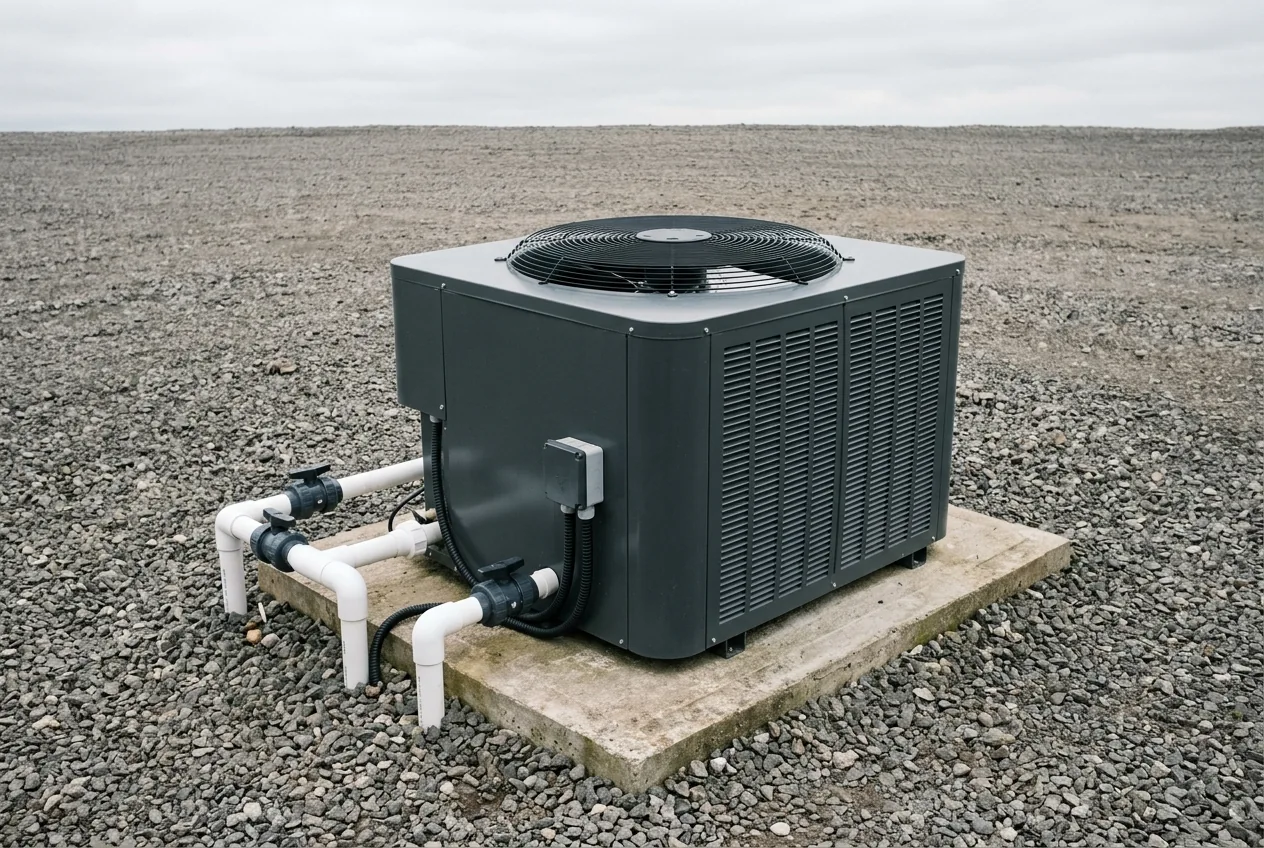
Size cooling from summer gain plus pull-down
Add the rate of stored-heat removal to the continuing net gain during the cooling window. Volume supplies the thermal mass; surface exposure and weather supply much of the uncertainty in the continuing load.
Scroll horizontally to see all columns when the table extends beyond the screen.
For these illustrative calculations, use pure liquid water at 25 C and 1 bar: density 997 kg/m3 and isobaric specific heat 4.181 kJ/(kg K), rounded from 997.047 kg/m3 and 4.18132 J/(g K) in the NIST Chemistry WebBook water-property table. J/(g K) and kJ/(kg K) have the same numerical value. With time in hours, divide by 3,600 to convert stored energy per hour to kW.
Formula: cooling duty (kW) = V x 997 x 4.181 x temperature reduction / (3,600 x hours) + net summer gain (kW).
Worked assumptions: a 50 m3 pool, a 3 C reduction, an 8-hour window and an assumed steady net summer gain of 8 kW give 50 x 997 x 4.181 x 3 / (3,600 x 8) + 8 = 29.7 kW, approximately 101,400 BTU/h from the unrounded duty using 3,412 BTU/h per kW (International Table convention): NIST SP 811, Appendix B gives 1 Btu_IT/h = 0.2930711 W, so 1,000 / 0.2930711 = 3,412.14 Btu_IT/h per kW, rounded to 3,412. This is an illustrative thermal requirement, not an OEM capacity or code minimum.
Build the summer balance with signs: absorbed sun, warmer-air exchange and equipment heat add energy; evaporation and other outward heat transfer remove it. The same term can change with water temperature, wind, humidity and time of day. Keep cover position and operating hours explicit. An assumed 8 kW net gain is not a climate allowance to reuse on another pool, and it is not a gross solar load to which evaporation should be subtracted twice.
Rules-of-Thumb: If available cooling output is less than 8 kW under the assumed target-temperature conditions with 8 kW of net summer gain, choose more delivered cooling capacity or reduce that gain, because the unit cannot even maintain the target. At exactly 8 kW there is no remaining capacity for pull-down.
If gain varies strongly during the eight hours, calculate the balance in time steps. Use the target-temperature load to check holding duty and the complete temperature trajectory to check recovery time. Review shading, cover schedule and design weather in the hot-climate equipment guide.
Check winter heat-pump duty separately
Size winter heating from recovery energy plus winter heat loss, then obtain heating performance at the winter design point. Reversing the cooling calculation does not preserve the summer capacity or electrical efficiency.
For an assumed 50 m3 pool, 3 C temperature rise over eight hours and 6 kW net winter loss, heating duty = 50 x 997 x 4.181 x 3 / (3,600 x 8) + 6 = 27.7 kW. All site inputs remain assumptions. This result is not evidence that the same model delivers both 29.7 kW cooling and 27.7 kW heating.
Scroll horizontally to see all columns when the table extends beyond the screen.
Evaporative cooling depends on the air’s capacity to accept moisture; it cannot be assessed from dry-bulb temperature alone. Keep its water consumption and weather limits in the comparison rather than treating it as a compressor unit with a different label.
The Pentair UltraTemp manual, Rev. AA dated May 4, 2023, page 1, identifies 80 F air, 80% relative humidity and 80 F water as its heating reference condition. Its instructions make output dependent on air, humidity and water conditions. That reference point is not a hot-weather cooling rating. The 2024 MAHC, Section 4.6.4.3, also requires pool-water heating installations to preserve applicable code and manufacturer requirements; confirm local adoption for public facilities.
Put a controlled bypass around the unit
Separate total circulation flow from the flow through the chiller or heat-pump branch. A bypass is a parallel path around the unit; its setting must leave the unit within its permitted operating range. If the unit also has internal flow control, its inlet flow does not by itself establish the flow through the internal heat-exchanger tubes.
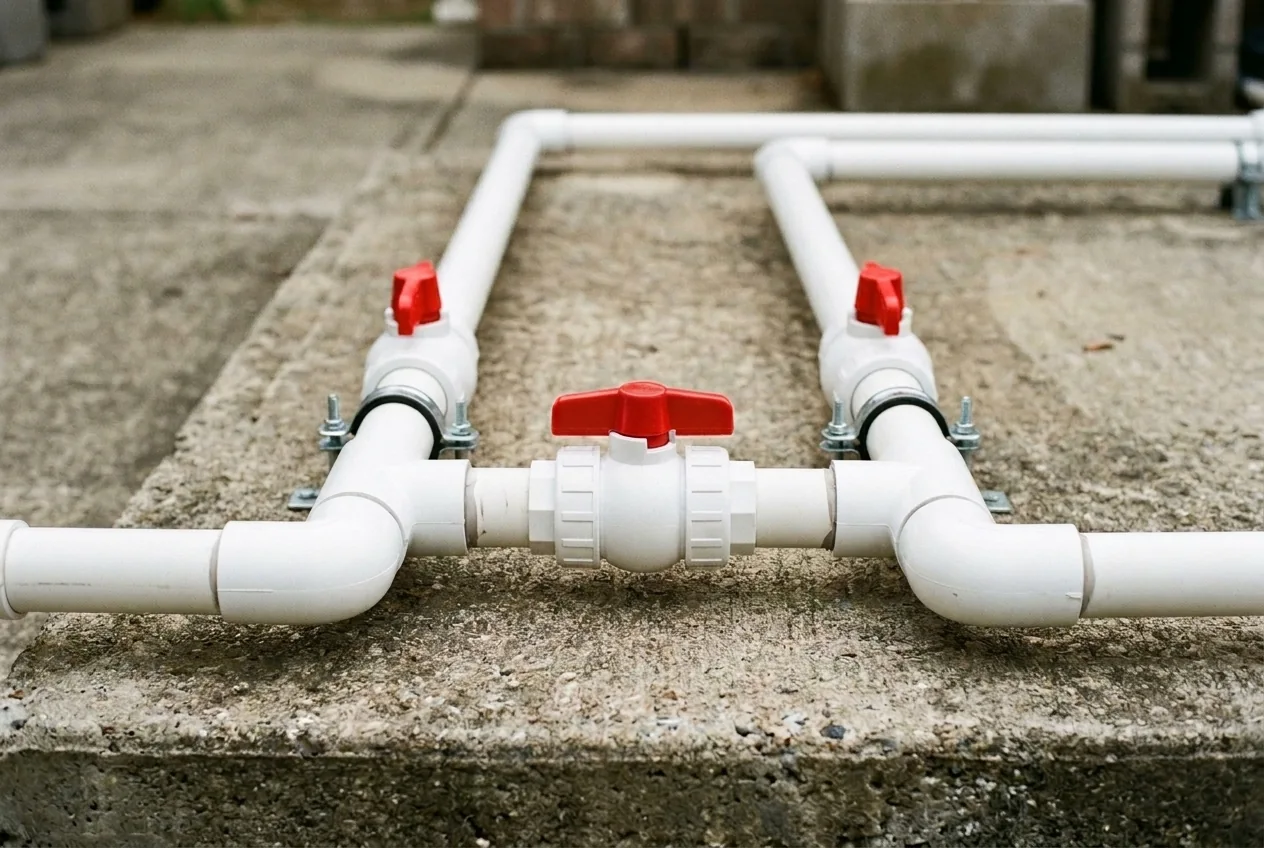
Flow balance: total circulation flow = unit branch flow + external bypass flow.
As a documented reference, the same dated installation manual specifies a 30 US gpm minimum and internal flow control through 120 US gpm. Its page 4 calls for an external bypass if total flow exceeds 120 US gpm or the circulation pump is over 2 HP. Those are that manual family’s conditions, not universal chiller limits. The horsepower condition is an installation instruction, not a substitute for hydraulic sizing.
At an assumed 140 US gpm total and a verified 80 US gpm unit branch, the parallel branch carries 140 - 80 = 60 US gpm. Valve handle angle alone cannot prove those flows. Use the exact unit’s permitted commissioning method and check the pump operating point.
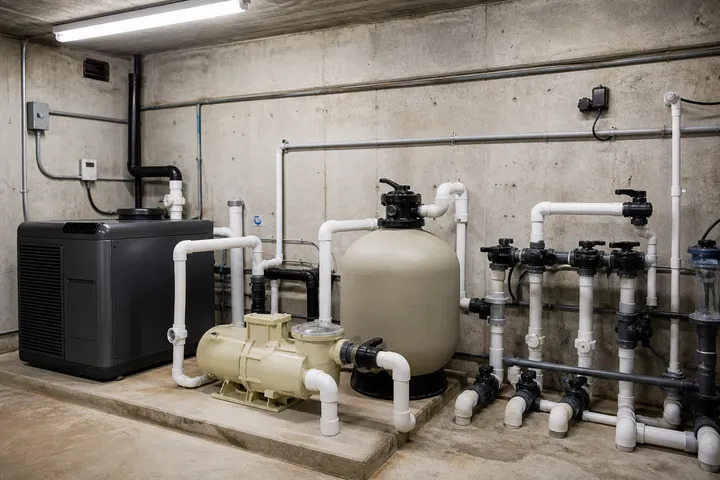
Verify each programmed speed with a clean filter and the intended loaded-filter condition. An open bypass can starve the thermal branch while total pool flow still appears adequate. Coordinate isolation valves, unions, flow protection and downstream chemical equipment with the model drawing. Follow the specified shutdown and isolation procedure before servicing; cooling or heating must not operate without its required water flow. Retain the filter pressure baseline with the settings.
Protect airflow and compare operating cost
Preserve the specified air path, then estimate electricity from model input power and operating hours. The thermal load in kW is not the electrical input in kW.
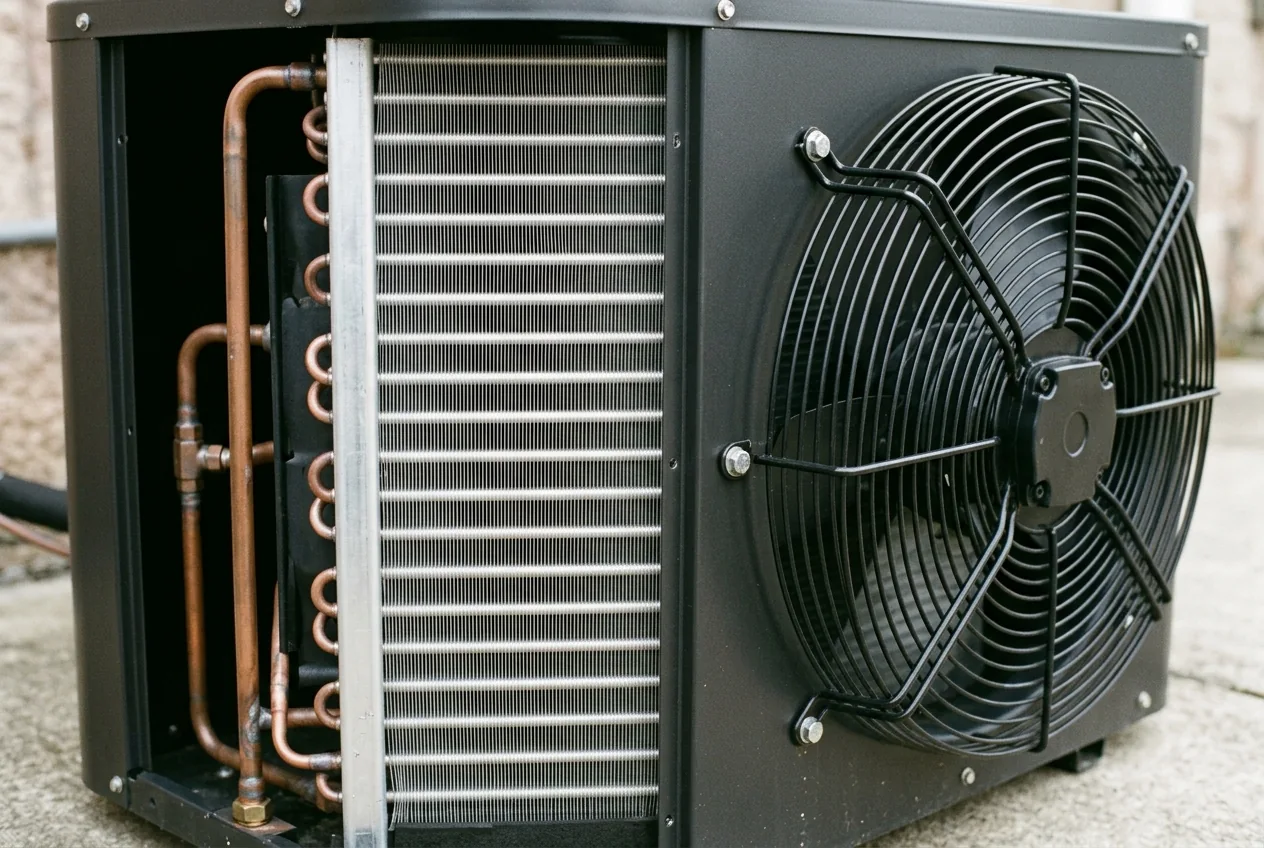
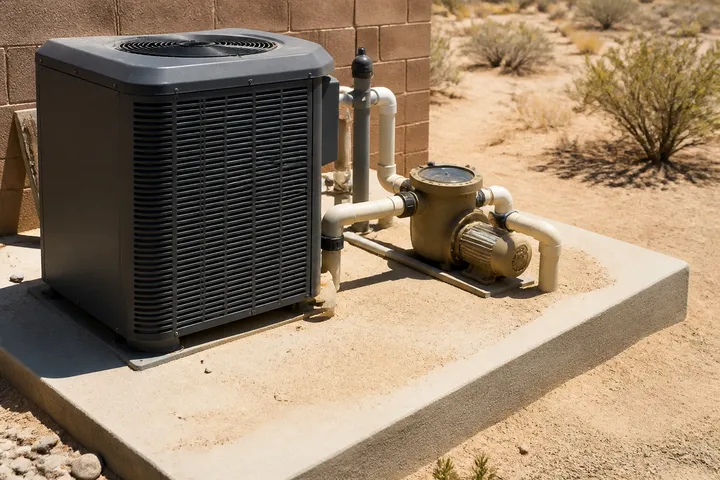
A restricted intake or recirculated discharge changes the air presented to the unit. The dated installation manual specifies outdoor use and model clearances; draw these into the equipment-room and pad plan instead of enclosing an outdoor unit to hide it.
For total cost of ownership, count unit input kW x runtime, additional circulation energy, cleaning access and downtime. Heating COP relates heating output to electrical input at stated conditions; do not use it as an assumed cooling efficiency. Cooling electrical demand needs cooling performance data. A longer window reduces the storage component of capacity but can add pump hours, so compare the combined operating schedule.
Method and sources
This guide combines a conservation-of-energy calculation with the 2024 MAHC, printed page 63, and the public installation manual linked above, pages i and 1-4 plus control and troubleshooting instructions. EPA WaterSense, November 2023, supplies the climate-dependent evaporation context. Documents were accessed October 19, 2026. The manual’s revision date is May 4, 2023. Numerical project loads, flow splits and recovery times are labeled assumptions. Exact model configuration, climate, water temperature, media loading and piping remain variables; selection requires performance at those conditions. No unread standard limits or universal cooling capacities are asserted.
Frequently asked questions
Can I trade a longer cooling window for a smaller unit?
Yes, for the stored-heat removal portion of the load. More hours reduce that portion of required power, but the unit must still overcome net heat gain at the target temperature during the operating window.
Is the thermal kW in the worked example the electrical demand?
No, it is heat-removal power. Electrical demand must come from the selected model's cooling performance at the relevant conditions, together with circulation and any other auxiliary loads.
Sources
- WaterSense at Work, Section 5.3: Commercial Pool and Spa Equipment, November 2023 — U.S. Environmental Protection Agency Accessed October 19, 2026.
- 2024 Model Aquatic Health Code, fifth edition, Section 4.6.4 — U.S. Centers for Disease Control and Prevention Accessed October 19, 2026.
- Pentair UltraTemp Heat Pump Installation and User's Guide, Rev. AA, May 4, 2023 — Pentair Accessed October 19, 2026.
- NIST Chemistry WebBook, SRD 69: liquid water at 25 C and 1 bar — National Institute of Standards and Technology Accessed October 19, 2026.
- NIST Special Publication 811, 2008 edition, Appendix B: heat flow rate — National Institute of Standards and Technology Accessed October 19, 2026.