Key takeaways
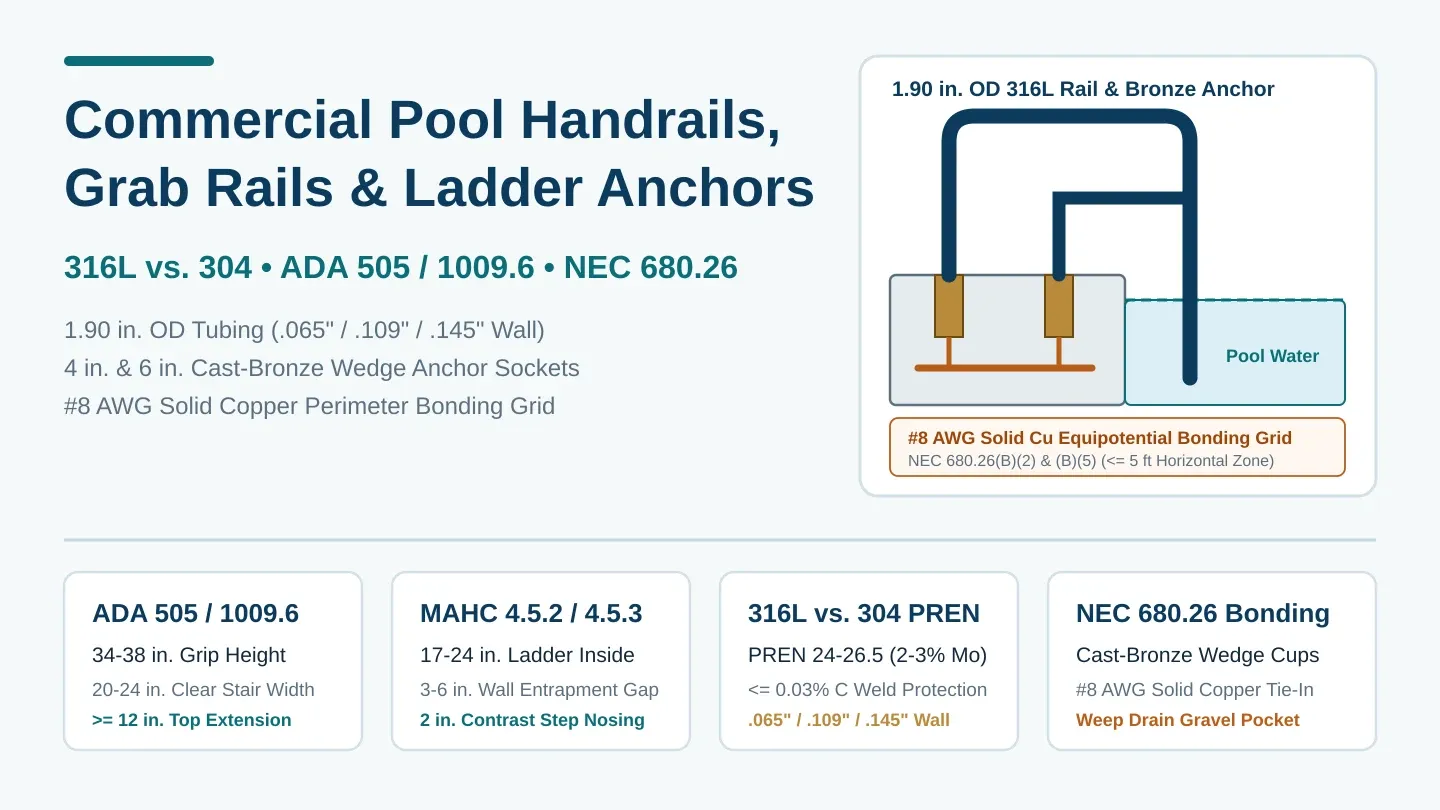
- Accessible pool stairs under 2010 ADA Sections 242.2, 505, and 1009.6 require dual handrails with 20 to 24 in. (510-610 mm) clear width, 34 to 38 in. (865-965 mm) grip height, and at least a 12 in. (305 mm) top deck extension.
- Under ADA Section 505.10 Exception 3, bottom handrail extensions are omitted on submerged pool stairs so protruding tubing does not create an underwater swimmer collision hazard.
- CDC MAHC Sections 4.5.2 and 4.5.3 require 17 to 24 in. clear inside spacing between vertical ladder grab rails, 3 to 6 in. clearance between ladder treads and the pool wall, and 2 in. dark contrast stripes on stair nosings.
- AISI 316L (UNS S31603) adds 2.0 to 3.0% molybdenum and caps carbon at <= 0.03%, raising PREN from 18.0-19.5 (in Grade 304) to 24.0-26.5 and preventing carbide precipitation (weld decay) at cross-brace and step welds.
- On sunbelt decks, salt pools (3,000-5,000 ppm NaCl), and coastal sites, thermo-polymer or powder-coated 316L rails isolate the bronze-to-stainless crevice and drop bare metal grip temperatures by 15 to 25 F.
- NFPA 70 (NEC) Sections 680.26(B)(2) and 680.26(B)(5) require every metallic handrail and ladder anchor socket within 5 ft horizontally of the inside pool wall to connect to the bonding grid via a #8 AWG solid copper conductor.
Treating a stainless steel pool handrail, a pair of swimming pool grab rails, or a set of inground pool ladder anchors as generic deck trim causes failed pre-opening inspections, premature crevice corrosion, and expensive concrete deck saw-cutting. When a bidder substitutes 0.049-inch residential 304 tubing or sets bare stainless rails into unbonded plastic sockets, the hardware fails structural, metallurgical, or electrical code checks within the first operating season.
Specify commercial pool deck hardware across four linked engineering boundaries: 2010 ADA and public health entry geometry, AISI 316L versus 304 chloride metallurgy, tubing wall gauge, and NEC Article 680.26 equipotential bonding. Coordinate these deck-embedded details alongside your commercial and hospitality pool planning guides, lock the exact tubing wall and alloy heat numbers into your pool equipment procurement specifications, and verify socket locations against the construction drawings and BOM checklist before deck rebar inspection.
Scroll horizontally to see all columns when the table extends beyond the screen.
Match rail geometry to 2010 ADA Standards and state aquatic codes
Commercial pool entry hardware splits into two regulatory tracks that must never be merged on construction drawings: federal accessibility rules for accessible pool stairs under the 2010 ADA Standards for Accessible Design and state or municipal public health rules for vertical ladders, recessed steps, and stair treads modeled on the CDC Model Aquatic Health Code (MAHC Sections 4.5.2 and 4.5.3). Establishing which entries serve as mandatory accessible means of entry belongs in the initial hotel and resort pool planning brief.
Under the U.S. Access Board ADA Chapter 10 swimming pool guide (Sections 242.2 and 1009.6), commercial and public swimming pools with more than 300 linear feet of pool wall must provide at least two accessible means of entry. While the primary entry must be a pool lift (Section 1009.2) or sloped entry (Section 1009.3), accessible pool stairs (Section 1009.6) are one of the most common secondary accessible entries specified in hospitality, lap, and community aquatic facilities.
To qualify as an ADA-compliant pool stair under Section 1009.6.3 and the U.S. Access Board Chapter 5 handrail requirements (Section 505), the handrail assembly must satisfy six dimensional constraints simultaneously:
- Dual handrails required (
ADA 1009.6.3): Handrails must be installed on both sides of the accessible stair. A single center handrail down the middle of wide architectural steps does not satisfySection 1009.6.3unless a dedicated pair of parallel rails provides the required narrow clear channel. - Clear width between handrails (
ADA 1009.6.3): The clear inside distance between the two handrails must be 20 to 24 inches (510 to 610 mm). Unlike wide dry building egress stairs, pool stair handrails are spaced narrowly so a bather with limited lower-body strength can grip both rails at once and support body weight while transitioning across the buoyant water plane. - Gripping surface height (
ADA 505.4): The top of the handrail gripping surface must remain 34 to 38 inches (865 to 965 mm) vertically above stair nosings along the entire stair slope. - Circular cross-section diameter (
ADA 505.7.1): Circular handrails must have an outside diameter (OD) between 1.25 and 2.0 inches (32 to 51 mm). Standard commercial pool handrail tubing manufactured at 1.90 inches (48.3 mm) OD (nominal 1.5-inch tubing size) sits inside this federal grip envelope while providing the moment of inertia needed to prevent lateral flex across multi-step spans. - Knuckle clearance (
ADA 505.5): Maintain a minimum clear space of 1.5 inches (38 mm) between the gripping surface and any adjacent wall, coping bullnose, or vertical riser obstruction. - Top deck extension vs. underwater bottom exemption (
ADA 505.10.2&505.10 Exception 3): At the top landing of the pool stairs, handrails must extend at least 12 inches (305 mm) horizontally above the deck beyond the top riser nosing and return smoothly to a deck post, wall, or floor (ADA 505.9). At the submerged bottom of the stairs,ADA Section 505.10 Exception 3explicitly exempts pool stairs from the sloped-plus-horizontal bottom extension because protruding underwater rail ends create a collision and foot-entrapment hazard for swimmers. Instead, the lower post anchors directly into a flush bronze step socket or turns cleanly into the step riser.
Formula (Anchor Center-to-Center Spacing from Clear Width):
Center-to-Center Socket Spacing = Clear Inside Width + Tubing OD
Worked example: To achieve the midpoint 22.0-inch (559 mm) clear inside width required by ADA 1009.6.3 using standard 1.90-inch (48.3 mm) OD commercial handrail tubing, set the paired cast-bronze anchor sockets at 22.0 + 1.90 = 23.90 inches (607 mm) center-to-center. Setting anchors at 24.0 inches center-to-center yields 24.0 - 1.90 = 22.10 inches of clear inside width, which stays well inside the 20 to 24-inch federal tolerance even with +/- 0.125-inch concrete placement variance.
Rules-of-Thumb: If an architectural pool stair is wider than 48 inches, do not push a single pair of handrails to the outer walls; install a dedicated 20 to 24-inch clear-width ADA dual-rail channel on one side of the stair and add perimeter guard or support rails separately.
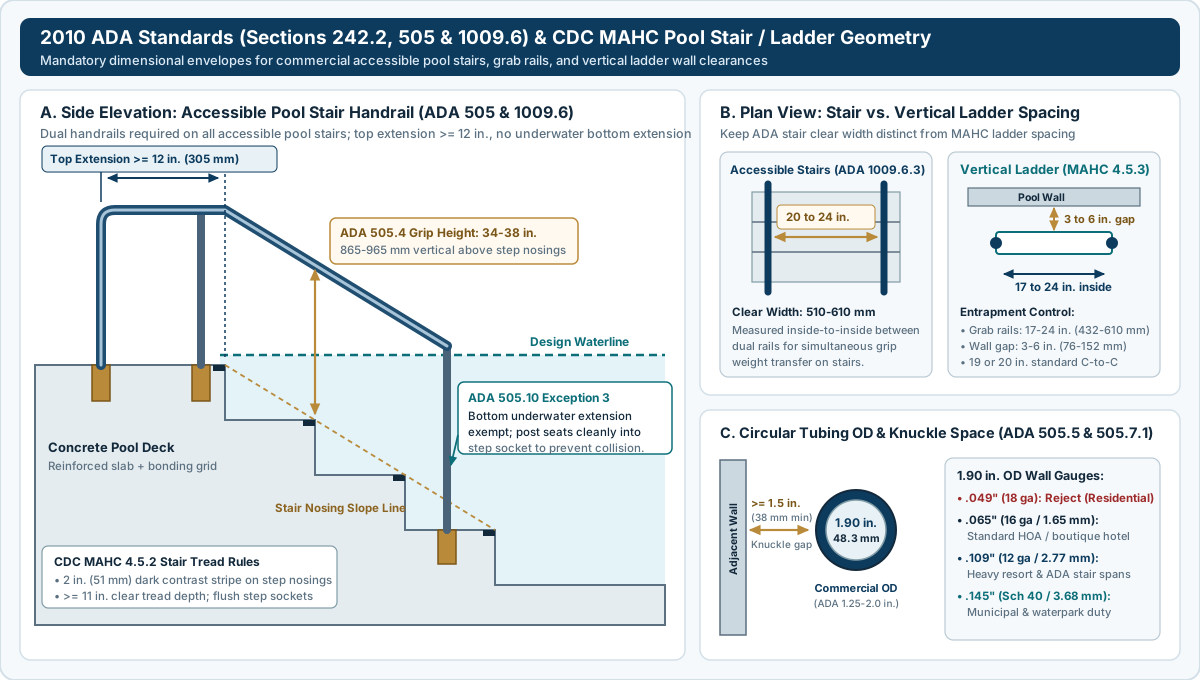
In parallel with ADA stair geometry, vertical commercial pool ladders and swimming pool grab rails (such as deck-mounted figure-4 rails paired with recessed wall steps) must comply with public health entrapment and visibility standards modeled on CDC MAHC Sections 4.5.2 and 4.5.3:
- Stair tread contrast stripes (
MAHC 4.5.2): Every pool stair tread requires a slip-resistant surface and a high-contrast dark border stripe (typically 2 inches /51 mmwide) along the leading nosing edge so bathers looking through refracted water can identify step drop-offs. Flush underwater step anchor sockets must not encroach on the minimum 11-inch clear tread depth. - Grab rail inside spacing (
MAHC 4.5.3): Every vertical pool ladder or recessed step well must provide two grab rails with a clear inside distance between rails of 17 to 24 inches (432 to 610 mm). Commercial ladder manufacturers standardize on 19.0-inch or 20.0-inch center-to-center rail spacing (17.1 to 18.1 inchesclear inside width with1.90-inch ODtubing). - Wall entrapment clearance (
MAHC 4.5.3): The horizontal gap between the vertical ladder frame/treads and the vertical pool wall must be strictly 3 to 6 inches (76 to 152 mm), unless steps are recessed flush into the basin wall. Gaps narrower than 3 inches trap wrists or ankles; gaps wider than 6 inches allow a child’s torso or head to pass behind the ladder frame, creating a fatal submerged entrapment hazard. - Cross-braced commercial ladder frames and bumpers: Standard residential 3-step ladders flex under heavy adult bather loads, driving the lower tube ends into the pool wall. When molded elastomer/rubber bumper plugs (
1.90-inchfit) split or fall off, bare stainless steel gouges pool plaster or cracks waterline tile. Specify S.R. Smith commercial cross-braced pool ladders with stainless steel treads and heavy-duty reinforced upper bows that resist cantilever deflection without relying on thin rubber wall bumpers for structural support.
Specify 304 vs. 316L stainless steel by chloride load and wall gauge
Writing “stainless steel handrail” on an equipment schedule without a Unified Numbering System (UNS) alloy designation and decimal wall thickness guarantees that bidders will price the cheapest domestic or imported tubing available. In commercial aquatic environments, two austenitic grades dominate S.R. Smith commercial rail specifications: AISI 304 (UNS S30400) and marine-grade low-carbon AISI 316L (UNS S31603).
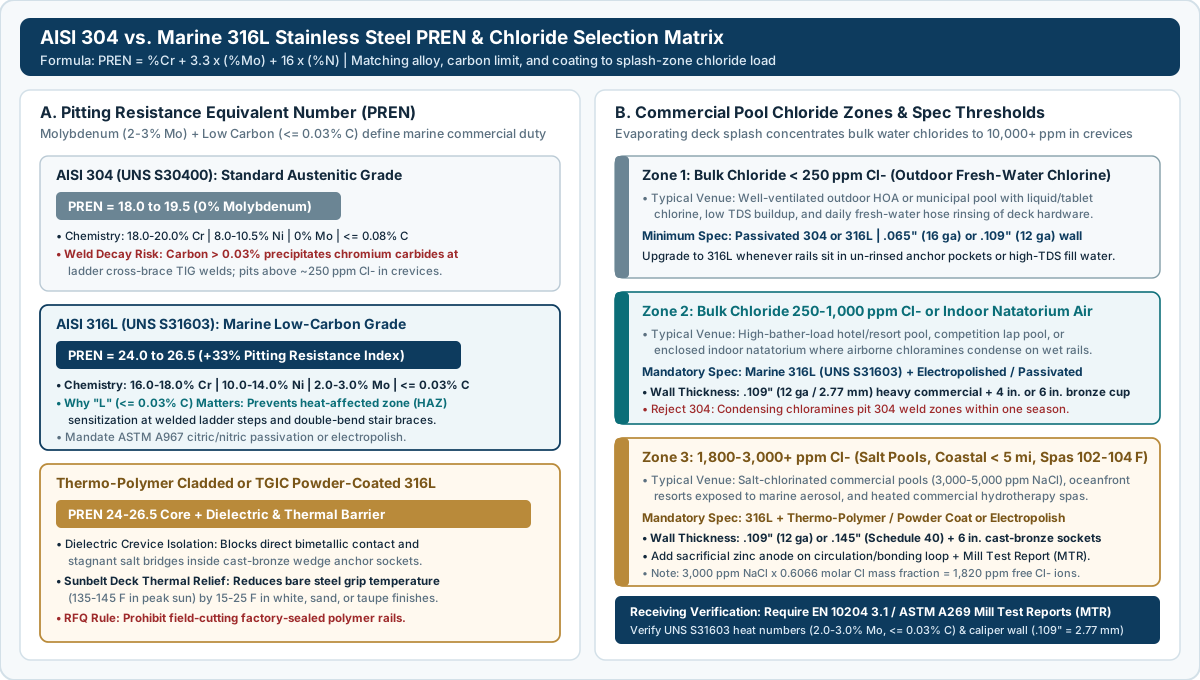
As detailed in the AZoM metallurgical comparison of Grade 316L versus Grade 304 stainless steel, localized chloride pitting resistance is quantified by the Pitting Resistance Equivalent Number (PREN):
Formula (Pitting Resistance Equivalent Number & Salt-Pool Free Chloride Load):
PREN = %Cr + 3.3 x (%Mo) + 16 x (%N)Free Chloride Ion Concentration (ppm Cl-) = NaCl Concentration (ppm) x 0.6066
Worked example:
- AISI 304 (
UNS S30400): Contains18.0 to 20.0% Cr,8.0 to 10.5% Ni,0% Mo,<= 0.08% C, and~0.05% N. At nominal18.0% Cr,0% Mo, and0.05% N,PREN = 18.0 + 3.3(0) + 16(0.05) = 18.8(typical range 18.0 to 19.5). - AISI 316L (
UNS S31603): Contains16.0 to 18.0% Cr,10.0 to 14.0% Ni,2.0 to 3.0% Mo,<= 0.03% C, and~0.05% N. At17.0% Cr,2.5% Mo, and0.05% N,PREN = 17.0 + 3.3(2.5) + 16(0.05) = 26.05(typical range 24.0 to 26.5, a 33% to 38% increase in pitting resistance index). - Salt-chlorinated pool chloride load: A commercial pool operating with an electrolytic chlorine generator at 3,500 ppm NaCl (see our salt cell sizing and runtime checklist) carries
3,500 x 0.6066 = 2,123 ppm Cl-in bulk water–more than five times the ~200 to 400 ppm continuous chloride pitting threshold of bare Grade 304 stainless steel at 82 to 104 F (28 to 40 C).
Why the “L” (Low Carbon <= 0.03%) designation is mandatory on fabricated commercial ladders and multi-bend stair rails: commercial cross-braced ladders, figure-4 grab rails, and mid-span ADA stair posts require structural TIG welds where cross-braces, step brackets, or mounting flanges join the 1.90-inch main tube. In standard-carbon grades (> 0.03% C), welding temperatures between 800 and 1,500 F (425 to 815 C) cause carbon atoms to combine with chromium along grain boundaries in the Heat-Affected Zone (HAZ). This chromium carbide precipitation depletes the surrounding grain boundaries of the >= 12% chromium needed to maintain a passive oxide layer, triggering rapid intergranular corrosion (weld decay) as soon as chlorinated water or chloramine vapor contacts the joint. Specifying 316L (<= 0.03% C) eliminates carbide precipitation during welding, and specifying post-fabrication citric or nitric acid passivation (ASTM A967 / A380) or electropolishing strips free surface iron left by bending dies and polishing wheels.
Even in fresh-water chlorine pools with < 250 ppm bulk chlorides, splash-zone evaporation creates an aggressive micro-environment. Water droplets splashed onto warm deck handrails evaporate repeatedly, concentrating dissolved salts to 10,000+ ppm Cl- along the waterline crust and inside the oxygen-starved crevice where the stainless tube slides into the cast-bronze anchor cup.
Scroll horizontally to see all columns when the table extends beyond the screen.
Rules-of-Thumb: If bulk pool water chloride exceeds 250 ppm, if the pool uses salt chlorination (3,000 to 5,000 ppm NaCl), if the facility is an indoor natatorium, or if the property sits within 5 miles of a saltwater coastline, reject AISI 304 and mandate electropolished or sealed AISI 316L (
UNS S31603) with a minimum0.109-inch(12-gauge) wall thickness.
Evaluate powder-coated and thermo-polymer sealed rails for salt and sunbelt decks
Polished bare stainless steel handrails face two operational challenges on high-insolation outdoor resort decks and high-salinity pools: bather contact burns and bimetallic crevice corrosion inside cast-bronze anchor cups. When specifying outdoor deck equipment in Arizona, Texas, Florida, Southern California, or Middle East resorts, pair your rail finish selection with the thermal and UV durability measures in our pool equipment guide for hot climates.
- Solar thermal comfort (
15 to 25 Fsurface temperature reduction): Bare polished stainless steel has high solar absorptance combined with low thermal emissivity. Under peak afternoon sun (1,000 W/m2solar irradiance at100 to 115 Fambient air), bare stainless handrail tops above the waterline routinely reach 135 to 145 F (57 to 63 C)–above the human pain and first-degree epidermal burn threshold (~131 F / 55 Cfor 5-second bare-palm contact). Extruded UV-stabilized thermo-polymer cladding (25 to 35 milsthick, such as S.R. Smith SealedSteel vinyl-coated rails) or marine-grade TGIC polyester powder coating (3 to 5 milsover zirconium/chromate pre-treated 316L tubing) in white, sand, or light taupe lowers peak surface grip temperatures by 15 to 25 F (8 to 14 C) and provides a non-slip wet texture. - Dielectric and crevice isolation in bronze sockets: When a bare stainless steel tube sits inside a cast-bronze wedge anchor socket filled with conductive salt water, the tight radial gap acts as an oxygen-depleted crevice cell, while the dissimilar metals (
cast bronzevs.passive/active stainless steel) establish a galvanic couple. A factory-extruded thermo-polymer sleeve extending to the bottom of the rail legs electrically and chemically isolates the stainless substrate from stagnant chlorides and bronze contact. - Inspection trade-off and field-cutting prohibition: Thin architectural powder coatings (
3 to 5 mils) can chip or score where the internal bronze anchor wedge bites against the lower leg or if an installer trims a rail leg with an abrasive saw on site. Once chlorinated water wicks beneath a breached coating (under-film filiform and crevice corrosion), anaerobic attack progresses faster than on bare air-exposed 316L because oxygen cannot repassivate the steel beneath the blistered film.- Procurement rule: Specify 316L stainless steel (
UNS S31603) as the base substrate even beneath powder or polymer coatings (never accept coated 304 or carbon steel as an “equivalent”), and write an explicit prohibition in the RFQ against field-cutting factory-sealed rail ends.
- Procurement rule: Specify 316L stainless steel (
Detail cast-bronze wedge anchor sockets and NEC 680.26 equipotential bonding
A commercial handrail or vertical ladder is only as rigid and electrically safe as the socket cast into the concrete deck. Commercial inground pool ladder anchors and stair rail sockets use cast-bronze wedge anchor cups sized for 1.90-inch OD tubing in two standard depths:
- 4-inch (
102 mm) standard commercial cast-bronze socket: Used for standard deck-mounted figure-4 grab rails, short-span stair rails, and standard commercial ladders in.065-inchor.109-inchwall tubing. - 6-inch (
152 mm) heavy-duty institutional cast-bronze socket: Provides 50% greater vertical embedment and bending-moment lever arm inside the concrete slab for cantilevered ADA transfer rails, heavy.109-inchand.145-inchSchedule 40 stair rails, and high-traffic waterpark or municipal pool ladders.
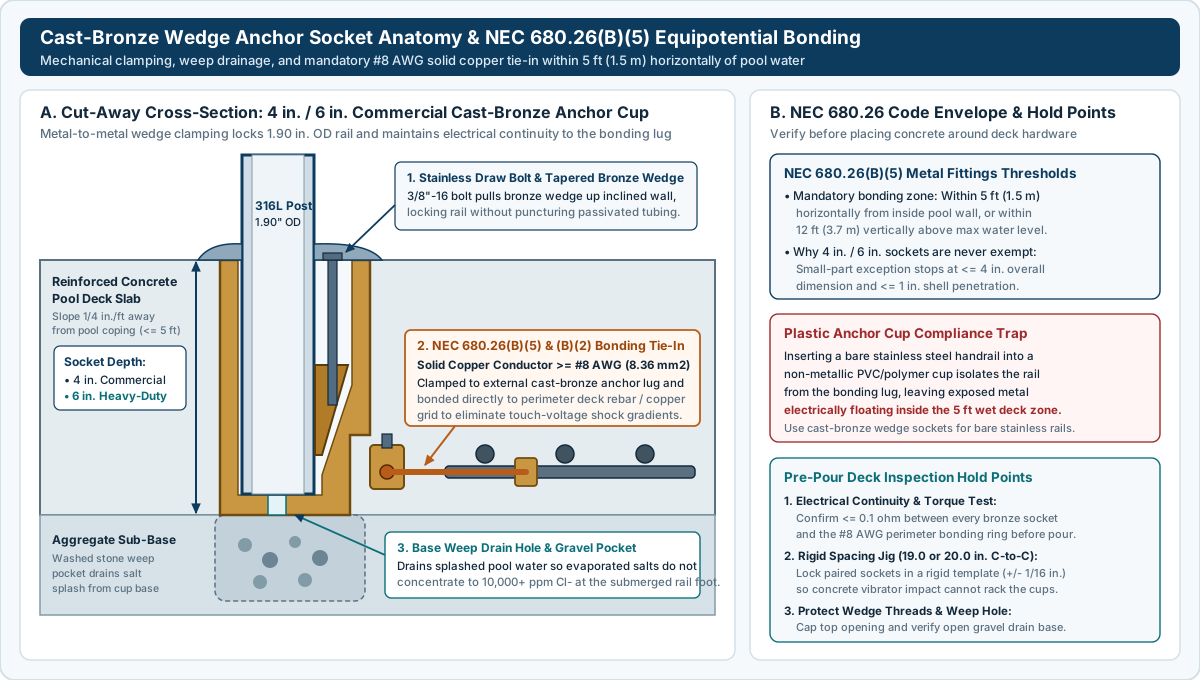
Inside the cast-bronze housing, a vertical 3/8"-16 or 5/16"-18 stainless steel draw bolt threads into an inclined cast-bronze wedge. Turning the draw bolt pulls the tapered wedge upward along the angled pocket of the cup, wedging radially against the stainless rail wall. Unlike residential set-screw cups that drive a sharp bolt tip into one point on the tube (dimpling thin walls and stripping protective passivation), a full-contact bronze wedge distributes clamping pressure across the tubing circumference and establishes a low-resistance metal-to-metal contact path between the removable rail and the anchor body.
Mandatory NEC Article 680.26 equipotential bonding
A swimmer stepping out of a pool grips the wet stainless steel handrail with one hand while placing bare wet feet onto the concrete perimeter deck. If the handrail and the concrete deck sit at different electrical potentials due to stray utility neutral currents or ground-fault leakage, current flows directly through the bather’s chest.
To eliminate voltage gradients across the deck, NFPA 70 (National Electrical Code) Article 680 enforces strict equipotential bonding rules detailed in NEC Sections 680.26(B)(2) and 680.26(B)(5):
- NEC 680.26(B)(5) Metal Fittings: All metallic parts of the pool structure and all metal fittings within or attached to the pool structure–explicitly including metallic handrail and ladder anchor sockets–must be bonded to the common equipotential bonding grid.
- Why handrail and ladder anchors are never exempt:
NEC 680.26(B)(5)grants only two narrow exceptions:- Isolated small metallic parts not over 4 inches (
100 mm) in any dimension that do not penetrate the pool structure more than 1 inch (25 mm). (A 4-inch or 6-inch deep anchor socket holding a 36-inch to 60-inch handrail exceeds both limits.) - Metallic components located more than 5 feet (
1.5 m) horizontally from the inside wall of the pool, or more than 12 feet (3.7 m) vertically above the maximum water level. Because every pool ladder, grab rail, and stair handrail sits right at the water edge (0 to 3 feetfrom the inside wall), 100% of commercial pool rail and ladder anchors fall inside the mandatory 5-foot bonding zone.
- Isolated small metallic parts not over 4 inches (
- NEC 680.26(B)(2) Perimeter Surfaces &
#8 AWGSolid Copper Conductor: Every cast-bronze anchor socket must connect via its integrated external bonding lug to the pool’s equipotential bonding grid (the680.26(B)(1)conductive shell reinforcement and the680.26(B)(2)perimeter deck rebar mat or buried copper ring) using a solid copper conductor not smaller than#8 AWG(8.36 mm2). Stranded wire is not permitted for the buried/embedded equipotential bonding grid because fine strands corrode faster in alkaline concrete and damp soil.
Rules-of-Thumb: Never pair non-metallic (PVC or molded polymer) anchor sockets with bare stainless steel handrails or ladders inside the 5-foot perimeter zone; a plastic cup isolates the metal rail from the embedded bonding wire, leaving the exposed stainless handrail electrically unbonded in violation of NEC 680.26(B)(5).
Pre-pour concrete deck inspection hold points
Once concrete is placed and finished around an anchor socket, fixing a tilted cup, a misaligned center-to-center distance, or a missed bonding clamp requires core-drilling and patching the new deck. Require sign-off on four field checks before concrete placement, coordinated with your drawings and BOM checklist:
- Rigid spacing jig and two-axis plumb check: Bolt paired ladder or figure-4 anchor sockets to a rigid steel or aluminum setting jig (
19.0 in.,20.0 in., or8.0 in.on center+/- 1/16 in.) before tying them to the support stakes. If sockets toe-in or rack by even1/4 inchduring concrete vibration, the factory-bent stainless ladder legs will bind during insertion or permanently scar the passivated surface. - Weep drain hole and gravel pocket verification: Confirm that the
1/4-inchweep hole at the bottom of each cast-bronze cup opens into a 6-inch washed crushed-stone drainage pocket (or PVC drain stub) below the slab vapor barrier, and seal the perimeter joint so wet concrete slurry cannot plug the drain port from underneath. - Electrical bonding continuity test (
<= 0.1 ohm): Verify that the#8 AWGsolid bare copper conductor is mechanically clamped inside every bronze anchor socket lug with its stainless set screw torqued, and measure electrical continuity (<= 0.1 ohmwith a low-resistance ohmmeter) between every anchor cup and the perimeter bonding grid before the electrical inspector signs off on the pre-pour deck inspection. - Top thread and wedge pocket masking: Install the factory plastic pour cap or tape over the top opening and draw-bolt threads of every bronze socket so concrete mortar cannot foul the internal
3/8"-16wedge threads. Maintain a 1/4-inch per foot (2%) deck slope away from the coping so puddle water drains off the escutcheon plates.
Lock down submittals, spare parts, and handover checks in your RFQ
Unchecked “or equal” substitutions during bidding routinely replace .109-inch wall 316L commercial rails and 6-inch cast-bronze anchors with .049-inch or .065-inch 304 residential tubing and 4-inch plastic or light die-cast cups. Freeze one specification baseline in your pool equipment RFQ package, audit every line item when you compare pool equipment quotes, and verify delivered crates against the pool equipment package acceptance checklist.
Attach the following specification and receiving verification schedule directly to your commercial pool bid documents and the pool equipment RFQ template:
Scroll horizontally to see all columns when the table extends beyond the screen.
Include routine deck hardware maintenance in the operator handover manual: rinse bare stainless rails daily with fresh low-chloride domestic water to dissolve evaporated salt crusts, inspect rubber ladder wall bumpers every month so bare tubing never contacts tile or plaster, and prohibit acid-washing concrete decks (muriatic/hydrochloric acid fumes cause immediate chloride stress-corrosion cracking and severe pitting on all stainless grades) unless all removable handrails and ladders are pulled from their sockets and stored outside the vapour zone.
Frequently asked questions
What is the required clear width between handrails on an ADA commercial pool stair?
Under 2010 ADA Standards Section 1009.6.3, accessible pool stairs must have handrails on both sides with a clear inside width between handrails of 20 to 24 inches (510 to 610 mm). This tight spacing allows a bather to brace simultaneously on both rails while transitioning into or out of the water.
Why are bottom handrail extensions omitted on submerged commercial pool stairs?
ADA Section 505.10.2 requires a 12-inch (305 mm) horizontal handrail extension at the top landing above the deck, but Section 505.10 Exception 3 exempts pool stairs from the bottom extension because horizontal tubing protruding past the lowest step underwater creates a collision and entrapment hazard for swimmers.
When should a commercial pool specification require 316L stainless steel instead of 304?
Specify AISI 316L (UNS S31603) whenever bulk pool water chloride exceeds 250 ppm, in all salt-chlorinated pools (3,000 to 5,000 ppm NaCl), in heated commercial spas (102 to 104 F), within 5 miles of coastal saltwater, and in indoor natatoriums where airborne chloramines condense on deck rails. The 2 to 3% molybdenum content and <= 0.03% carbon limit prevent pitting inside anchor sockets and weld decay at cross-braces.
What tubing outside diameter and wall thickness should be specified for commercial pool rails?
Commercial pool handrails, figure-4 grab rails, and vertical ladders standardize on 1.90-inch (48.3 mm) outside diameter (OD) circular tubing, which satisfies the ADA Section 505.7.1 envelope of 1.25 to 2.0 inches OD. Specify 0.065-inch (16-gauge) wall for standard HOA and hotel pools, 0.109-inch (12-gauge) wall for high-traffic resorts and multi-bend ADA stair spans, and 0.145-inch (Schedule 40) wall for municipal aquatic centers and waterparks. Reject 0.049-inch (18-gauge) residential tubing.
Do inground pool ladder anchors require electrical bonding under NEC Article 680?
Yes. Under NFPA 70 (NEC) Sections 680.26(B)(5) and 680.26(B)(2), all metallic handrail and ladder anchor sockets installed within 5 feet (1.5 m) horizontally of the inside pool wall or within 12 feet (3.7 m) vertically above maximum water level must be bonded to the equipotential bonding grid using a solid copper conductor not smaller than #8 AWG (8.36 mm2) clamped to the external lug on the cast-bronze anchor cup.
Why do cast-bronze wedge anchor sockets have a hole at the bottom of the cup?
The base opening is a weep drain port designed to release chlorinated or salt-laden splash water into a crushed-stone gravel pocket beneath the concrete deck slab. If the weep hole is plugged with mortar during concrete placement, trapped water evaporates and concentrates chlorides above 10,000 ppm around the concealed rail foot, causing severe crevice corrosion.
Sources
- U.S. Access Board ADA Guide: Chapter 10 Swimming Pools, Wading Pools, and Spas (Sections 242 & 1009.6) — U.S. Access Board Accessed October 25, 2026.
- U.S. Access Board ADA Guide: Chapter 5 Stairways and Handrails (Section 505 Handrails) — U.S. Access Board Accessed October 25, 2026.
- 2010 ADA Standards for Accessible Design (Sections 242, 505, and 1009.6) & CDC MAHC Sections 4.5.2 / 4.5.3 — U.S. Department of Justice Accessed October 25, 2026.
- NFPA 70: National Electrical Code (NEC) Article 680 - Swimming Pools, Fountains, and Similar Installations — National Fire Protection Association (NFPA) Accessed October 25, 2026.
- NFPA 70 (NEC) Section 680.26(B)(2) Perimeter Surfaces & 680.26(B)(5) Metal Fittings Equipotential Bonding — NFPA / UpCodes Adopted Electrical Code Reference Accessed October 25, 2026.
- S.R. Smith Commercial & Residential Pool Handrails, Grab Rails, and SealedSteel Vinyl/Powder-Coated Specifications — S.R. Smith Accessed October 25, 2026.
- S.R. Smith Commercial Pool Ladders, Heavy-Duty Cross-Braced Frames, and Bronze Wedge Anchor Sockets — S.R. Smith Accessed October 25, 2026.
- Stainless Steel Grade 316L (UNS S31603) vs. Grade 304 (UNS S30400) Metallurgy and Pitting Resistance — AZoM Materials Science Reference Accessed October 25, 2026.