Mesh vs Solid Pool Cover: ASTM F1346 Safety Cover Criteria and Weave Architecture
ASTM F1346 establishes requirements for safety covers for swimming pools, spas, hot tubs, and wading pools; when correctly installed and used in accordance with the manufacturer’s instructions, it is intended to reduce the risk of drowning by inhibiting the access of children under five years of age to the water.
ASTM F1346 includes performance tests to demonstrate the compliance or noncompliance to requirements herein stated for safety covers, and it also includes marking requirements for all covers.
A Meyco safety cover meets ASTM F 1346-91 for Manual Safety Covers (MSC) when used in accordance with printed instructions.
LOOP-LOC safety pool covers are manufactured to conform to ASTM standards which state that a safety cover must hold two adults’ and one child’s weights in the event of an emergency.
Underwriters Laboratories (known as U.L.) is an outside testing company that tested LOOP-LOC safety swimming pool covers against the ASTM standard F1346-91 for manual safety covers, earning LOOP-LOC the U.L. seal of approval.
LOOP-LOC covers have undergone extensive testing through Underwriters Laboratories (UL) and have earned the seal of approval for safety pool covers, and their brass anchors recess flush with the deck when the cover is removed.
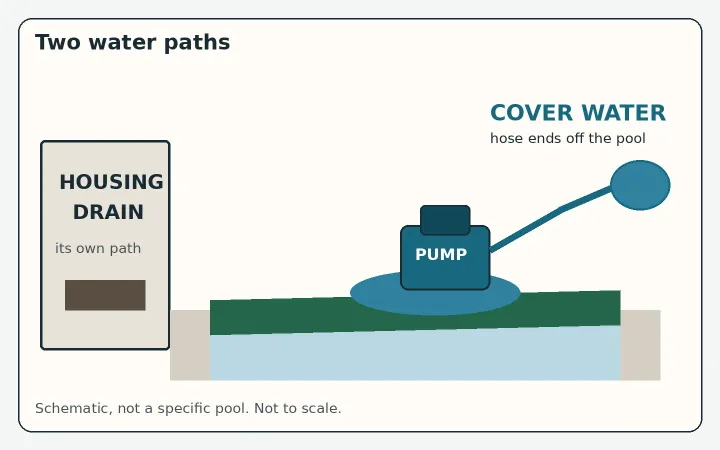
In order to meet safety cover performance standards, solid covers must provide for the elimination of standing water; LOOP-LOC’s patented ULTRA-LOC solid safety cover is available in two versions, one with invisible mesh panels that allows water to drain through and an all-solid version that is always sold with an automatic cover pump that must be used at all times.
The Merlin solid safety cover must have a properly working automatic pump or a properly working window mesh drain panel on the cover at all times to meet ASTM standards.
Merlin solid safety covers can come with a Window Mesh Drain Panel, a removable square piece of 250-micromesh material attached to a square piece of standard mesh material and applied to the top of the cover with Velcro, to remove water from the top of the cover in lieu of an automatic cover pump.
LOOP-LOC Super Dense Mesh Covers block virtually all sunlight and let rain and melting snow easily drain through, and their polyester thread is 30% stronger in thread size producing a higher margin of safety in all seams.
LOOP-LOC ULTRA-LOC III blocks 100% of sunlight and drains fast with optional mesh drainage panels, and unlike traditional solid water bag covers, there is no scrubbing or maintenance required.
LOOP-LOC ULTRA-LOC III blocks 100% of sunlight and is manufactured with premium coated vinyl material with enhanced 100% polyester rip-stop scrim for extra safety.
LOOP-LOC Aqua-Xtreme Virtually Solid Mesh light-blocking fabric deters algae growth and drains up to 80 gallons per minute without clogging.
LOOP-LOC Aqua-Xtreme weave mesh is 50% lighter than solid safety covers for easy handling.
Scroll horizontally to see all columns when the table extends beyond the screen.
Sunlight Blockage, Silt Filtration, and Spring Opening Maintenance
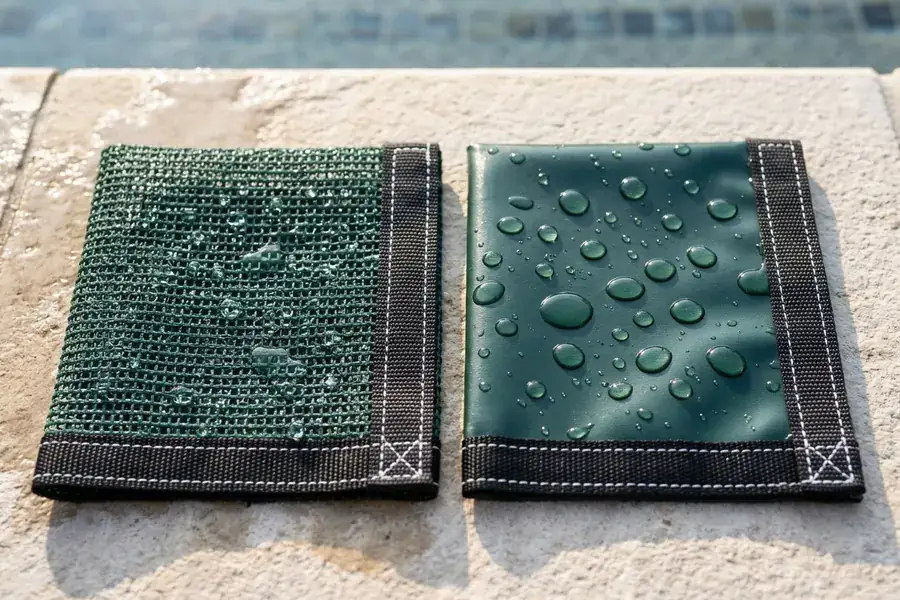
On a Merlin taut solid safety cover, the cover is held together and given its strength by the webbing which is sewn in place, and water may pass through the needle holes formed by this process; this is not a defect in the cover, and over time these needle holes will become clogged by the expansion of the thread when it becomes wet and by small debris particles that become lodged in the holes.
When cleaning a Merlin SmartMesh cover by spraying through the backside/underside with a garden hose or low power pressure washer, high pressure power washing may damage the cover; do not use high pressure power washers or high pressure power washer tips.
When leaves and debris are left on a Merlin SmartMesh cover, they can begin to decay and can steep when water drains through the cover, affecting the pool water similar to how a tea bag affects water when brewing tea.
On a Merlin mesh cover, to help assure you open your pool to clear water, it may be necessary to add chlorine and/or algaecide (40% to 60% quat algaecide) 2-3 times in the spring prior to opening your pool.
All LOOP-LOC mesh and solid safety pool covers come with a 15-year pro-rated manufacturer’s warranty; within the first 25 months of service LOOP-LOC will furnish a replacement cover or repair any part or parts at no charge, and after the 25 month period has elapsed the customer will pay 1/156 for each month of the current list price.
LOOP-LOC uses double perimeter webbing and double-thick straps, 302 grade stainless steel springs, and polyester bonded thread that is up to 30% stronger than that used by competitors, with contrasting white thread to hand inspect every stitch on every cover.
For holes 3” or smaller in a LOOP-LOC cover, LOOP-LOC sells Self-Adhesive Patch Kits with a 4” x 8” patch size that come 3 to a pack, while holes larger than 3” need to be sent in to be repaired in order to maintain the safety features of the cover.
Under Anchor Industries’ Limited Warranty, for Mesh pool covers the warranty period is 144 months beginning on the date of purchase, for Solid and Five-Star covers the warranty period is 120 months, and the Limited Warranty does not cover damage caused by water levels that drop more than 1’-3” below the coping.
Solid Winter Pool Cover Pump Dependency, Seam Seepage, and Freeze Rules
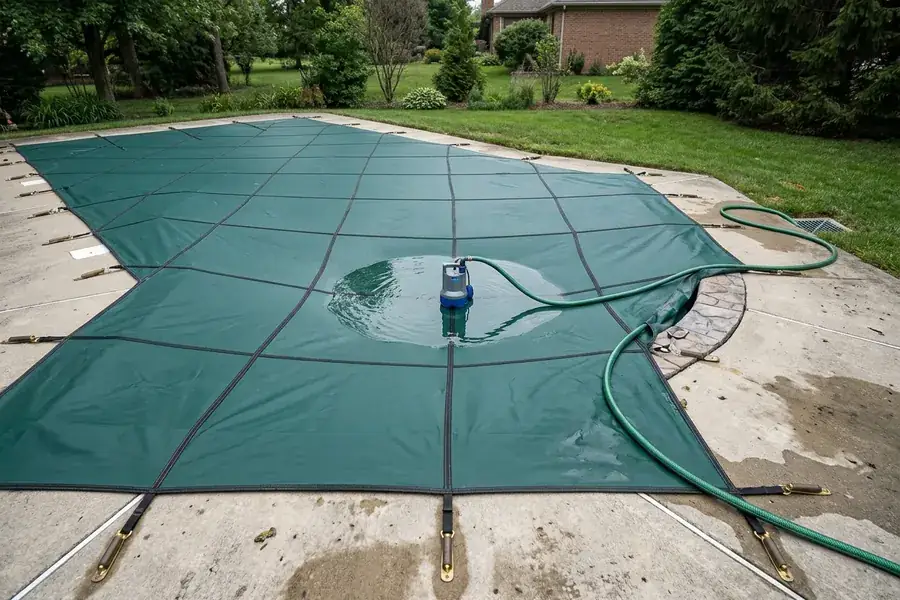
On an Anchor Solid Safety Pool Cover, place the pump onto the cover at the geographical center of the cover; the pump rating must be 1200 gph or more, and the cover will present a hazard and will not meet safety cover criteria without a pump.
The Wayne WAPC250 Auto On-Off Pool Cover Pump requires a 120 V, 60 Hz power supply and a 15 A minimum circuit, has a 1/4 HP single phase motor, and has a liquid temperature range of 40° F- 120° F.
The Wayne WAPC250 manual warns not to place the pump on a weak, damaged, or leaking pool cover because placing the pump on a damaged pool cover could cause the cover to give way or could allow the pump to remove treated swimming water from the pool in addition to rainwater.
Scroll horizontally to see all columns when the table extends beyond the screen.
Winter Water Level Support and Spring or Rubber-Tie Tension Loads
On a Merlin safety cover, the swimming pool water level must be maintained between 6 inches & 18 inches from the cover or the cover warranty will be voided, and serious structural damage to the cover and/or the hardware may result.
Upon installation of a Merlin safety cover, the cover should be taut across the pool, and the springs on a mesh safety cover should be compressed approximately 50% and between 60% to 75% for solid safety covers, and should not be removed without the aid of the installation tool.
To tighten loose straps on a Merlin safety cover, remove the spring from the anchor with the installation tool, adjust the length of the strap by 2 inch increments using the strap and buckle, and reinstall the spring on the anchor using the installation tool until the spring is compressed 50% for mesh covers and 60% to 75% for solid covers and the straps are snug.
Upon original installation of a LOOP-LOC mesh cover, the adjustable springs should be compressed about 90% for in-ground and about 50% for on-ground, and adjusted as needed over time to maintain 75% compression for in-ground and 50% compression for on-ground.
The adjustable springs on a LOOP-LOC ULTRA-LOC cover should be compressed about 60% at all times, and drainage can be verified by running a garden hose over the entire cover for at least 5 minutes, simulating a heavy rainfall.
During the snow season on a LOOP-LOC mesh cover, the water level in your pool should be kept approximately 15” to 18” below the top of the pool for in-ground and 14” below the top of the pool for on-ground; allowing the water level to drop below 18” for in-ground and 14” for on-ground will put excess stress on the cover and will void your warranty.
LOOP-LOC winter water level guidelines are 15” - 18” below the top of the swimming pool for mesh covers and 12” - 16” below the top of the swimming pool for solid covers to support the weight of the snow on the cover; allowing the water levels to drop below the recommendations will put excess stress on the cover, may cause damage, and will void your warranty.
For an Anchor Solid Safety Pool Cover, it is best to have the water level so that there is approximately 15” from the pool’s edge to where the cover rests on water.
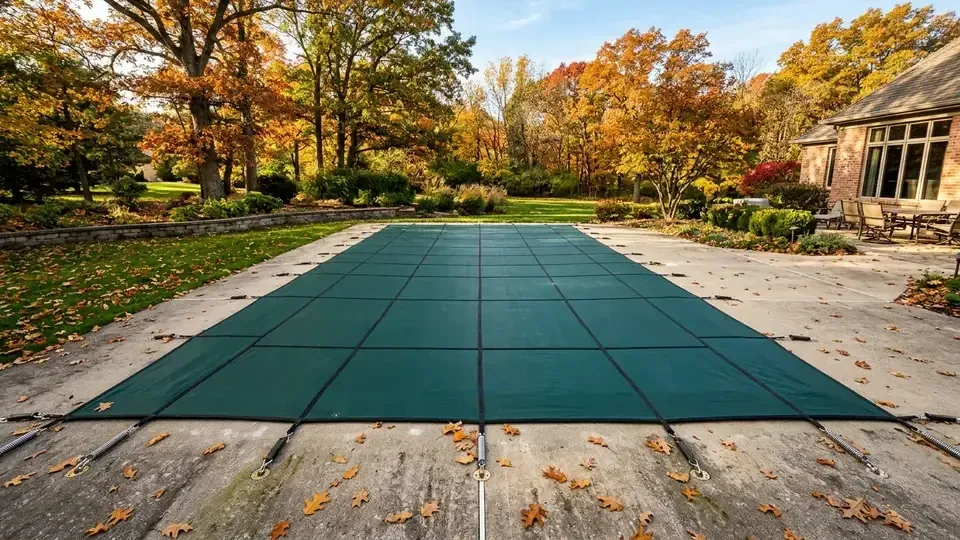
On an Anchor Solid Safety Pool Cover, take the split connection end of the rubber tie, align the holes with the grommet around the outer edge of the cover, and attach it with a saw bolt, while brass anchors are placed approximately 11” from the pool cover edge.
To install an Anchor Defender Mesh or Anchor Mesh safety pool cover, it is best to have water at operating level and not lower the water more than 15” below deck level.
When fastening the springs on an Anchor Defender Mesh or Anchor Mesh cover, the brass anchor inserts should be in the open position (opened approximately 1/2”), the end of the spring is approximately 1’-5” from the end of the pool cover, and the spring is slid approximately 6” up the end of the spring tool and pushed down into position with your shoe.
Once an Anchor Defender Mesh or Anchor Mesh cover is anchored, re-adjust the straps as needed so the cover should be very taut across the pool, and with proper tensioning the springs should be approximately half compressed.
For a Meyco pool cover, the pool water level must be within 18” of the top of the pool and must not fall lower during the winter (snow) season, because low water level will cause undue stress on the cover and could result in damage not covered by warranty.
On a Meyco safety cover, anchors should be located 20” from the cover’s edge (typically about 32” to 38” back from the pool edge), and straps should be tightened so that spring coils are compressed about halfway (approx. 2 1/2” apart, or 50% to 75% compressed).
On a WaterWarden safety cover, each spring should be compressed 50%, and the water level in the pool must not drop below 18” from the top since the cover is designed to rest on the water with the weight of any snow and/or ice; if the water level is too low, the cover will stretch excessively and place undue strain on the cover, which will void the warranty.
Pool Safety Cover Installation: Deck Anchor Hardware and Perimeter Clearances
On a Merlin safety cover, the overlap on a rectangle swimming pool can vary from 10 inches to 18 inches, and for free-form pools this overlap can vary from 12 inches to 24 inches, while in the case of an obstruction such as rock walls or waterfalls the cover can be cut flush at these areas.
For a WaterWarden Pool Safety Cover, there must be a minimum of 3’ (feet) of deck space around the pool on all sides for proper installation; the cover itself will overlap the pool from the water’s edge approximately 9”- 18” onto the deck surface, and the springs and straps will extend an additional 17” from the cover’s edge.
Merlin step riser kits are designed to close or fill the triangular gaps created when a safety cover is installed to go up and over a raised wall area; failure to install a step riser kit when one is required will result in a safety hazard and will void ASTM safety approval.
Merlin raised wall kits are designed to secure a safety cover to a pool with a raised wall or beam using a stainless steel cable assembly and eyebolts that are installed during initial installation; failure to install a raised wall kit when one is required will result in a safety hazard and will void ASTM safety approval.
For Anchor Industries optional cable assembly 3/8” drop-in anchors on a raised wall, the drill diameter is 1/2” and the minimum depth of embedment is 1 7/8”.
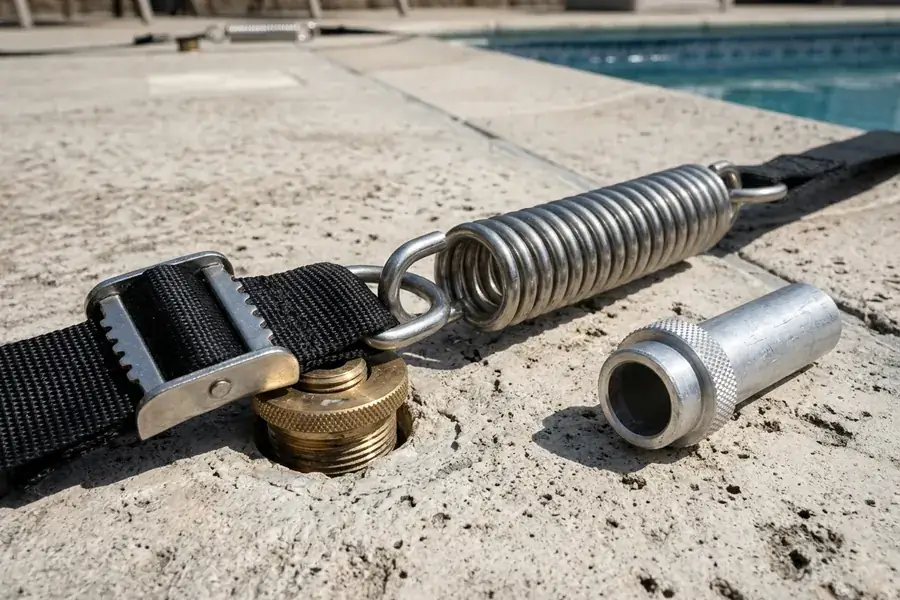
When installing a Merlin cover with the installation tool, use the allen wrench to raise the threaded portion of the brass anchor approximately 1/4”, slip the installation tool through the round end of the stainless steel spring, and pull the top of the installation tool away from the pool seating the spring on the brass anchor.
For LOOP-LOC in-ground anchors, in the spring and fall remove all anchors and flush out all anchor casings with a hose to prevent anchors from sticking when you re-install them, and when the cover is not in use close the anchors completely so they are flush against the deck.
Merlin Industries lists A.S.T.M. exceptions when more than 25% of the safety cover requires lawn stakes or aluminum tubes, when no step riser kit, gap filler, or cable assembly is installed when required, or when a solid cover does not have a pool pump or window mesh drain panel in proper working order.
Scroll horizontally to see all columns when the table extends beyond the screen.
Sources
- ASTM International - ASTM F1346-23 Standard Performance Specification for Safety Covers and Labeling Requirements for All Covers for Swimming Pools, Spas and Hot Tubs.
- Merlin Industries - Safety Cover Owner’s Guide.
- LOOP-LOC - Super Dense Mesh Safety Pool Covers.
- LOOP-LOC - ULTRA-LOC III Solid Safety Pool Covers.
- LOOP-LOC - Aqua-Xtreme Virtually Solid Mesh Safety Covers.
- LOOP-LOC - DECK-LOC No-Drill Anchoring System for Pool Covers.
- LOOP-LOC - The Care and Maintenance of Your Mesh In-Ground and On-Ground LOOP-LOC Safety Swimming Pool Cover.
- LOOP-LOC - Safety Covers Care and Maintenance FAQs.
- LOOP-LOC - Safety Pool Covers FAQs.
- Anchor Industries - Installation Instructions: Anchor Solid Safety Pool Covers.
- Anchor Industries - Installation Instructions: Defender Mesh and Anchor Mesh Safety Pool Covers.
- Meyco Pool Covers - Safety and Owners’ Manual and Installation Instructions.
- WaterWarden - Pool Safety Cover Installation and Maintenance Manual.
- Wayne Water Systems - WAPC250 Auto On-Off Water Removal Pool Cover Pump Operating Instructions and Parts Manual.
Sources
- Anglo American Pools Automatic Pool Covers Guide — Anglo American Pools Accessed October 28, 2026.