Key takeaways
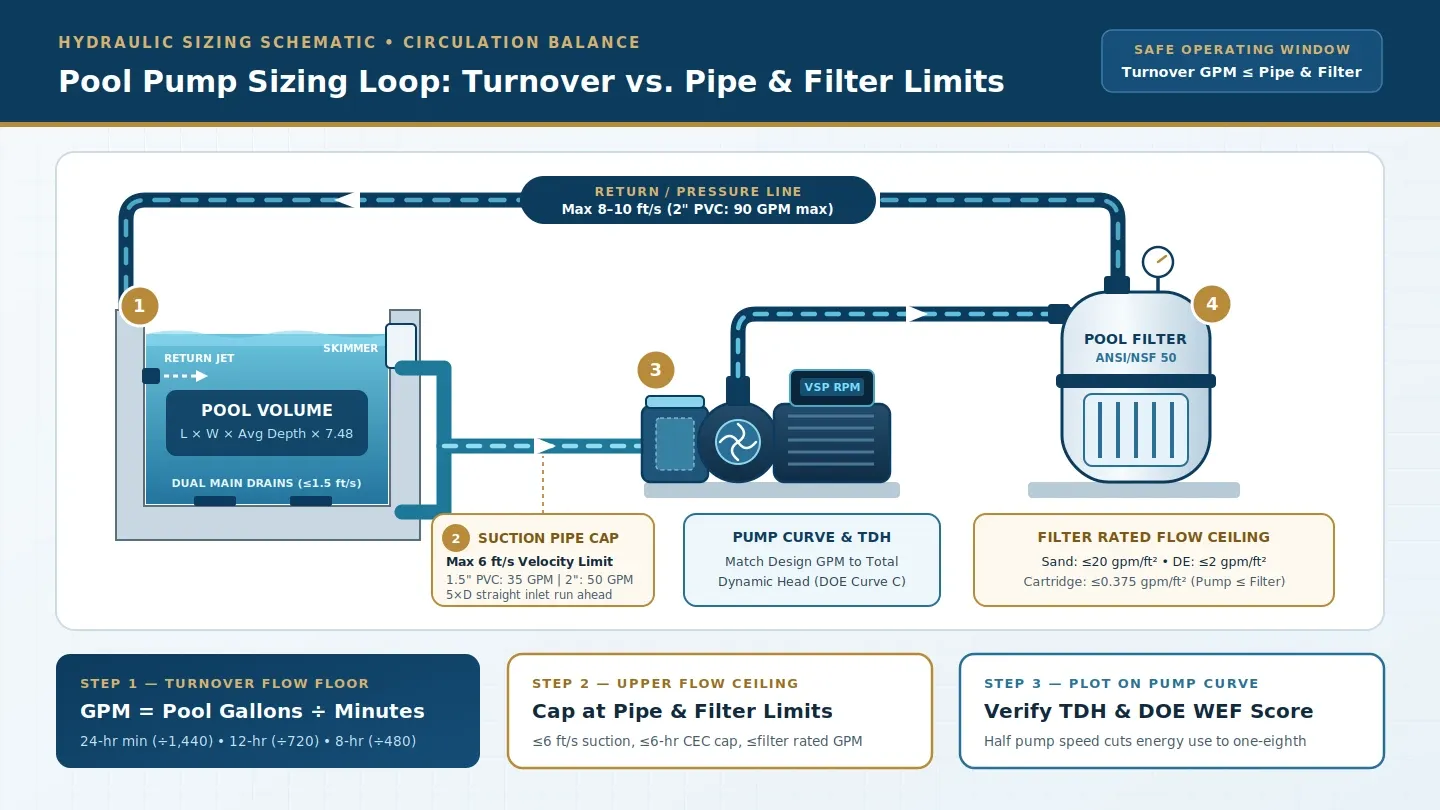
- Residential filtration flow sits between a 24-hour minimum turnover floor (volume divided by 1,440 minutes) and a 6-hour maximum ceiling (volume divided by 360 minutes, capped at 36 gpm below 13,000 gallons).
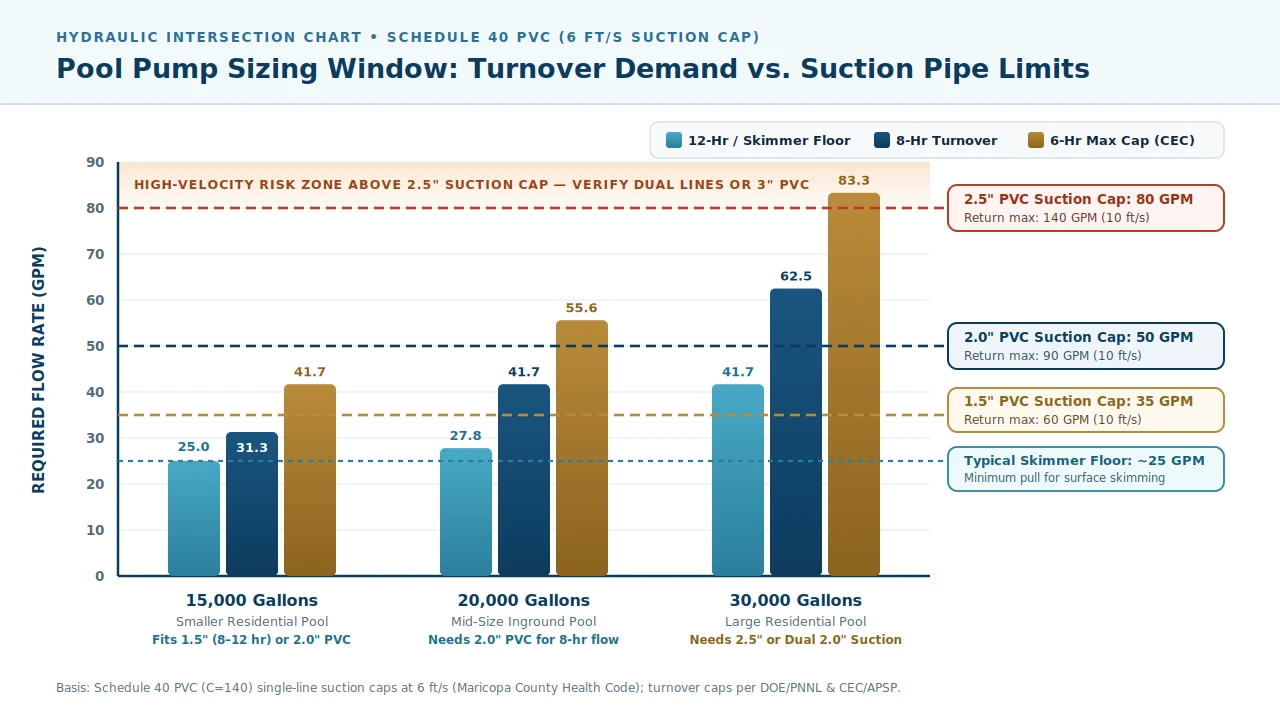
- Schedule 40 PVC suction piping capped at 6 feet per second limits single-line flow to 35 gpm on 1.5-inch pipe, 50 gpm on 2-inch pipe, and 80 gpm on 2.5-inch pipe.
- Pump flow should not exceed the filter rated capacity under ANSI/NSF Standard 50 limits (up to 20 gpm/ft² for high-rate sand, 2 gpm/ft² for DE, and 0.375 gpm/ft² for cartridge filters).
- Under the Pump Affinity Law, cutting pump speed in half lowers power draw to one-eighth, and federal 10 CFR 431.465 rules require high Weighted Energy Factor ratings on replacement pumps.
To determine what size pool pump you need, calculate your required circulation flow from pool volume and turnover hours, keep that flow below your suction pipe velocity cap (35 gpm for 1.5-inch or 50 gpm for 2-inch Schedule 40 PVC) and your filter rated maximum flow, then match the flow and total dynamic head on a manufacturer performance curve.
Can a pool pump be too big for your pool and plumbing?
Yes. A pool pump is too big when its flow exceeds the 6-feet-per-second suction pipe velocity cap or the filter’s rated design flow, driving high head pressure, straining filter media and plumbing joints, wasting electricity during routine filtration, and elevating suction entrapment hazards.
According to U.S. Department of Energy Building America Solution Center guidance, the primary reason single-speed pool pumps consume excessive electricity is that they are oversized and overused. High-flow duties such as spa jets, filter backwashing, pool sweepers, solar collectors, and waterfalls represent roughly 10% of operating time, leaving a standard 1½ to 2 hp single-speed pump running at 3,450 rpm and drawing 1,500 to 2,500 watts to deliver excess flow during 90% of its operating time. ENERGY STAR pool pump guidance notes that routine filtration requires only half the flow rate needed for a pool cleaner, and that slower circulation improves filtration while putting less strain on filters, plumbing, and valves reducing the chance of leaks, repairs, or premature plumbing component replacement.
Power demand rises steeply with speed under the Pump Affinity Law. Reducing pump speed by one-half cuts power consumption to one-eighth, and cutting speed on a 1½-hp pump from 3,450 rpm to 2,400 rpm (a 30% speed cut) drops electrical draw from 2,000 watts to 593 watts (a 70% power drop). Permanent magnet motors (PMM) inside variable-speed pumps reach 90% motor efficiency versus 30% to 80% for average single-speed induction motors, enabling 50% to 90% total energy reductions. Even with a variable-speed upgrade, installers should program a maximum flow cap because some variable-speed pumps can produce a higher maximum flow rate than the existing single-speed pump, risking suction entrapment or damage to older filters and piping.
Nameplate horsepower labels compound oversizing errors. Under 10 CFR 431.462 federal definitions, motor total horsepower equals nominal motor horsepower multiplied by the motor service factor. General-purpose motors rarely exceed a 1.15 service factor, whereas dedicated pool motors can carry service factors as high as 1.65 or 1.9, allowing a 1½-hp motor with a 1.47 service factor to draw roughly 2,100 watts (2.1 kW).
How does a pool pump size calculator determine required flow?
A pool pump size calculator multiplies pool dimensions into gallons, divides volume by turnover minutes to establish the minimum and maximum filtration GPM window, verifies the 25 gpm skimmer operating floor, and adds piping, fitting, dirty-filter, and heater resistance into Total Dynamic Head so you can select a pump curve that reaches that exact operating point.
Pool volume and residential turnover window
For a flat-bottom rectangular pool, volume in cubic feet equals length times width times depth, and total pool volume in gallons equals cubic feet multiplied by 7.48. For sloped floors, ovals, circles, or irregular shells, break the pool into measured zones using our pool volume calculator before calculating circulation flow.
Once volume is established, U.S. Department of Energy residential guidance sets both a lower floor and an upper ceiling for filtration flow:
- 24-hour minimum turnover floor: Divide total pool volume in gallons by 1,440 minutes per day to find the minimum filtration flow rate needed to circulate the entire pool once every 24 hours and limit algae and pathogen growth.
- 12-hour calibration benchmark: Per ANSI/NSPI-5 2003, calibrating a replacement pump to its lowest effective speed targets a 12-hour turnover (pool volume divided by 720 minutes).
- Minimum skimmer floor: Most residential skimmers require approximately 25 gpm for effective surface skimming across the weir door. Under Georgia Department of Public Health hydraulic worksheet rules, if calculated turnover flow falls below 25 gpm, the design flow rate must be raised to supply minimum skimmer flow.
- 6-hour maximum filtration ceiling: Developed by the California Energy Commission and adopted by the Association of Pool and Spa Professionals, maximum filtration flow should not exceed pool volume divided by 360 minutes (a 6-hour turnover) or 36 gpm, whichever is greater. Pools under 13,000 gallons must stay at 36 gpm or less during filtration.
Calculating total dynamic head across pipes and equipment
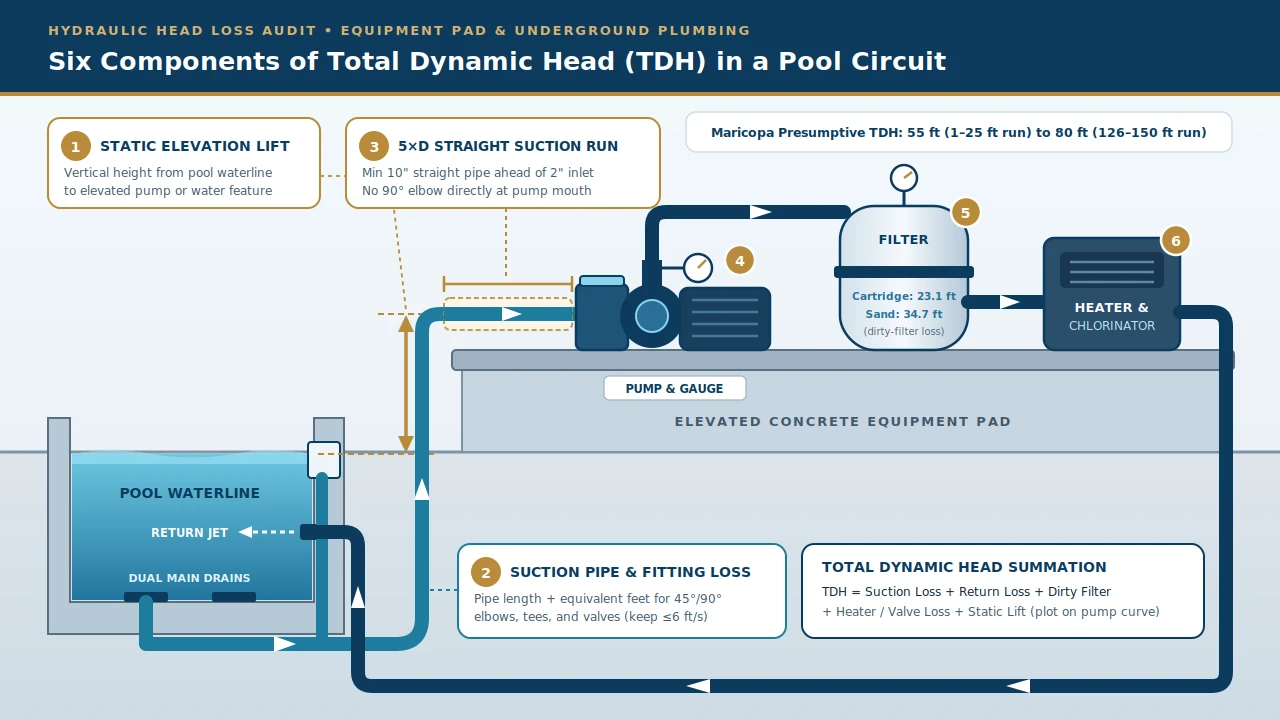
Total Dynamic Head (TDH) is the total equivalent vertical height (in feet of head) the pump overcomes after accounting for pipe and equipment friction losses, and it sets where the pump operates on the manufacturer performance curve. Follow this five-part field audit to calculate TDH:
- Measure suction and return pipe runs: Record straight pipe lengths from skimmers and main drains to the pump and from the equipment pad back to return inlets, noting pipe diameter (commonly 1.5-inch or 2-inch Schedule 40 PVC).
- Convert fittings to equivalent pipe length: Count every 45-degree elbow, 90-degree elbow, tee, and valve, convert each fitting into equivalent feet of straight pipe, and add those feet to the measured pipe lengths.
- Apply PVC friction loss at target flow: Multiply total equivalent length by the Schedule 40 PVC friction loss per 100 feet at an approximate flow close to your filter Design Rate of Flow.
- Add dirty-filter and equipment head losses: Add published head losses for the heater, chlorinator, multiport valve, and a loaded (dirty) filter. Georgia Department of Public Health hydraulic worksheets assign standard dirty-filter head losses of 23.1 feet for cartridge filters, 34.7 feet for sand filters, 57.8 feet for pressure pre-coat (DE) filters, and 4.3 feet for vacuum pre-coat filters.
- Cross-check against presumptive distance baselines: Where full piping drawings are unavailable, Maricopa County Environmental Health Code Chapter VI Section III lists presumptive recirculation TDH values scaled by main-drain-to-pump distance: 55 feet for 1 to 25 feet, 60 feet for 26 to 50 feet, 65 feet for 51 to 75 feet, 70 feet for 76 to 100 feet, 75 feet for 101 to 125 feet, and 80 feet for 126 to 150 feet, requiring full hydraulic calculations beyond 150 feet.
How do you read a pool pump size chart by pool volume?
Read a pool pump size chart in three steps: start with your pool volume to find the allowable turnover GPM window, cross-check that flow against the maximum GPM allowed by your installed suction pipe diameter and filter media rating, and finally plot your target GPM and calculated TDH on the pump manufacturer’s performance curve rather than selecting by horsepower.
Matching turnover GPM against Schedule 40 PVC pipe limits
Existing underground pipe diameter frequently caps usable pump flow before pool volume does. Maricopa County pool piping standards limit water velocity to 6 feet per second on the suction side and 10 feet per second on the PVC discharge side (or 8 feet per second for copper discharge piping), while Georgia Department of Public Health limits return lines to 8 feet per second and evaluates main drain lines at 6 feet per second at the highest flow rate on the pump curve.
Matching pump flow to filter media ratings and DOE standards
A pump sized to pass pipe velocity limits can still overwhelm an undersized filter. Maricopa County Regulation 7 requires the pump to meet, but not exceed, the flow rate required for filtering against total system head. Under ANSI/NSF Standard 50 limits codified in Maricopa County Regulations 16 through 19 and Georgia Department of Public Health design worksheets, filter media area directly bounds allowable flow:
Compare filter media trade-offs in our pool filter types comparison before pairing a replacement pump with an existing tank. When evaluating pump curves, remember that federal testing under 10 CFR Part 431 Subpart Y, Appendix C measures rated hydraulic horsepower at maximum rotating speed and full impeller diameter along reference Curve C (head equals 0.0082 multiplied by flow squared), with low-speed test points at or above 31.1 gpm for pumps above 0.75 rated hydraulic horsepower and at or above 24.7 gpm for pumps at or below 0.75 hydraulic horsepower. Our pool pump sizing guide explains how to plot both clean and dirty head endpoints onto a bidder’s published curve.
What size pool pump fits a 15,000-gallon residential pool?
A 15,000-gallon pool requires daily filtration flow between 25 gpm (the practical skimmer floor) and 31.3 gpm for an 8-hour turnover, capped at 41.7 gpm under the 6-hour filtration limit. That window fits single 1.5-inch PVC suction piping (35 gpm cap) at 8 to 12 hour speeds or 2-inch piping (50 gpm cap) with full margin.
For example, applying the published turnover formulas to a 15,000-gallon basin yields this operating window:
- 24-hour minimum turnover: 15,000 gallons divided by 1,440 minutes equals 10.4 gpm, which falls below the 25 gpm needed for most skimmers to pull floating debris over the weir door.
- 12-hour ANSI/NSPI-5 2003 calibration: 15,000 gallons divided by 720 minutes equals 20.8 gpm; program daily filtration to approximately 25 gpm so the skimmer stays active while still running slowly enough to capture high Affinity Law savings.
- 8-hour turnover: 15,000 gallons divided by 480 minutes equals 31.3 gpm, which remains below the 35 gpm suction velocity ceiling of a single 1.5-inch Schedule 40 PVC line.
- 6-hour CEC/APSP maximum ceiling: 15,000 gallons divided by 360 minutes equals 41.7 gpm, which exceeds a single 1.5-inch suction pipe (35 gpm) and requires 2-inch suction piping (50 gpm cap) or split suction lines if you run at peak speed for vacuuming or backwashing.
Because pools under 13,000 gallons are capped at 36 gpm or less under the CEC/APSP guideline and a 15,000-gallon pool needs only 25 to 31.3 gpm for routine circulation, installing a high-output pump without a programmed speed ceiling wastes energy and pushes 1.5-inch suction plumbing past 6 feet per second. A compact variable-speed pump with a programmed maximum flow limit at or below 35 gpm (for 1.5-inch suction) or your filter’s rated GPM covers daily filtration efficiently while keeping higher speeds available for short cleaning cycles.
What size pool pump fits a 20,000-gallon inground pool?
A 20,000-gallon inground pool requires 27.8 gpm for a 12-hour turnover and 41.7 gpm for an 8-hour turnover, with a 6-hour maximum filtration ceiling of 55.6 gpm; because 41.7 gpm exceeds a single 1.5-inch PVC suction line (35 gpm cap), 8-hour turnover requires 2-inch suction piping (50 gpm cap) or parallel suction trunks paired with a variable-speed pump.
For example, applying the turnover equations to a 20,000-gallon pool highlights where existing plumbing sizing limits flow:
- 24-hour minimum turnover: 20,000 gallons divided by 1,440 minutes equals 13.9 gpm (raise to at least 25 gpm for reliable skimmer pull).
- 12-hour ANSI/NSPI-5 2003 calibration: 20,000 gallons divided by 720 minutes equals 27.8 gpm, which clears the 25 gpm skimmer floor and stays inside a single 1.5-inch suction pipe (35 gpm max).
- 8-hour turnover: 20,000 gallons divided by 480 minutes equals 41.7 gpm, which exceeds single 1.5-inch suction capacity by 6.7 gpm and sits comfortably inside 2-inch Schedule 40 PVC suction capacity (50 gpm max).
- 6-hour CEC/APSP maximum ceiling: 20,000 gallons divided by 360 minutes equals 55.6 gpm, which exceeds a single 2-inch suction pipe (50 gpm max) unless flow splits across separate skimmer and main drain trunks.
If your 20,000-gallon pool has legacy 1.5-inch suction plumbing, the safest engineering response is not a bigger motor - it is programming a variable-speed pump to circulate slower and longer at 28 to 35 gpm (achieving a full turnover in 9.5 to 11.9 hours (at 35 gpm down to 28 gpm) while respecting the 6-feet-per-second pipe cap) and verifying the filter is rated above peak programmed flow (for example, choosing a 60 gpm filter rather than one rated right at 42 gpm). Once your design GPM window is verified, use our variable-speed pool pump flow rate guide to map daily runtime hours and speed schedules.
What size pool pump fits a 30,000-gallon residential or commercial pool?
A 30,000-gallon pool requires 41.7 gpm for a 12-hour turnover, 62.5 gpm for an 8-hour turnover, and caps at 83.3 gpm for a 6-hour turnover. Because 62.5 gpm exceeds a single 2-inch suction line (50 gpm cap), 8-hour flow needs 2.5-inch suction piping (80 gpm cap) or split trunks, while commercial pools face stricter health codes.
Larger residential pools (30,000 gallons)
For example, comparing 15,000-gallon, 20,000-gallon, and 30,000-gallon pools shows where 2-inch suction piping runs out of headroom:
For a 30,000-gallon residential pool plumbed with a single 2-inch suction line (50 gpm cap), running a variable-speed pump near 42 to 48 gpm delivers a complete turnover in 10.4 to 11.9 hours while keeping suction velocity below 6 feet per second and slashing wattage draw. Where an 8-hour turnover (62.5 gpm) or 6-hour turnover (83.3 gpm) is needed, verify 2.5-inch (80 gpm) or 3-inch (140 gpm) suction piping - or independent balanced suction trunks - and confirm the filter media area matches peak flow.
Commercial pool pump sizing codes and velocity caps
Commercial and semipublic pools cannot rely on residential 12 to 24 hour turnover windows. Health departments mandate continuous circulation and fixed engineering ceilings:
- Mandatory commercial turnover: Maricopa County public pool standards require continuous recirculation that filters and disinfects the entire pool within 8 hours or less. Georgia Department of Public Health requires a minimum 6-hour (360-minute) turnover - or 1.5 times average water depth, whichever is less - and 25 to 55 gpm through each skimmer.
- Strict pipe and grate velocity ceilings: Suction lines (skimmers and main drains) are capped at 6 feet per second, with Georgia DPH requiring main drain pipe velocity to stay at or below 6 feet per second at the highest flow rate on the pump curve. Return lines are capped at 8 feet per second under Georgia DPH (10 feet per second PVC / 8 feet per second copper under Maricopa County), and water velocity through main drain grate openings must not exceed 1.5 feet per second.
- ANSI/NSF 50 filter area sizing: Calculate required filter surface area by dividing commercial design flow by the applicable code maximum rate: 15 gpm/ft² (15-inch bed minimum) to 20 gpm/ft² for high-rate sand, 2 gpm/ft² for pressure pre-coat DE, or 0.3 to 0.375 gpm/ft² for cartridge vessels, and submit the manufacturer pump curve showing design flow at dirty-filter TDH.
What steps should you check before replacing a pool pump?
Before replacing a pool pump, verify your existing pipe diameter and filter max GPM, confirm VGB 2008 main drain cover compliance, check electrical voltage, breaker sizing, and bonding, measure port heights and 5-pipe-diameter straight suction clearance, confirm DOE 10 CFR 431.465 WEF compliance, and manually prime the wet end while bleeding filter air at startup.
- Confirm DOE 10 CFR 431.465 WEF and priming class: Under 10 CFR 431.465 federal energy conservation standards, dedicated-purpose pool pumps manufactured starting July 19, 2021 must meet minimum Weighted Energy Factor (WEF, in kgal/kWh) ratings. Single-phase self-priming pool filter pumps from 0.711 to below 2.5 rated hydraulic horsepower require WEF at least equal to minus 2.30 times the natural log of hydraulic horsepower plus 6.59; self-priming units below 0.711 hhp require 5.55 (at or below 0.13 hhp) or minus 1.30 times ln(hhp) plus 2.90; non-self-priming above-ground pumps below 2.5 hhp require 4.60 (at or below 0.13 hhp) or minus 0.85 times ln(hhp) plus 2.87; pressure cleaner booster pumps require at least 0.42 WEF. Verify you select a self-priming pump (certified under NSF/ANSI 50-2015 or capable of lifting 5.0 feet within 10.0 minutes) whenever the pump sits above the pool waterline; ENERGY STAR certified in-ground models use 20% less energy than standard pumps, and certified above-ground models use 11% less energy.
- Audit existing plumbing and filter ceilings: Identify suction and return pipe sizes (use Schedule 40 or 80 PVC, avoiding lower-pressure DWV fittings) and verify the filter’s rated GPM and VGB 2008 compliant main drain covers before ordering. Running a timer for 6 hours instead of 24 hours cuts pump energy use by 75%, while a variable-speed pump matched to low filtration speed saves 50% to 90%.
- Measure pad footprint and straight inlet clearance: Inspect threaded housing ports (commonly 2-inch MPT), suction port height, and suction-to-discharge spacing so shims or pipe cuts are planned ahead. Keep at least 5 pipe diameters of straight pipe directly before the suction inlet (10 inches straight on 2-inch pipe) avoiding 90-degree elbows directly into the pump inlet, reducing turbulence and TDH.
- Verify electrical supply, bonding, and controls: Shut off and verify dead circuits at the breaker panel, confirm supply voltage, wire gauge, and breaker compatibility, secure the ground bonding wire to the pump bonding lug, and wire variable-speed pumps for continuous power (bypassing legacy mechanical time clocks or routing via automation relays).
- Prime wet end, bleed air, and program safe flow limits: Fill the strainer pot with water to the suction port before start-up so the pump does not run dry and damage the mechanical seal, open the filter manual air relief valve until a solid stream of water flows, verify skimmer pull (~25 gpm) visually across the weir door, and lock a maximum flow limit below your suction pipe and filter ceilings. If the new pump struggles to evacuate air on startup, follow our pool pump priming diagnostics before restarting, or explore related circulation guides in the pool equipment hub.
Frequently asked questions
Why does nameplate horsepower mislead when comparing pool pumps?
Under 10 CFR 431.462, total horsepower equals nominal motor horsepower multiplied by the motor service factor. General-purpose motors rarely exceed a 1.15 service factor, whereas pool motors can carry service factors of 1.65 or 1.9, so a 1½-hp motor with a 1.47 service factor draws around 2,100 watts (2.1 kW). Compare pumps using rated hydraulic horsepower and published flow-versus-head curves instead of nameplate labels.
What is the maximum flow rate for 1.5-inch and 2-inch PVC pool pipe?
Under Maricopa County Schedule 40 PVC standards (C=140), maximum suction-side flow at 6 feet per second is 35 gpm for 1.5-inch pipe and 50 gpm for 2-inch pipe. Maximum pressure-side return flow at 10 feet per second is 60 gpm for 1.5-inch PVC and 90 gpm for 2-inch PVC, dropping to 48 gpm and 72 gpm for copper return piping at 8 feet per second.
How much energy does cutting pool pump speed in half save?
Under the Pump Affinity Law cited by ENERGY STAR, reducing pump speed by one-half allows the pump to use one-eighth as much energy. In U.S. Department of Energy Building America Solution Center guidance, reducing a 1½-hp pump from 3,450 rpm to 2,400 rpm (a 30% speed cut) drops power draw from 2,000 watts to 593 watts, a 70% power reduction.
Do federal rules require a variable-speed replacement pool pump?
Dedicated-purpose pool pumps manufactured starting July 19, 2021 must meet federal Weighted Energy Factor (WEF) minimums under 10 CFR 431.465. Single-phase self-priming pool filter pumps from 0.711 rated hydraulic horsepower up to 2.5 hydraulic horsepower face steep WEF thresholds that single-speed motors cannot meet, making variable-speed or compliant multi-speed pumps the replacement standard for most inground pools.
How much straight pipe do you need before the pool pump inlet?
Install a straight section of suction pipe equal to at least five times the pipe diameter directly ahead of the pump suction port, avoiding 90-degree elbows right at the inlet. For 2-inch suction piping, that equals 10 inches of straight pipe, matching the federal 10 CFR 431 Appendix C test setup and improving priming and hydraulic efficiency.
Sources
- Variable-Speed Pool Pumps Resource Guide — U.S. Department of Energy Building America Solution Center (PNNL) Accessed November 23, 2026.
- Pool Pumps Buying Guidance and Efficiency — ENERGY STAR (U.S. EPA) Accessed November 23, 2026.
- Environmental Health Code, Chapter VI Section III: General Design Standards and Specifications — Maricopa County Environmental Services Department Accessed November 23, 2026.
- Public Swimming Pool Hydraulic Analysis Worksheet — Georgia Department of Public Health Accessed November 23, 2026.
- 10 CFR 431.465 - Pumps Energy Conservation Standards and Compliance Dates — eCFR (U.S. Department of Energy) Accessed November 23, 2026.
- 10 CFR Part 431 Subpart Y, Appendix C - Uniform Test Method for Dedicated-Purpose Pool Pumps — eCFR (U.S. Department of Energy) Accessed November 23, 2026.
- 10 CFR 431.462 - Dedicated-Purpose Pool Pump Definitions — eCFR (U.S. Department of Energy) Accessed November 23, 2026.