Key takeaways
- EPA's nominal capture figures are category baselines; they do not establish an absolute particle cutoff for an installed filter.
- Divide design flow by the permitted filtration rate to calculate effective media area, then check the model rating and media depth.
- Count backwash, rinse and cartridge-cleaning water separately, along with media handling and service downtime.
- Record clean pressure at each pump setting so a change of speed is not mistaken for filter loading.
Choosing the wrong swimming pool filtration system among sand, diatomaceous earth (DE) and cartridge filters can leave insufficient flow or an unworkable cleaning route.
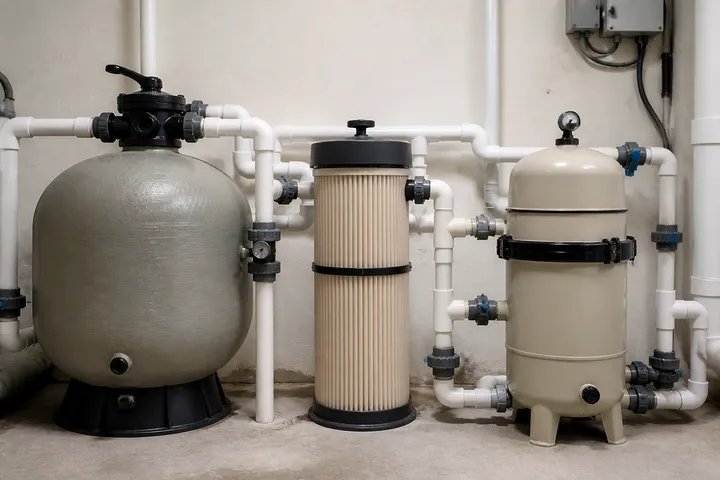
Choose a swimming pool filtration system by comparing sand, DE and cartridge filters at the same design flow, then checking media area and cleaning-water disposal. Nominal capture describes one aspect of the media; it does not size the vessel, establish a pressure-loss curve or prove an absolute particle cutoff. For each proposal, identify the installed model, specified media, clean and loaded operating points, cleaning procedure and service access. This comparison adds rate and water calculations to the filter-types introduction within the pool equipment guides.
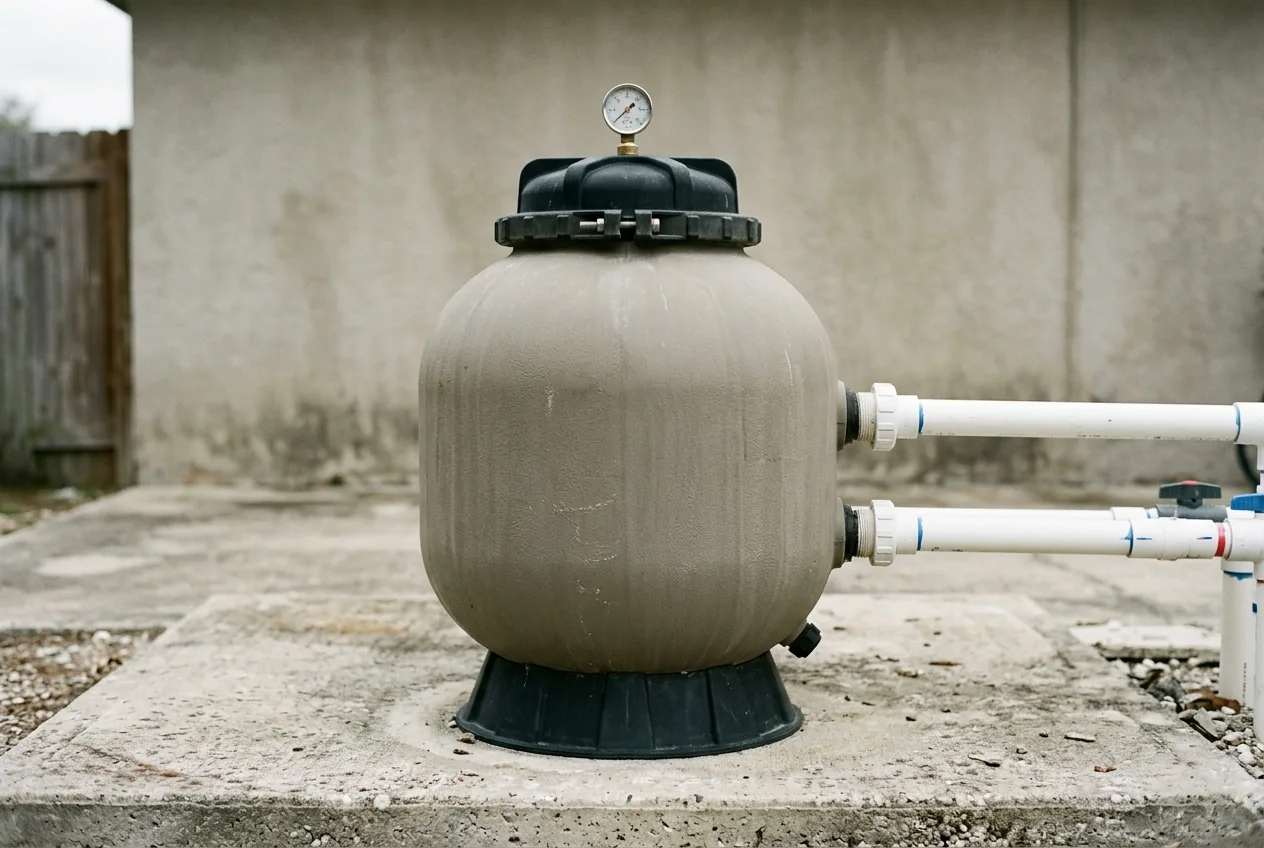
Compare capture, area and cleaning together
Use nominal capture as a reference-condition baseline, then size the actual media area and cleaning arrangement. The EPA’s November 2023 WaterSense guide, Table 4, summarizes sand at 20-40 microns, sorptive media at 5 microns and cartridge at 10 microns. Its sorptive category includes DE and other precoat materials. Those overview figures do not provide a matched-model efficiency percentage or test protocol, so they cannot guarantee that every particle above the stated size will be retained.
Scroll horizontally to see all columns when the table extends beyond the screen.
The rate column summarizes the 2024 MAHC, Sections 4.7.2.2-4.7.2.4, for public aquatic venues. It is model guidance whose local adoption must be checked, rather than a universal residential rule. Vacuum precoat has its own provisions, including a body-feed exception; do not transfer that exception to pressure DE filters. Confirm the offered model’s permitted rate and media arrangement separately.
Calculate media area at the design flow
Divide flow by the applicable permitted rate, using the more restrictive applicable code and model limits. Effective cartridge or coated-grid area is different from the vessel’s floor footprint.
Formula: minimum effective area (sq ft) = design flow (US gpm) / permitted rate (US gpm per sq ft).
Worked assumptions: at 60 US gpm, shallow-bed granular area = 60 / 12 = 5 sq ft; pressure-precoat area = 60 / 2 = 30 sq ft; surface-cartridge area = 60 / 0.30 = 200 sq ft. These are illustrations using the stated model-code rates, before checking model ratings and local requirements. They do not select three interchangeable products.
Rules-of-Thumb: If granular bed area is less than 5 sq ft at an assumed 60 US gpm with a bed shallower than 24 in, choose more bed area or a redesigned flow basis when applying the MAHC 12 gpm/sq ft provision, because the smaller area exceeds that reference rate. A 2 sq ft proposal would operate at 60 / 2 = 30 gpm/sq ft.
Reducing flow must still satisfy the required circulation duty. Take the design point into the pump-sizing calculation. Request pressure-loss data at that flow for clean and service conditions; no generic sand-versus-cartridge pressure curve substitutes for the installed model and piping.
Count backwash and cartridge rinse water
Calculate the complete cleaning event, including every water-to-waste phase. Cartridge filtration avoids backwash, but reusable cartridges still consume cleaning water and handling time.
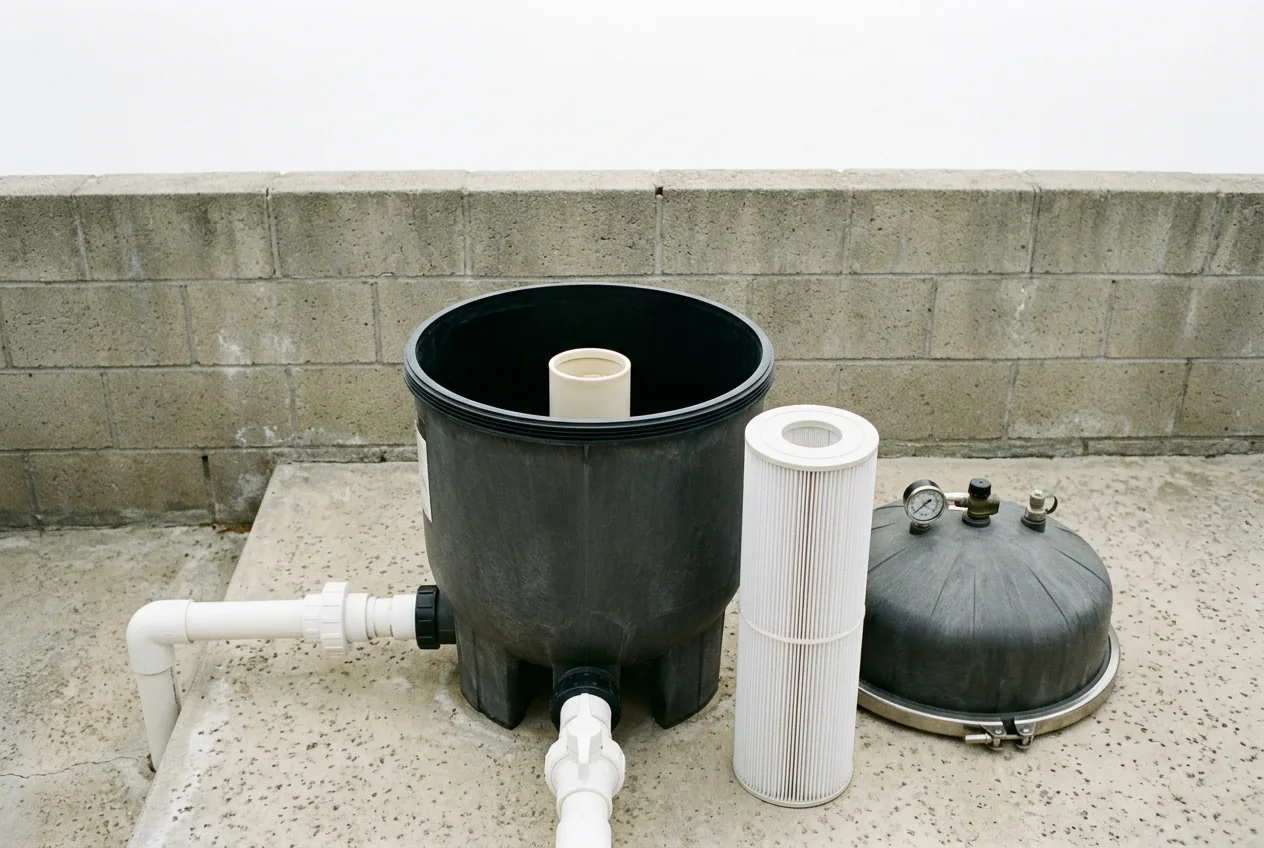
The Pentair Triton manual, Rev. L dated November 21, 2025, page 6, gives approximately 3-5 minutes of backwash or until clear, followed by approximately 30 seconds of rinse for its multiport arrangement. It instructs the operator to stop the pump before changing valve positions. Use the installed manual’s complete procedure; that sequence is not a schedule for every sand or DE filter.
Formula: event water (US gal) = backwash flow x minutes + rinse flow x minutes + other cleaning water.
The MAHC granular backwash baseline is at least 15 US gpm per sq ft of bed, with its stated manufacturer-prohibition and approved-listing exception. For the earlier 5 sq ft example, that baseline requires 5 x 15 = 75 US gpm in backwash mode, even though filtration was 60 US gpm. Check that the pump and waste piping can deliver this separate operating point.
Worked assumptions: 75 US gpm for 4 minutes plus an assumed rinse flow of 75 US gpm for 0.5 minute = 337.5 US gal per event, before any additional wash water. The flows and chosen four-minute duration are assumed. Measure actual discharge and duration; stopping conditions come from the supported procedure.
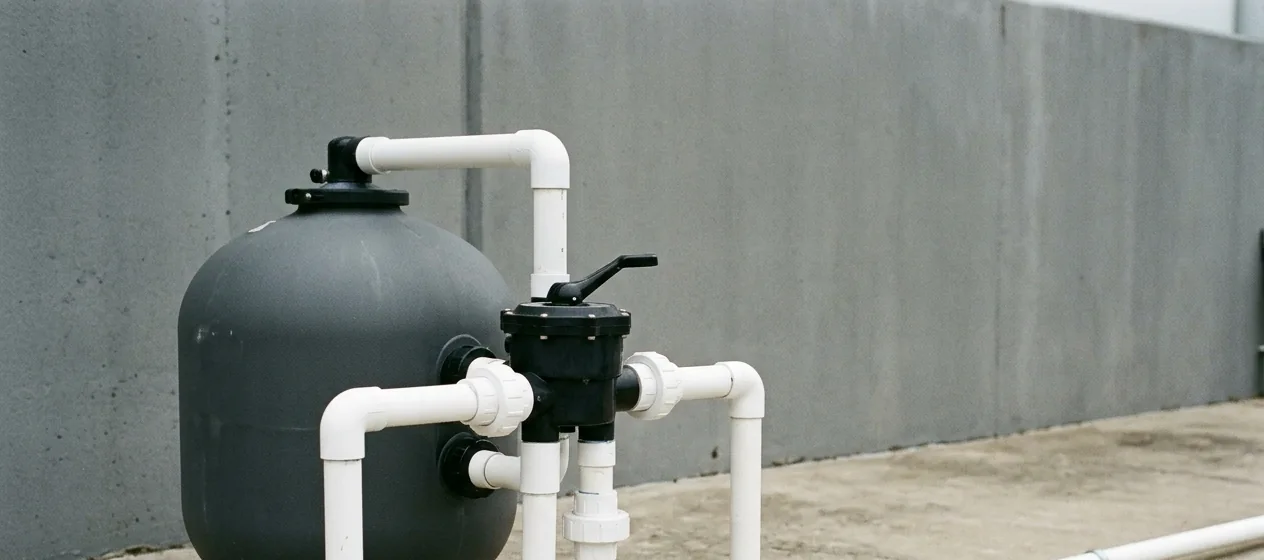
For cartridge cleaning, record hose flow multiplied by elapsed rinsing time, plus any soak or rinse batches. For DE, include replacement media and its permitted disposal route. EPA’s category-level water comparisons help frame these tasks, but an annual water estimate needs the site’s event frequency and measured event volume.
Keep pressure and lifetime cost in the same decision
Compare water, energy and service interruption over the operating plan. A filter with a convenient vessel size can still be costly if every cleaning needs difficult access or repeated circulation shutdowns.
Log clean pressure and flow at each programmed pump setting using the filter pressure baseline guide. A pressure change after a speed change is not automatically a dirty-filter signal. Apply the model’s cleaning trigger and retain enough flow for downstream equipment as the media loads.
For total cost of ownership, multiply event water by expected event count, then add replacement media or elements and staff time. Heated makeup water also carries a thermal penalty; use actual makeup temperature and the operating season rather than claiming a fixed saving. Draw cartridge withdrawal and media-removal routes into the equipment-room plan. Public facilities also need the staffing and code context in hotel pool planning.
Method and sources
This comparison uses EPA WaterSense Section 5.3, November 2023, pages 5-7; the 2024 MAHC, printed pages 74-76; and the dated filter installation manual linked above. All were accessed October 19, 2026. Public numbers are engineering baselines under their stated conditions. Installed model, media, climate-driven debris, piping and local adoption remain selection variables. The area and water examples are dimensional calculations with assumed inputs. No proprietary standard’s unread limits are asserted.
Frequently asked questions
Can used DE be discharged with ordinary backwash water?
Only if the applicable waste rules allow that discharge. The 2024 MAHC requires discharged precoat media to be handled under the applicable laws; a suitable pipe connection alone does not establish disposal permission.
Does the MAHC cartridge provision require a spare element or a complete set?
It specifies one complete set of spare cartridges stored clean and dry onsite. This is the 2024 model-code provision for applicable public aquatic venues; confirm local adoption and the installed filter's element arrangement.
Sources
- WaterSense at Work, Section 5.3: Commercial Pool and Spa Equipment, November 2023 — U.S. Environmental Protection Agency Accessed October 19, 2026.
- 2024 Model Aquatic Health Code, fifth edition, Sections 4.7.2.2-4.7.2.4 — U.S. Centers for Disease Control and Prevention Accessed October 19, 2026.
- Pentair Triton Side Mount Sand Filter Installation and User's Guide, Rev. L, November 21, 2025 — Pentair Accessed October 19, 2026.