Key takeaways
- Standard wall skimmer openings measure 1 foot wide by 6 inches high and work best when pool water intersects midway through the throat.
- Buoyant hinged weirs tilt up to 90 degrees across at least 4 inches of waterline travel to pull thin surface flow when running and float vertical at shutoff to trap debris.
- Public pool hydraulic standards size each wall skimmer for at least 30 gallons per minute and balance roughly 75 to 80 percent surface draw against 20 to 30 percent main-drain flow.
- Older two-port skimmers use an automatic equalizer valve at least 1 foot below the skimmer mouth, while federal and state suction-safety rules require rated anti-entrapment covers or prohibit new equalizer lines.
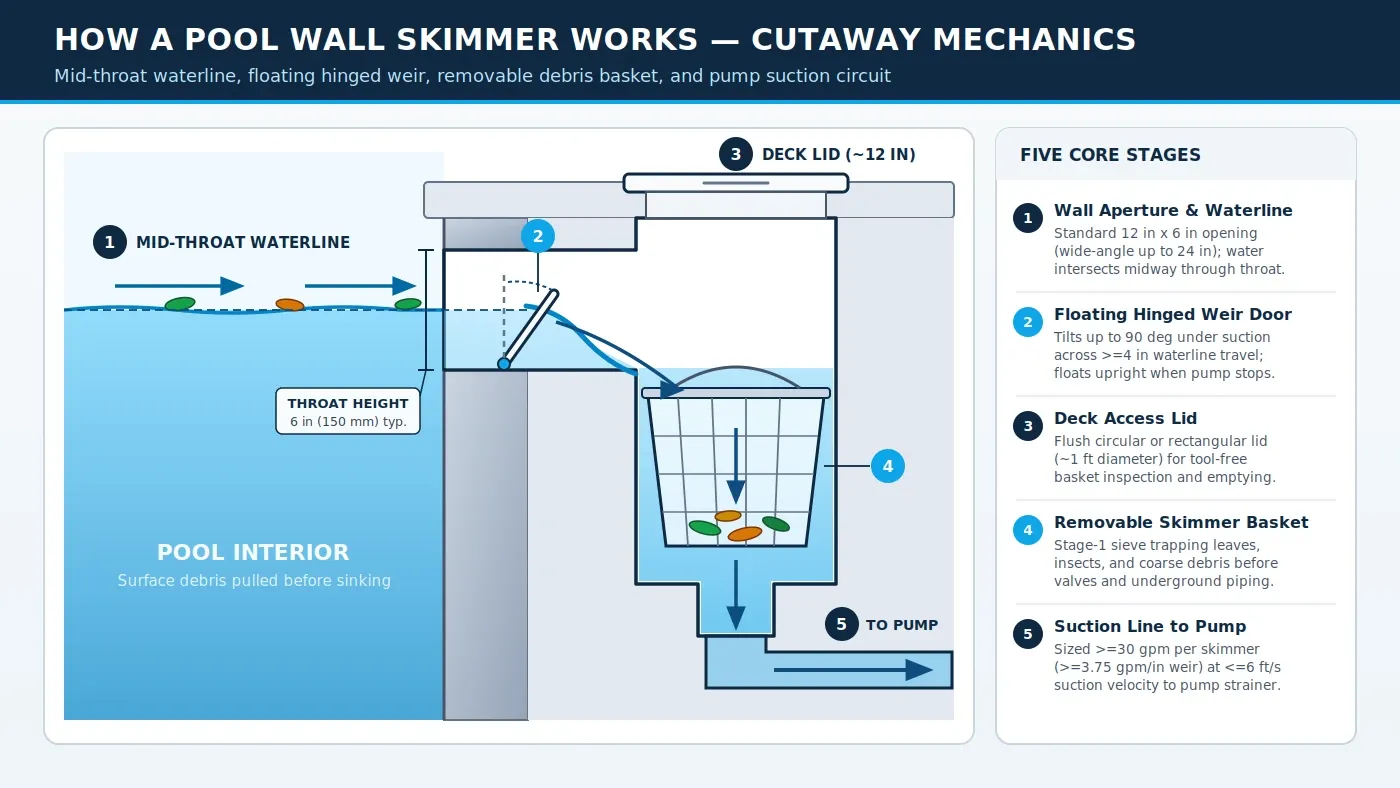
A pool skimmer works by using circulation pump suction to pull surface water through a rectangular wall opening, over a floating hinged weir door, and down into a removable skimmer basket. Holding the waterline midway through the opening lets the weir accelerate thin surface flow and trap leaves, insects, and floating oils before debris sinks.
What is a skimmer in a swimming pool?
A pool skimmer is a corrosion-resistant suction housing built into the upper pool wall at the waterline that draws floating contaminants into the circulation loop before they sink. Under swimming pool sanitation practice, a standard rectangular opening measures 1 foot wide (300 mm) by 6 inches high (150 mm), accessed from the deck through a 1-foot lid.
Wider models called wide-angle skimmers expand that wall opening up to 2 feet (600 mm) wide to widen surface capture. Before PVC skimmers arrived in the late 1960s and replaced earlier styles by the mid-1970s, builders relied on copper, stainless steel, or cast-in-place concrete skimmers. Modern public design standards such as 77 Ill. Admin. Code 820.210 require wall skimmers to be tested in accordance with NSF Standard 50, made of sturdy corrosion-resistant materials, and positioned so surface velocity draws floating oils and wastes from across the entire pool area.
Wall skimmer sizing and state engineering benchmarks
Because wall skimmers lose surface reach across wide basins, state engineering codes limit skimmer installations by pool width and surface area. For the broader hydraulic path from skimmer through pump, filter, and return inlets, see our pool equipment system overview.
How does a pool skimmer weir door work?
A pool skimmer weir door is a buoyant hinged flap that tilts up to 90 degrees away from the pool under pump suction to skim a thin, fast surface layer, then floats upright when the pump stops to keep trapped leaves from drifting back into the pool via wave action.
To keep working through evaporation and bather splash-out, Indiana 675 IAC 20-2-21 and New York 10 NYCRR 6-1.29 require skimmer weirs to adjust automatically and operate freely across at least 4 inches of water-level variation. New York links weir width directly to skimming velocity by sizing flow at 30 gallons per minute or 3.75 gallons per minute per lineal inch of weir.
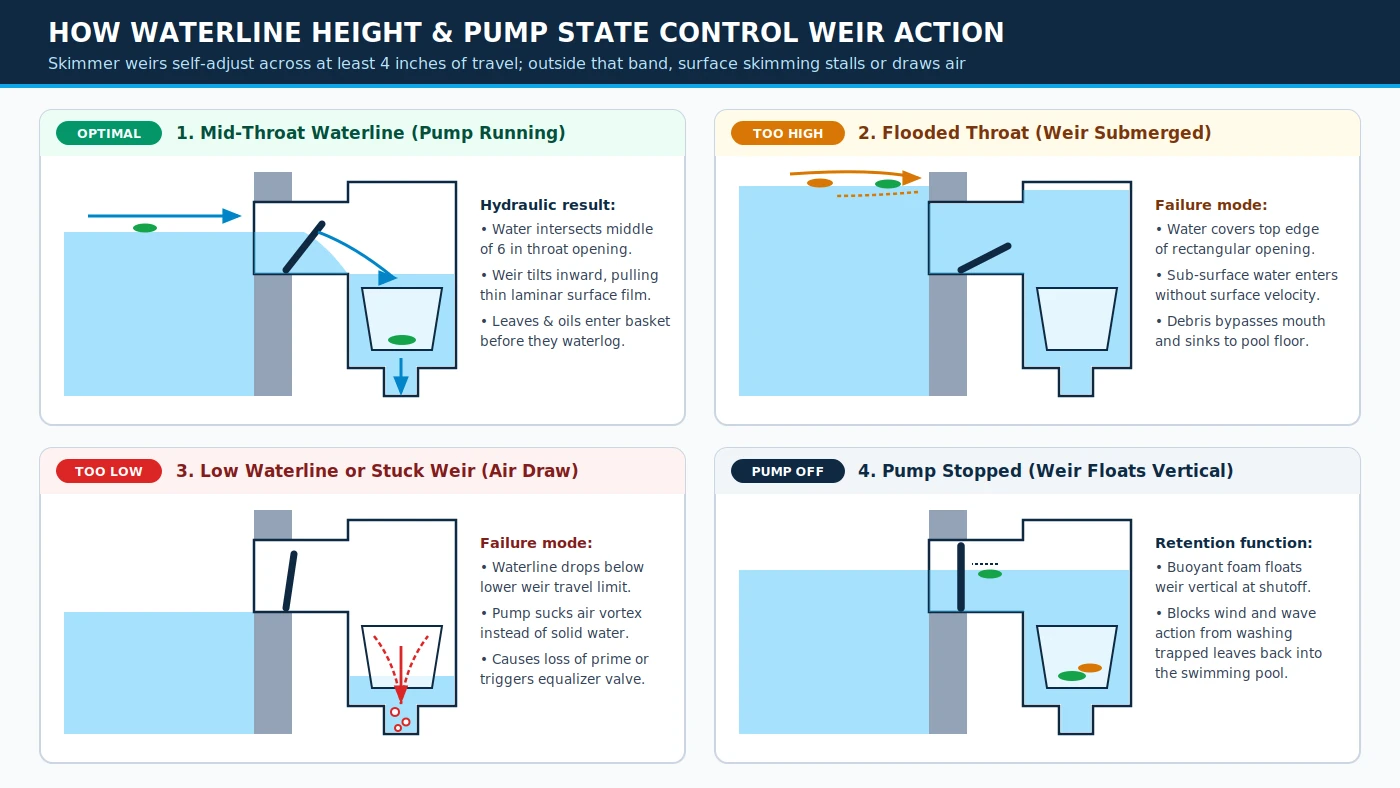
How waterline height changes weir behavior
Water height relative to the 6-inch throat determines whether the weir helps or hurts circulation:
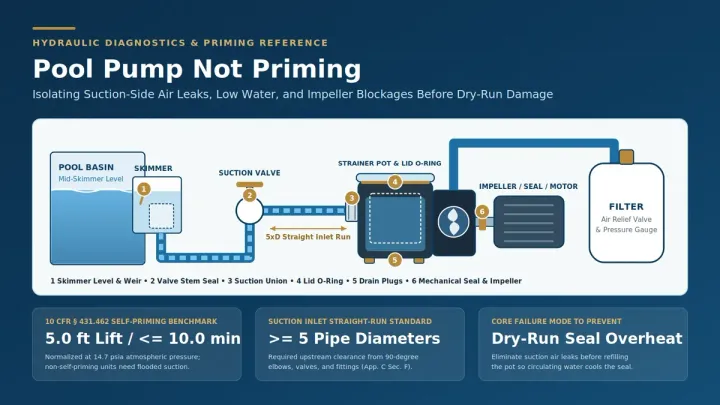
If low water or a jammed weir pulls air into the pump basket and causes the pump to spin dry, work through our pool pump not priming diagnostics before restarting.
How does a pool skimmer basket trap debris?
The skimmer basket sits directly behind the skimmer mouth as the first screen in a consecutive dilution chain, trapping leaves, dead insects, and large floating solids before water reaches control valves or suction lines. Under Illinois 77 Ill. Admin. Code 820.210, all overflow water must pass through a tool-free removable basket.
Never operate a pool without an intact leaf basket inside the skimmer housing. Once water leaves the skimmer basket, it travels to a second sieve basket mounted on the circulation pump as the final barrier protecting the close-tolerance impeller from hair and leaf jams. Under New York 10 NYCRR 6-1.29, pump-side strainers must be rigid and corrosion-resistant so they do not collapse when clogged, with openings no greater than one-eighth inch and total clear open area at least four times the connecting pipe area.
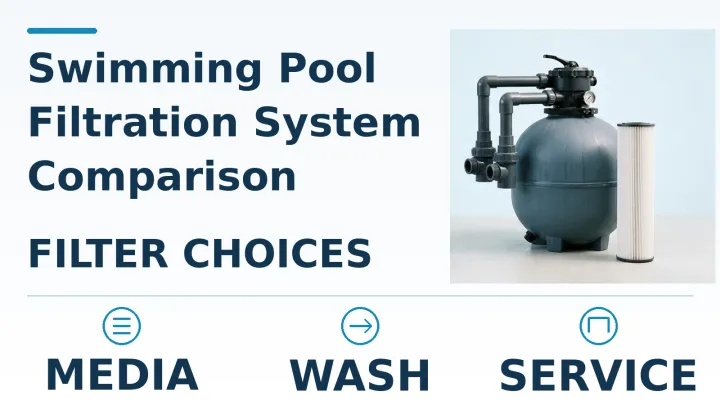
From the pump, water enters the third stage (the pool filter), which removes fine organic solids down to 10 microns in a well-maintained consecutive dilution system. Both U.S. EPA ENERGY STAR pump guidance and sanitation references emphasize emptying skimmer and pump baskets regularly. Leaving trapped leaves and insects to decay inside baskets leaches ammonia and organic compounds into recirculated water, accelerating chloramine and disinfection by-product formation while choking pump suction. For how downstream sand, cartridge, and diatomaceous earth filters capture what passes the baskets, compare options in our swimming pool filtration system comparison.
How does a pool skimmer float valve work?
A pool skimmer float valve sits under the basket on two-port housings with an equalizer pipe, staying tightly closed during normal operation and opening automatically if pool water drops below the weir so pump suction pulls submerged water instead of drawing an air lock.
Under New York 10 NYCRR 6-1.29, skimmers must include a device to prevent an air lock in the suction line; where equalizer pipes are used, the pipe sits at least one foot below the skimmer’s lowest overflow level with an automatic valve that opens only when water drops below minimum skimmer level.
Equalizer routing and suction-entrapment rules
Older systems routed the equalizer port either to a wall opening below the skimmer throat or, as specified in Illinois 77 Ill. Admin. Code 820.210, directly to the main drain pipe with a restrictive valve closed during normal skimming. Because any submerged wall opening under pump vacuum can trap a bather, the U.S. Consumer Product Safety Commission ruled, as documented by North Carolina DHHS drain safety compliance guidance, that skimmer equalizer tubes are submerged suction outlets requiring safety covers certified to ASME/ANSI A112.19.8-2007 under the December 2007 Virginia Graeme Baker Pool and Spa Safety Act.
Under ANSI/APSP-7, each active equalizer cover must carry a flow rating equal to the greater of maximum system flow divided by the number of skimmers on a common line or the skimmer’s maximum flow rating, which is usually 55 or 75 gallons per minute. Because submerged single-point equalizers create compliance and entrapment burdens, newer public codes such as Indiana 675 IAC 20-2-21 ban equalizer lines outright and prohibit connecting the main drain through a skimmer.
Should a pool skimmer line be open or closed?
Keep a pool skimmer line open during normal filtration, using its internal flow-control device or an equipment-pad suction valve to equalize draw across multiple skimmers and balance surface flow against the main drain without exceeding the 6 feet per second suction pipe velocity limit.
Closing a skimmer line halts surface debris removal and redirects extra flow through the floor drain or remaining pipes, where New York 10 NYCRR 6-1.29 caps suction velocity at 6 feet per second, return pressure velocity at 10 feet per second, and gravity flow at 3 feet per second.
State design rules illustrate how open skimmer lines split total recirculation flow with the floor drain. Under Michigan R. 325.2144, a recirculation circuit is sized for 37.5 gallons per minute per surface skimmer serving up to 500 square feet: 80 percent of that flow (30 gallons per minute) moves through the open skimmer while 20 percent (7.5 gallons per minute) moves through the main drain. Consecutive-dilution design references similarly blend 75 percent surface water with 25 percent main-drain water at the pump basket, whereas New York recommends directing at least 30 percent of total recirculation flow through the main drain while still delivering at least 30 gallons per minute per skimmer.
When a pool has multiple skimmers, piping and flow-control valves near pump suction or inside each skimmer balance suction equally so the skimmer closest to the equipment pad does not starve the far skimmer.
How does a pool skimmer work with the main drain and return jets?
A pool skimmer pulls floating organic waste from the surface while floor main drains draw deeper water and sunken solids, and directional wall return jets connect both suction zones by creating a circular surface current that sweeps floating debris past the skimmer mouth.
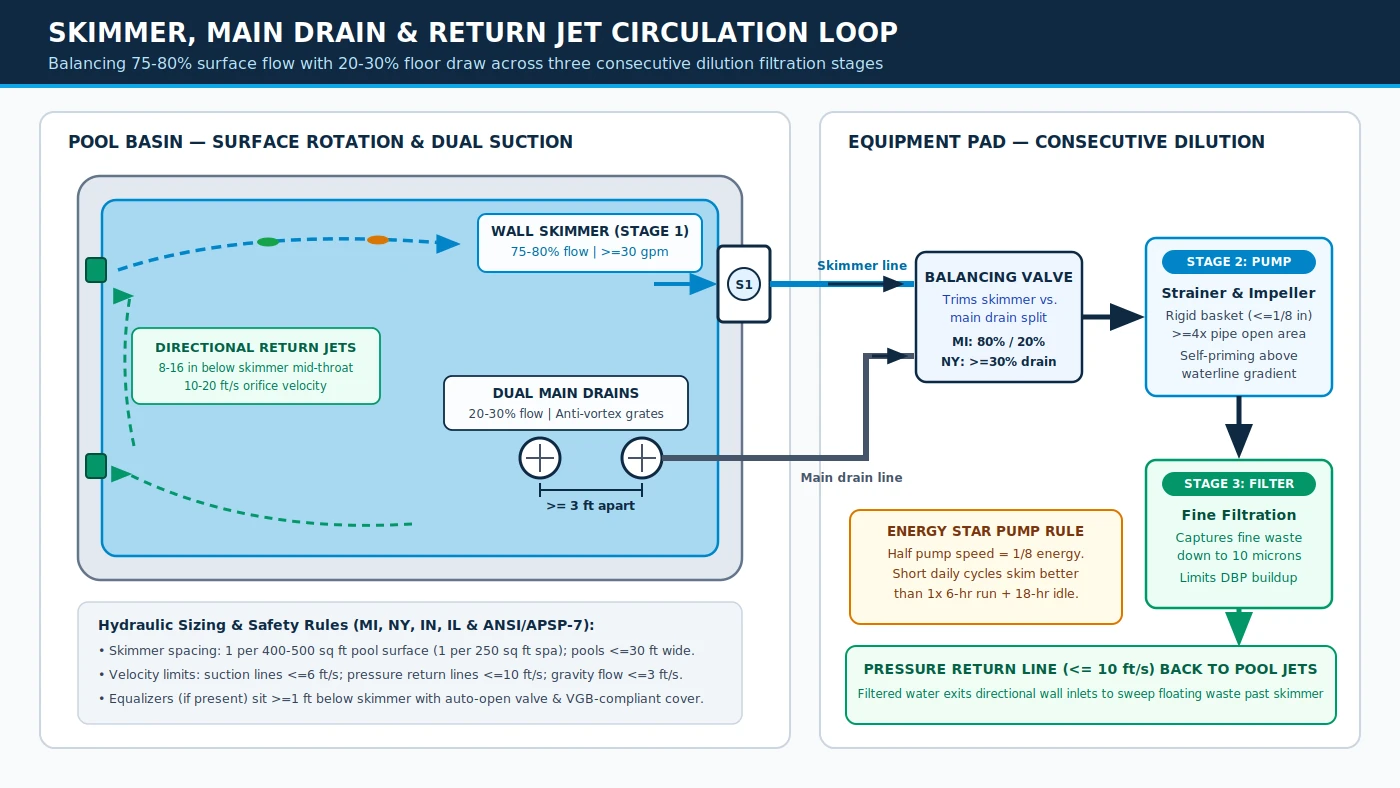
Directional wall return jets drive surface capture
Under Illinois 77 Ill. Admin. Code 820.210, wall inlets in skimmer-equipped pools must be directional, mounted 8 inches to 16 inches below the skimmer throat midpoint, and sized for 10 to 20 feet per second orifice velocity, compared with 5 to 20 feet per second in non-skimmer pools. As filtered water exits those swivel nozzles, it generates a capillary wave across the surface tension that carries floating leaves and oils around the perimeter wall and across the skimmer weir. Angling swivel nozzles left or right also rotates the deeper water column clockwise or counterclockwise, gradually nudging sunken inorganic dirt toward the deep-end main drain.
Dual main drains and anti-entrapment protection
Floor main drains sit at the deepest point of the basin. Under both New York design standards and the federal Virginia Graeme Baker Pool and Spa Safety Act, public pools install two main drain suction outlets separated by at least 3 feet on centers, protected by tool-secured antivortex grates meeting ASME/ANSI A112.19.8-2007 so flow stays safe even if one outlet becomes blocked.
How does an above-ground or floating pool skimmer work?
An above-ground or floating skimmer uses the same pump-suction and basket-filtration principle as a built-in wall skimmer, but floating skimmers track water-level shifts automatically via pump suction instead of relying on a fixed wall aperture, and below-waterline above-ground pumps run under flooded suction rather than lifting water over a deck wall.
Fixed through-wall skimmers on in-ground pools require a self-priming pump whenever the pump sits above the hydraulic gradient, as specified in New York 10 NYCRR 6-1.29, and they lose surface capture if water drifts outside the 4-inch weir travel window. By contrast, floating skimmers described in swimming pool sanitation references self-adjust to pump suction rate and maintain optimal surface skimming regardless of waterline height, cutting floating bio-material buildup.
Pump speed and scheduling affect both in-ground and above-ground skimming performance. According to U.S. EPA ENERGY STAR, certified in-ground pool pumps use 20 percent less energy and certified above-ground pumps use 11 percent less energy than standard models, because cutting pump speed by one-half reduces energy consumption to one-eighth. Just make sure low filtration speeds still tip the weir open and generate surface pull; compare flow windows in our variable-speed pool pump flow rate guide. ENERGY STAR also notes that running a pump for one continuous 6-hour stretch leaves 18 hours a day for surface debris to accumulate and sink, whereas scheduling several short daily cycles keeps the skimmer clearing the surface throughout the day.
Daily pool skimmer inspection checklist
Run through these six checks in order whenever surface skimming weakens or during routine pool service so waterline height, weir travel, basket cleanliness, and suction balance stay within operating limits; explore related hydraulic and filtration guides in the pool equipment hub.
- Verify mid-throat waterline: Confirm pool water intersects the middle of the 6-inch wall opening within the 4-inch weir travel window; top off low water or lower overfilled water after heavy rain.
- Test weir door movement: Watch the hinged weir tilt inward smoothly when the pump starts and float upright to vertical when the pump shuts off; clear wedged twigs or replace a missing weir.
- Empty both strainer baskets: Lift the deck lid, remove the skimmer basket without tools, dump leaves and insects before organic decay forms chloramines, and inspect the rigid pump strainer basket for cracks.
- Confirm open, balanced suction valves: Check that skimmer flow-control devices and pad suction valves remain open and evenly balanced across skimmers and the main drain without restricting suction flow.
- Inspect equalizer covers on older pools: If your skimmer has a submerged wall equalizer tube, verify its ASME/ANSI A112.19.8-2007 cover is intact, securely fastened, and undamaged, and confirm the float valve stays closed during normal waterline operation.
- Check directional return jet aim: Verify wall return nozzles angle consistently in one direction around the perimeter so surface circulation sweeps floating debris across the skimmer mouth.
Frequently asked questions
What does a pool skimmer do in the circulation system?
A pool skimmer acts as the surface intake of the circulation loop. Pump suction pulls floating leaves, insects, oils, and organic waste over the weir and into a removable basket before contaminants waterlog and sink to the pool floor.
How high should pool water be on the skimmer?
Pool water should intersect midway through the center of the rectangular wall opening, which typically stands 6 inches tall. State pool standards require skimmer weirs to self-adjust across at least 4 inches of waterline movement; water above the top lip stalls surface skimming and water below the weir draws air.
Can you run a pool pump without a skimmer basket?
No. Every skimmer requires a removable leaf basket between the opening and the pump suction line so leaves, insects, and coarse debris cannot enter control valves, clog underground piping, or overload the pump strainer basket and close-tolerance impeller.
Should the skimmer valve stay open while the pump runs?
Yes. Keep the skimmer suction line open during normal filtration and use the skimmer flow-control device or equipment-pad suction valve to balance multiple skimmers evenly against the main drain rather than shutting the skimmer off.
Why do some skimmers have a second port or float valve underneath the basket?
On older two-port skimmers, the second port connects to a submerged equalizer line at least 1 foot below the skimmer opening or to the main drain branch. A float valve keeps that bypass closed normally and opens automatically if pool water falls below the skimmer weir so the pump does not draw air.
Sources
- Mich. Admin. Code R. 325.2144: Surface Skimmers and Surge Weirs — Cornell Law School Legal Information Institute Accessed November 28, 2026.
- 675 IAC 20-2-21: Surface Skimmer Systems — Cornell Law School Legal Information Institute Accessed November 28, 2026.
- 10 NYCRR 6-1.29: Swimming Pool Design Standards — Cornell Law School Legal Information Institute Accessed November 28, 2026.
- 77 Ill. Admin. Code 820.210: Swimming Facility Water Treatment System — Cornell Law School Legal Information Institute Accessed November 28, 2026.
- Drain Safety Compliance and Skimmer Equalizers — North Carolina Department of Health and Human Services Accessed November 28, 2026.
- Swimming Pool Sanitation: Skimmers and Consecutive Dilution — Wikipedia Accessed November 28, 2026.
- Pool Pumps Maintenance and Efficiency Guidance — U.S. EPA ENERGY STAR Accessed November 28, 2026.