Commercial Pool Sand Filter Velocity Limits, Bed Depth Tiers, and Turnover Rules
Under the CDC Model Aquatic Health Code for commercial pool equipment, all filters shall be certified, listed, and labeled to NSF/ANSI 50 by an ANSI-accredited certification organization or approved by the AHJ with proper engineering justification, and all filter media, including alternative filter media, shall be certified, listed, and labeled to NSF/ANSI 50 by an ANSI-accredited certification organization and within the size specifications provided by the filter manufacturer and NSF/ANSI 50 or approved by the AHJ with proper engineering justification.
For new construction and system design, high-rate granular media filters shall be designed to operate at no more than 15 GPM per square foot (37 m/h) when a minimum bed depth of 24 inches (61 cm) of media depth is provided.
When a bed depth is less than 24 inches (61 cm) in new system design, filters shall be designed to operate at no more than 12 GPM per square foot (29 m/h).
The granular media filtration system shall be designed to backwash each filter at a rate of at least 15 GPM per square foot (37 m/h) of filter bed surface area, unless explicitly prohibited by the filter manufacturer and approved at an alternate rate as specified in their NSF/ANSI 50 listing.
In existing facility operation and maintenance, high-rate granular media filters shall be operated at no more than 15 GPM per square foot (36.7 m/h) when a minimum bed depth of 15 inches (38.1 cm) is provided per manufacturer’s instructions.
In operation and maintenance, when a bed depth is less than 15 inches (38.1 cm), filters shall operate at no more than 12 GPM per square foot (29.3 m/h).
Under the CDC Model Aquatic Health Code, maximum allowable turnover times are 6 hours or less for All Other Pools, 2 hours or less for Activity Pools, Lazy River, and Wave Pools, 8 hours or less for Diving Pools, and 1 hour or less for Wading Pools and Plunge Pools.
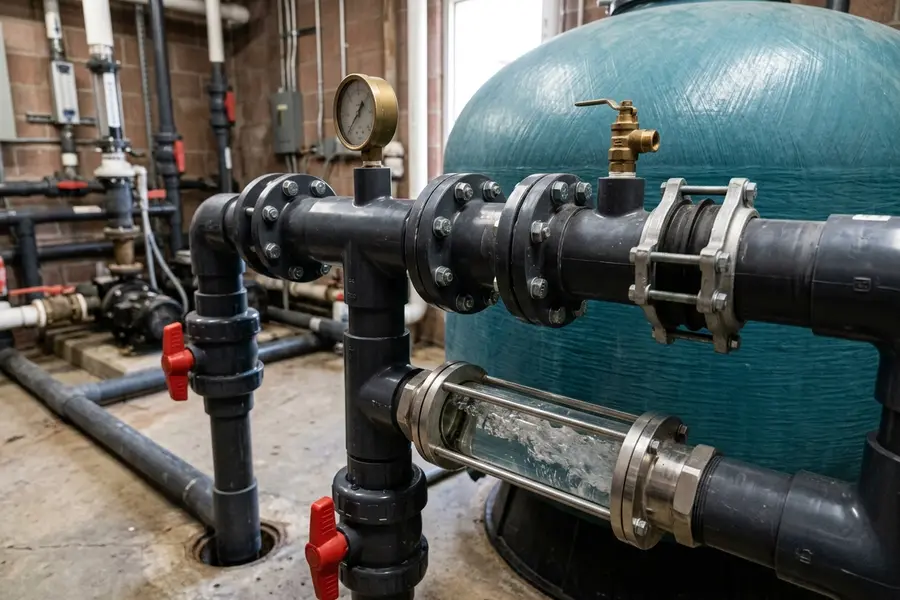
Granular media filtration accessories shall include the following items: 1) Influent pressure gauge, 2) Effluent pressure gauge, 3) Backwash sight glass or other means to view backwash water clarity, and 4) Manual air relief system.
Influent and effluent pressure gauges shall have the capability to measure up to a 20 pounds per square inch (138 KPa) increase in differential pressure across the filter bed in increments of 1 pound per square inch (6.9 KPa) or less.
A flow meter accurate to within +/- 5% of the actual design flow shall be provided for each filtration system and shall be certified, listed, and labeled to NSF/ANSI 50 or 61.
Scroll horizontally to see all columns when the table extends beyond the screen.
Silica Sand Sieve Grading, Pea Gravel Support Beds, and Tank Freeboard
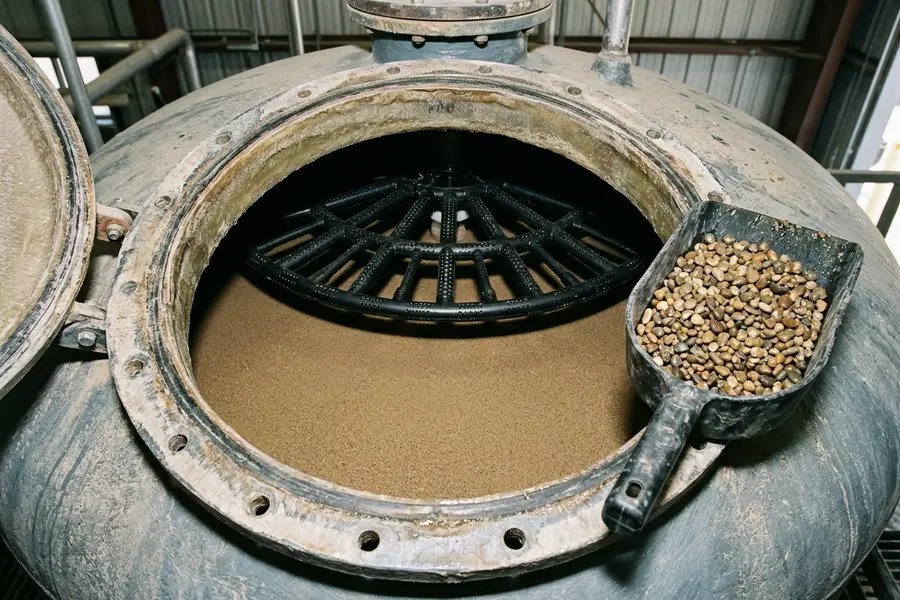
To ensure compatibility with the minimum 15 GPM/ft2 (37 m/h) backwashing rate, filter sand should pass through a number 20 U.S. standard sieve so all sand grains are smaller than approximately 0.85 mm, or be specified with an effective size (E.S.) of 0.45 mm and a uniformity coefficient (U.C.) of less than or equal to 1.45 (20/40 mesh, between 0.85 mm and a #40 0.42 mm sieve).
In rapid-rate filtration practice, the optimal backwash flow rate will result in at least a 20 percent expansion of the filter bed (such as 30 inches of combined anthracite and sand media expanding to at least 36 inches); less expansion may not adequately clean the filter, while more expansion may cause excessive loss of media.
Providing sufficient freeboard (space between the top of the media and the backwash overflow) to allow for a minimum of 35% filter bed expansion during backwashing adds a factor of safety when the target bed expansion is 20%.
The Pentair Triton Side Mount Manual specifies freeboard of 8.25 in. for TR40 (175 lbs. sand), 10.5 in. for TR60 / TR60 ClearPro (325 lbs. sand), 11.25 in. for TR100 / TR100C-3 (600 lbs. sand), and 13.5 in. for TR140 / TR140C-3 (925 lbs. sand), using No. 20 Standard Silica (0.018 - 0.022 in. or 0.44 - 0.55 mm) with a uniformity coefficient of 1.75 or less.
Pentair THS Series Manual Appendix B specifies Pea Gravel of 1/4” - 1/8” media size with a specific gravity greater than 2.5 and a uniformity coefficient less than 1.5, and #20 Standard Sand of .018”-.022” (.45mm-.55mm) media size with a specific gravity of 2.65 and a uniformity coefficient less than 1.5.
The Hayward HCF Flanged Manual specifies using 1/2” x 1/4” gravel media and #20 silica sand (.45 - .55 mm), with sand fill height levels (Dimension F) of 18.5” on HCF342C, 19.7” on HCF348C, 17.3” on HCF455C, and 18.9” on HCF663C, and recommends a minimum of 3” Schedule 40 piping on HCF342C and HCF348C, 4” Schedule 40 on HCF455C, and 6” Schedule 40 on HCF663C.
Vertical vs. Horizontal Commercial Sand Filter Capacities (Pentair and Hayward)
Pentair Triton C Series models TR100C and TR100C-3 each provide 4.91 sq. ft. of filter area, a 74 GPM flow rate at 15 GPM/sq. ft., with 26,640 gallons turnover capacity in 6 Hours and 35,520 gallons in 8 Hours, a 39 3/4” height, a 30 1/2” diameter, and require 600 lbs. of all-sand media or 450 lbs. sand and 150 lbs. gravel.
Pentair Triton C Series models TR140C and TR140C-3 each provide 7.06 sq. ft. of filter area, a 106 GPM flow rate at 15 GPM/sq. ft., with 38,160 gallons turnover capacity in 6 Hours and 50,880 gallons in 8 Hours, a 45 1/4” height, a 36 1/2” diameter, and require 925 lbs. of all-sand media or 650 lbs. sand and 275 lbs. gravel.
In the Pentair Triton Side Mount Manual, model TR100 (4.9 ft2 area) is rated at 74 GPM based on 15 GPM/FT2, whereas TR100C and TR100C-3 (4.9 ft2 area) are rated at 98 GPM, TR140 (7.1 ft2 area) is rated at 106 GPM based on 15 GPM/FT2, and TR140C and TR140C-3 (7.1 ft2 area) are rated at 141 GPM.
The Pentair Triton heavy duty (HD) filter model TR100 HD is a thirty-inch fiberglass filter that offers a maximum operating pressure of 75 PSI and flow rates up to 98 gpm.
Pentair Triton installation guidelines state that a vacuum breaker is recommended if the backwash line exceeds 40 feet or if the backwash line discharges more than 10 feet below the pool water line, and that maximum operating pressure is 50 PSI.
For best efficiency, Pentair Triton installation instructions state to use the fewest possible number of fittings and large diameter pipe: at least 2 in. for TR100 and TR140 and at least 3 in. for TR100C-3 and TR140C-3.
For Pentair THS Series horizontal filters, a flow of 15- 20 GPM per square foot of filter area should pass through the filter in the reverse direction for a two to five minute backwash duration to fluidize the sand bed, and a 6” waste line is recommended for all THS Series filter vessels.
In the Pentair THS Series manual charts based on using NSF approved #20 sand for pressure drop through the tanks only, for design purposes a filter pressure drop of 6.5 psi at 20 gpm per sq. ft. is recommended.
The Pentair THS manual tank parts list specifies 14, 20, 18, 24, and 28 of the 10” Effluent Lateral (B4804) and 8, 10, 10, 12, and 14 of the Shower Head Diffuser (B4806) for models THS3461, THS3484, THS4272, THS4284, and THS4296 respectively, with 1 of the 4” Grooved Coupling Assembly (B4570) on THS3461 - THS3484 and 1 of the 6” Grooved Coupling Assembly (B4572) on THS4272 - THS4296.
Scroll horizontally to see all columns when the table extends beyond the screen.
In the Hayward Commercial HCF Bobbin-Wound Sand Filters dimensions table, dimensions and gravel/sand media quantities are 19.64, 31.46, 42, and 48.66 inches with a 3 inch port and 225/1400 lbs. gravel/sand for HCF342C; 27.12, 38.94, 48, and 58.03 inches with a 3 inch port and 600/2250 lbs. for HCF348C; 31.90, 48.90, 55, and 74.50 inches with a 4 inch port and 500/5300 lbs. for HCF455C; and 28.22, 47.22, 67.25, and 75.82 inches with a 6 inch port and 850/6800 lbs. for HCF663C.
Backwash Fluidization Physics, Parallel Pump Sizing, and Hotel Water Budgets
According to the CDC Model Aquatic Health Code Annex, decreasing the filtration rate to values lower than 15 GPM/ft2 (37 m/h) may generally produce a positive change in filtration performance, whereas a similarly lower backwash rate could lead to a total filtration system failure.
In CDC Model Aquatic Health Code Annex column testing of commercial pool filter sand at 68°F (20° C), backwashing achieved 3.6% bed expansion at 12.4 GPM/ft2 (30.3 m/h), 11.4% at 16.3 GPM/ft2 (39.8 m/h), 16.3% at 18.5 GPM/ft2 (45.2 m/h), 19.3% at 20.3 GPM/ft2 (49.6 m/h), and 22.5% at 22.1 GPM/ft2 (54.0 m/h).
Calculations in the CDC Model Aquatic Health Code Annex indicate that filter backwashing rates should increase by approximately 18% for this media as the temperature is increased from 68° to 86°F (20° to 30°C) due to changes in the viscosity of water with temperature.
As Washington State Department of Health guidance explains, for a given flow rate, colder water results in greater filter-bed expansion because it is more viscous than warmer water, so when temperatures go up, backwash flow rates need to go up, too.
When coordinating commercial pool pump sizing across a parallel bank, the CDC Model Aquatic Health Code Annex notes that when a single pump feeds two filters at 10 GPM/ft2 (24 m/h), redirecting the entire flow through one filter into the backwash line of the other should result in a backwash rate of approximately 20 GPM/ft2 (49 m/h).
The Hayward HCF Flanged Manual states that when using multiple filters, they must be plumbed in parallel configuration, that it is a good idea to oversize the surface area required by 10% or more, and that bringing the discharge from each pump together in a single manifold to the filters will allow for greater flow rates for the backwash cycle.
Under the CDC Model Aquatic Health Code, recirculation system piping shall be designed so water velocities do not exceed 8 feet (2.4 m) per second on the discharge side of the pump, and suction piping shall be sized so that the water velocity does not exceed 6 feet per second (1.8 m/s).
Pentair EQ Series commercial plastic pumps provide flows to 800 GPM and from 3-15 HP, feature a 6” suction and 4” discharge with strainer pot, and are self-priming under NSF standards and NSF Certified.
Waterco Commercial Multiport Valves (65 mm, 80 mm, and 100 mm models) include a sight glass fitted to the waste line for easy inspection of the backwash water, are designed for a 400 kPa (58 psi) operating pressure, indicate that backwash is normally necessary when the filter pressure gauge reads 10 PSI higher than starting pressure on a clean filter, and use the RINSE position with sand filters to flush stray sand.
Scroll horizontally to see all columns when the table extends beyond the screen.
Backwash Triggers, Mudballs, Channeling, and Annual Bed Inspection
When tracking differential pressure on a pool filter pressure baseline log, the EPA WaterSense rule of thumb is that filter cleaning is necessary after the filter pressure has increased by 5.0 to 10.0 pounds per square inch (psi) (35 to 70 Kilopascal [kPa]).
Pentair Triton cleaning frequency instructions state to backwash and clean the filter after operating for 48 hours on a new pool, and thereafter to backwash when water flow is 30% lower than original clean flow (such as when original flow was 60 GPM and has fallen to 40 GPM) or when the pressure gauge reads 10 PSI higher than it would just after a backwash.
The Pentair Triton backwash procedure states to always turn off the pump before changing valve positions, backwash the filter for approximately 3 to 5 minutes until backwash water is clean, rinse the filter for approximately 30 seconds, and if the pressure is 4 to 6 PSI above the start condition after backwashing, the sand bed should be chemically cleaned.
Under the CDC Model Aquatic Health Code, when backwashing without bathers present, bathers shall not be permitted to reenter the venue until the responsible supervisor or qualified operator ensures that the recirculation pump and chemical feeders have restarted and run for a minimum of 5 minutes.
The Pentair THS Series manual states that the sand media bed should be inspected on a yearly basis for trenches and erosion, and that a difference in sand elevation between the highest and lowest points of the bed that is 3” or more may indicate a problem with damaged internal tank components such as diffusers or laterals.
Pentair THS troubleshooting states to check the backwash flow rate on the waste pipe where a minimum of 15 GPM per square foot of filtration area is recommended, remedy an impacted sand bed by draining and turning over the top 6”-10” of sand, and address excessive sand media being lost to the waste drain when the backwash flow rate is too high.
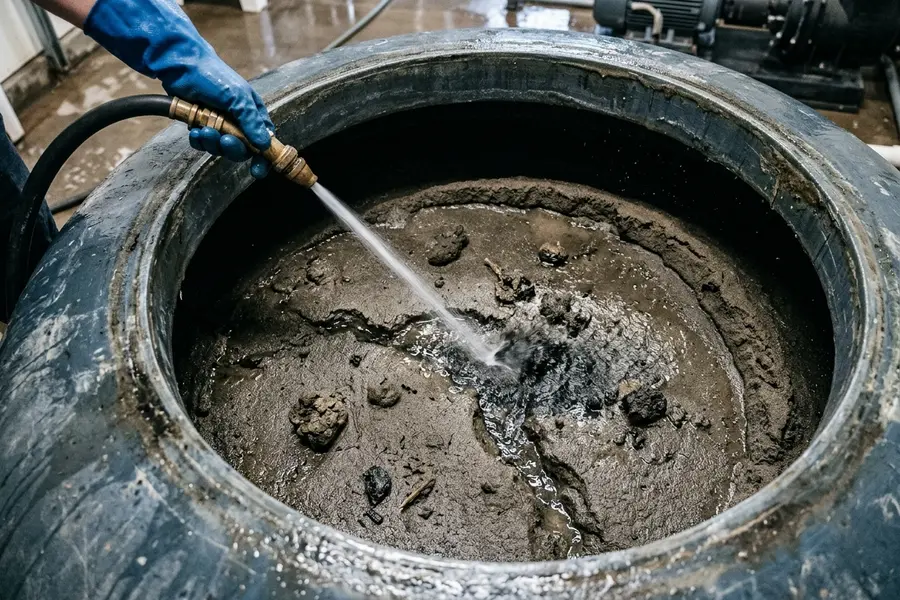
Washington State Department of Health guidance notes that inadequate backwashing allows a build-up of dirt and coagulant deposits, leading to problems such as mud-ball formation and cracks or fissures in the media, where filter cracking promotes short-circuiting.
As Kurita America explains, a mudball is the result of solids accumulating in a filter that combine with filter media to form into a ball of solids; if media is inadequately backwashed, thin layers of solids coat grains, sink down into the media bed eventually stopping at the support gravel; these mudballs block the passage of water, creating higher velocity filtration and uneven distribution, and can also form in filter dead zones.
As Orenda Technologies details, filter channeling is when gaps or channels are created by water flowing through the filter and bypassing the media due to fouling by non-living organics or calcification if the LSI of the water is too high (such as in pools feeding cal hypo), clumping the top layers of sand together around the edge of the filter bed and leaving a perimeter ridge during backwashing.
Trouble Free Pool notes that filter sand can get gummed up if you have used flocculants (floc), cheap clarifiers, or multi use products containing them or after a baquacil conversion, and that a sand filter deep clean should be done about once per year to break up clumps in the sand and reduce channeling through the sand bed.
Sources
- U.S. Centers for Disease Control and Prevention (CDC) - Model Aquatic Health Code (Code).
- U.S. Centers for Disease Control and Prevention (CDC) - Model Aquatic Health Code (Annex).
- U.S. Environmental Protection Agency (EPA) - WaterSense at Work: Commercial Pool and Spa Equipment.
- Washington State Department of Health - Optimizing Backwash and Filter to Waste for Rapid Rate Filtration.
- Pool Water Treatment Advisory Group (PWTAG) - Swimming Pool Filter Specification.
- Pentair - Triton Side Mount Sand Filter Installation and User’s Guide.
- Pentair - Triton C Series Commercial Sand Filters Data Sheet.
- Pentair - THS Series High Rate Sand Filter Installation and User’s Guide.
- Pentair - THS Series High Performance Horizontal Sand Filters Data Sheet.
- Pentair - EQ Series High Performance Commercial Pump Brochure.
- Hayward Flow Control - HCF Series Commercial Sand Filter Owner’s Manual.
- Hayward Flow Control - HCF Commercial Sand Filter Flanged Installation and Operation Manual.
- Hayward Commercial Pool Products - HCF Commercial Bobbin-Wound Sand Filters Sell Sheet.
- Waterco - Commercial Multiport Valves Owner’s Manual.
- Kurita America - Your Performance Index: The Secret to Avoiding Mudballs.
- Orenda Technologies - What is filter channeling?
- Trouble Free Pool - Deep Cleaning a Sand Filter.
Sources
- Anglo American Pools Pool Equipment Guide — Anglo American Pools Accessed November 7, 2026.