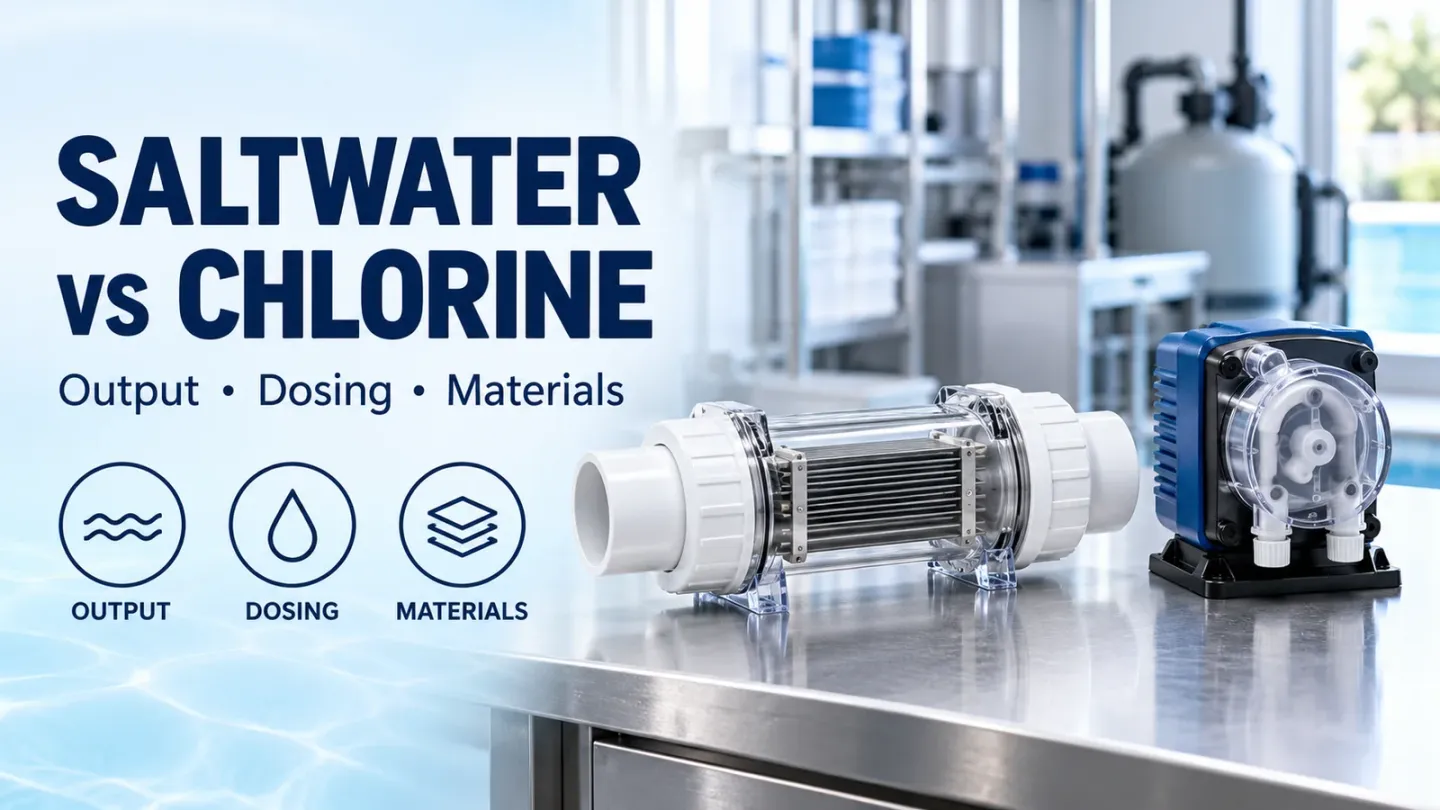
For commercial pool equipment, the saltwater pool vs chlorine decision starts with how chlorine reaches the water. Compare an in-line saltwater chlorine generator with an automated liquid-feed system on the same demand profile, then check the heater, rails and plant-room requirements.
Saltwater generation is a useful starting point where the full equipment package accepts the operating salinity and the cells can meet demand within their available producing hours. Liquid dosing is a useful starting point where a calibrated feeder and managed solution supply fit the facility’s operating needs. Both require free-chlorine and pH checks. Pentair’s 2025-2026 commercial catalog, for example, rates COMSYS-2 at 2 lb per 24 hours; that time basis matters when comparing it with a pump rated in solution volume.
Scroll horizontally to see all columns when the table extends beyond the screen.
What changes between the two systems?
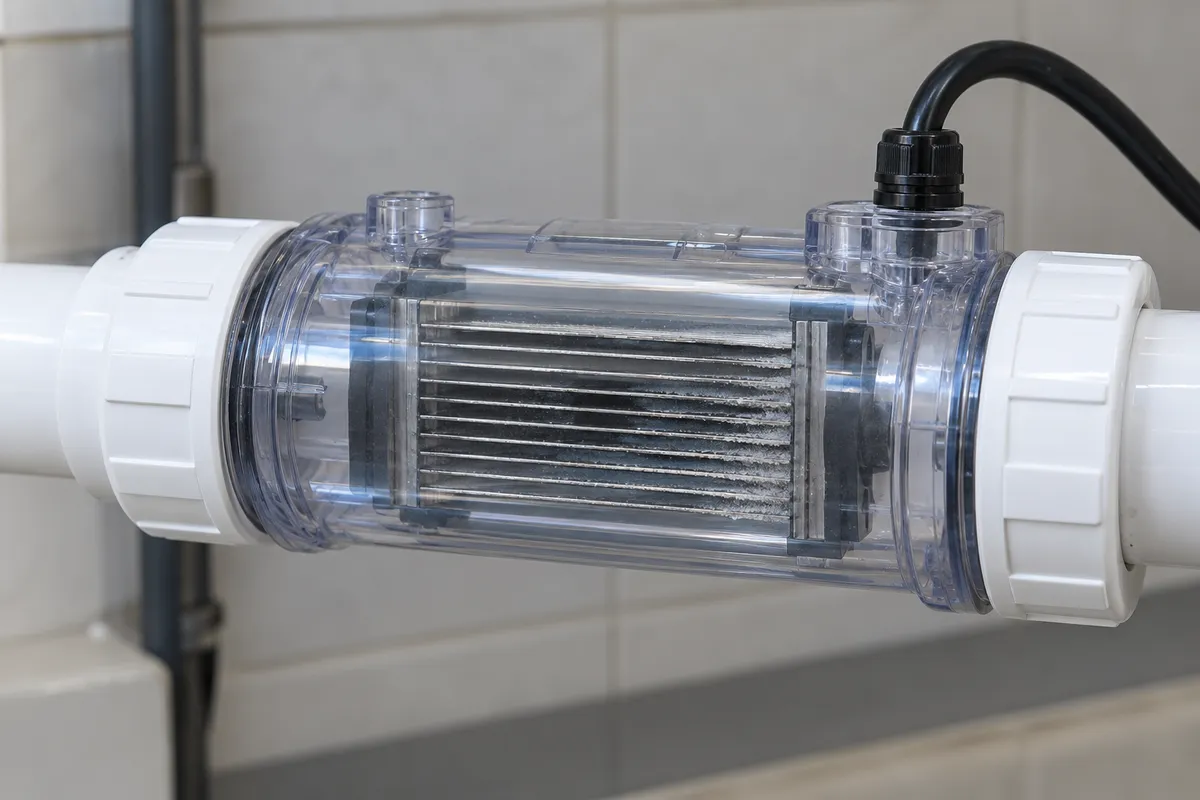
The equipment changes the delivery method; the pool still needs a controlled disinfectant residual. Here, liquid chlorine means aqueous sodium hypochlorite, supplied from a solution reservoir. An in-line salt generator produces chlorine in the circulating pool water; a separate brine-batch generation plant is a different configuration.
Scroll horizontally to see all columns when the table extends beyond the screen.
Automation is available for both principal systems. Comparing an automated generator with manual chlorine additions misses the capabilities and maintenance needs of a metered liquid-feed installation. Use the pool equipment system overview to coordinate treatment with circulation, heating and controls.
Will the generator produce enough chlorine during peak use?
Size against demand during operation, then check daily mass. The 2024 CDC Model Aquatic Health Code, section 4.7.3.2.2 calls for feed capacity that maintains the required concentration throughout operation, considering factors including pool volume, surface area, bather loading, temperature, sunlight and water loss. Apply the jurisdiction’s adopted requirements when specifying a public pool.
A representative commercial benchmark is Pentair’s 2025-2026 Pool Product Catalog, Sanitizers and Water Quality, printed page 251:
Scroll horizontally to see all columns when the table extends beyond the screen.
The catalog requires an external ORP/pH controller for these assemblies. Match the power centers and hydraulic configuration to the selected package as well as its chlorine production.
For a rating expressed in pounds per 24 hours, the time relationship is:
Nominal chlorine mass (lb) = rated lb per 24 h × (valid operating hours ÷ 24 h) × producing-duty fraction.
Valid hours require the specified flow, salinity, temperature and operating status. The duty fraction is the share of those hours during which the controller actually calls for production. If the log already counts energized producing hours, use those hours directly without applying another duty reduction. The salt cell sizing and runtime checklist develops the model-specific runtime calculation.
The engineering implication is that a controller calling continuously for chlorine cannot increase a cell’s rated production rate. A satisfactory daily total can also hide a shortfall during a busy afternoon. Check residual trends against loading and demand-on logs, especially when production is already continuous. Salt concentration describes the feedstock condition; free chlorine measures the disinfectant residual.
How do you compare a liquid-feed pump fairly?
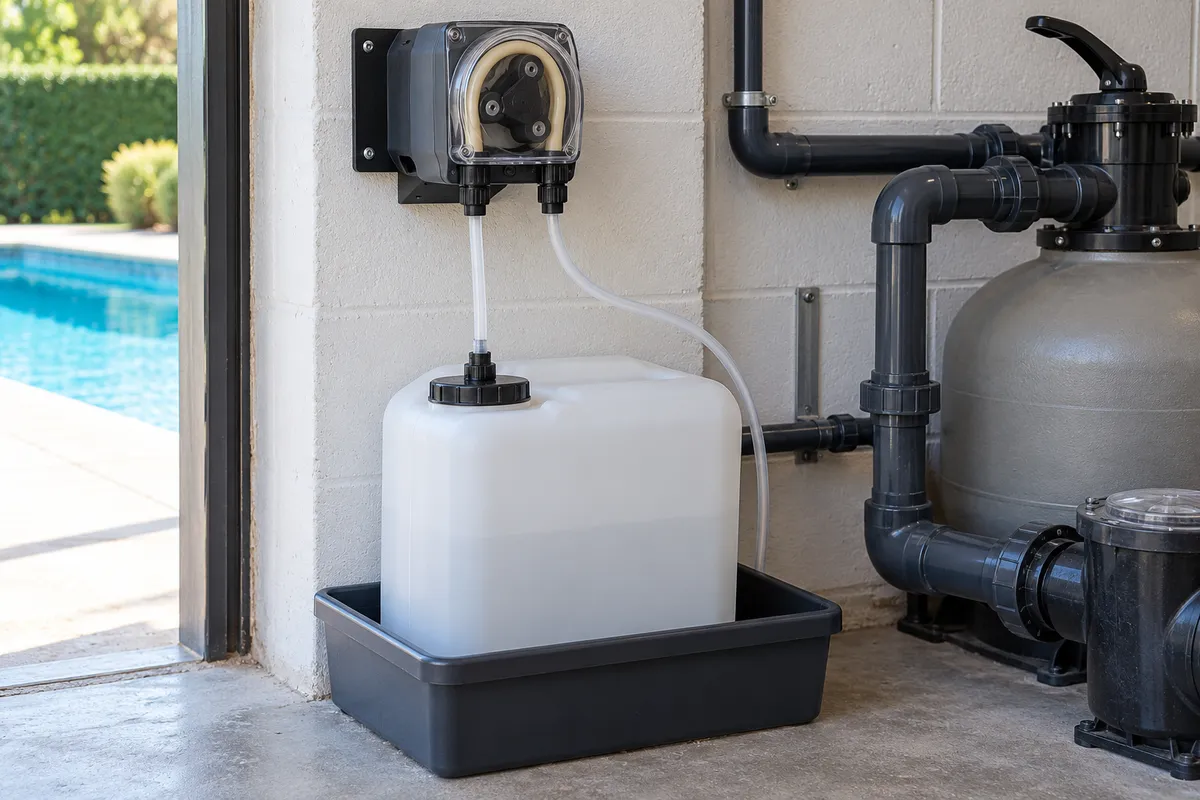
Convert the calibrated solution flow to available-chlorine mass, keeping product concentration and feed time attached. Pump gallons per day and generator pounds per day describe different quantities.
Available chlorine delivered (g) = calibrated solution flow (L/h) × available chlorine concentration (g/L) × enabled feed time (h).
Use the actual solution’s concentration on an available-chlorine basis. When the label gives a mass percentage, establish the stated chemical basis and solution density before converting it to grams per litre.
Stenner’s Classic Series Installation and Maintenance Manual, IMCL 092926, printed page 6, illustrates why rating conditions matter. Its adjustable 45MHP10 with tube 2 lists 10.0 US GPD at setting 10 and 60 Hz, with a 100 psi maximum pressure. The separate 50 Hz table lists 30.3 L/day. Frequency changes the operating condition, so these figures must retain their frequency labels. The manual describes approximate water-test outputs and calls for field calibration to establish actual delivery.
Review the pump, tubing, injection connection and solution-storage installation together. As with the generator, controller demand is useful only within the equipment’s available feed capacity. A larger nameplate flow still needs a verified operating point and suitable control range.
Which controls and maintenance tasks remain necessary?
Both systems need coordinated flow shutdown, residual verification and a maintenance plan. Check the complete control sequence rather than treating a component’s built-in protection as the whole installation.
The 2024 MAHC, section 4.7.3.2.1.3, specifies automatic low/no-flow feed shutdown using an interlock with at least two of its listed signals or devices; section 4.7.3.2.6.7 applies that interlock provision to generators. Have the designer document how the selected sensors, pump status, controller and alarms meet the applicable requirements in each circulation mode.
ORP, or oxidation-reduction potential, is a control signal. Continue free-chlorine and pH testing under the venue’s operating procedure, as described in CDC’s public-pool operator guidance. The test results show whether treatment is maintaining the required water condition.
Scroll horizontally to see all columns when the table extends beyond the screen.
Pentair’s Commercial IntelliChlor Installation and User’s Guide, P/N 521011 Rev. E (August 7, 2023), pages 20-21, starts cell cleaning with water and warns that excessive acid washing can damage the blades. Reverse-polarity self-cleaning still requires inspection. Use the matched manual’s cleaning sequence and condition-based checks.
Stenner’s Classic Series manual covers pump-tube inspection and replacement. For liquid-feed layout, the MAHC also specifies a protective shield against sprays from leaking feed-pump connections. Include these service and protection items when comparing the complete equipment scope.
Where are the corrosion boundaries?
Accept or reject the conversion against the exact equipment’s water limits and material requirements. Check wetted heater surfaces and splash-zone assemblies separately: they experience different combinations of water, deposits, crevices and drying.
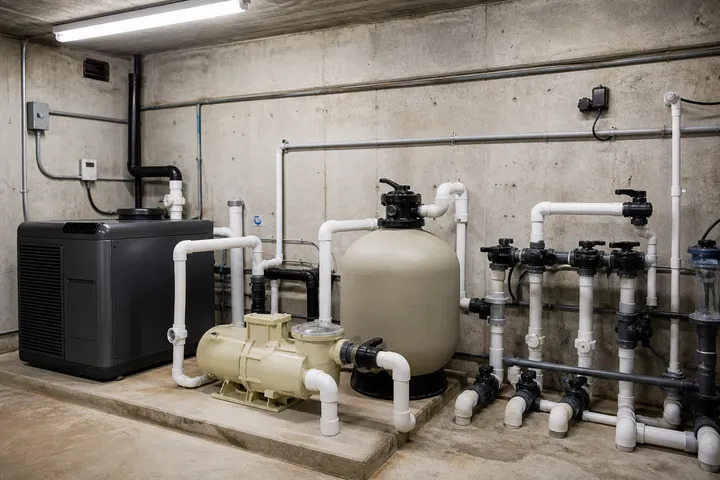
A heater’s model matters more than a universal material slogan. Hayward’s Australian H150FDAU/H250FDAU/H400FDAU installation manual (©2013), pages 7-8, identifies a cupronickel heat exchanger and a 2,700-5,000 ppm salt band alongside other water-chemistry requirements. That is a model-specific example of a non-titanium exchanger with stated salt operating conditions. For an existing heater, obtain the manual matching its model and region, then compare all chemistry and flow limits with the proposed pool conditions.
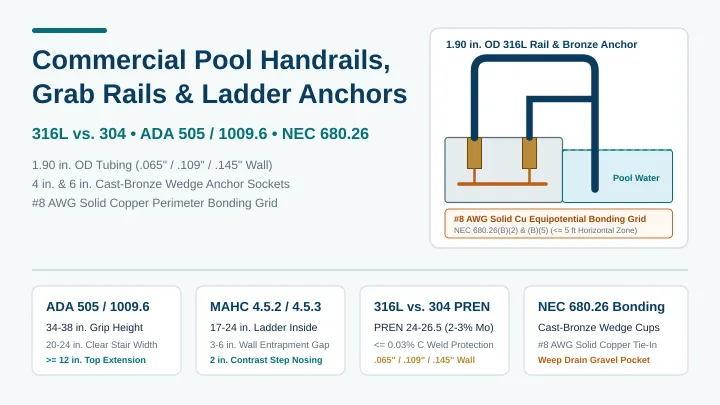
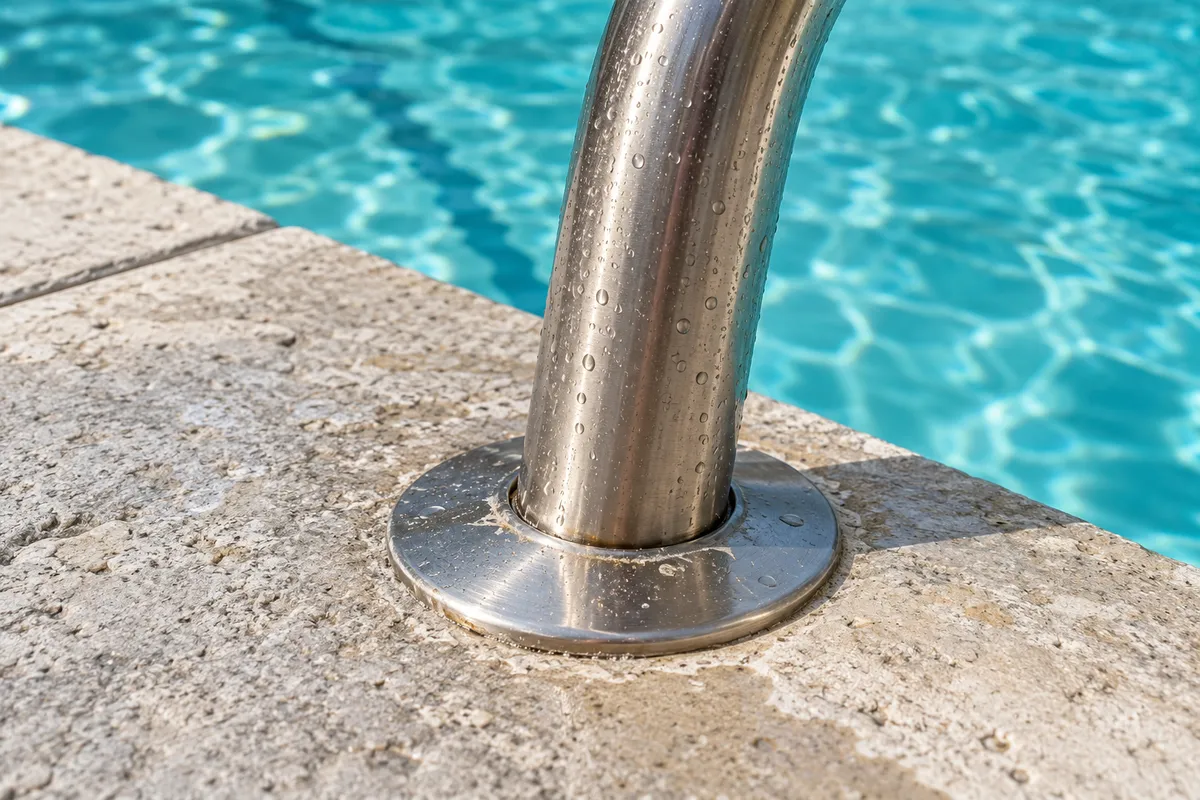
For stainless rails and anchors, inspect the alloy and assembly specification, surface condition, trapped deposits and cleaning access. S.R. Smith’s Rail Maintenance, document 06-417 0413, explains how chloride deposits affect stainless surfaces and prescribes fresh-water rinsing and appropriate cleaning for salt-pool environments. A grade designation alone cannot settle the condition of a complete installed assembly. The commercial pool handrails and ladder anchors guide covers the associated component selection.
Retain required electrical bonding and assess corrosion compatibility as a separate task. Bonding serves electrical safety; material selection, chemistry, deposit control and manufacturer-specified heater backflow protection address other mechanisms. Review the existing installation and its service history before changing salinity.
Which option fits the facility’s operating plan?
Choose the system whose capacity, material conditions and maintenance demands the facility can support. Compare the complete installed scope and recurring tasks, then resolve the conditions that could prevent either option from maintaining residual.
Scroll horizontally to see all columns when the table extends beyond the screen.
For salt generation, include cells, power centers, controls, plumbing changes, salt replacement after water loss and inspection access in the scope. For liquid dosing, include solution deliveries, storage and containment, the calibrated pump, replacement tubes, injection parts and leak protection. Both options carry testing, pH management and control maintenance duties.
Tablet feeding deserves its own product check. CDC identifies dichlor and trichlor as stabilized chlorine; other products have different chemistry and feeder requirements. Identify the actual tablet and its compatible feeder before comparing it with either principal system.
Prepare pool volume, peak bather loading, the heater model and exchanger material, and existing disinfectant-equipment nameplates for the facility’s designer or supplier. Attach actual runtime/control logs, recent free-chlorine and pH records, water-analysis history and photos of existing corrosion or deposits. These inputs support a comparison of chlorine mass, peak delivery and equipment compatibility. Continue with the pool equipment guides to coordinate the rest of the system.
Sources
- 2024 Model Aquatic Health Code, fifth edition, sections 4.7.3.2 and 5.7.3 — Centers for Disease Control and Prevention Accessed October 27, 2026.
- Operating and Managing Public Pools, Hot Tubs and Splash Pads — Centers for Disease Control and Prevention Accessed October 27, 2026.